

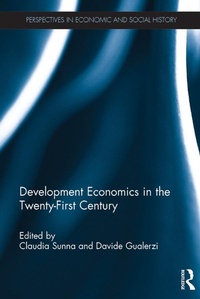
Development Economics in the Twenty-First Century
Published on 14. December 2015
200 pages
978-1-317-21997-2 (ISBN)
Description

Development Economics has been identified as a homogeneous body of theory since the 1950s, concerned both with the study of development issues and with the shaping of more effective policies for less advanced economies.
Development Economics in the Twenty-First Century brings together an international contributor team in order to explore the origins and evolution of development economics. This book highlights the different elements of 'high development theory' through a precise reconstruction of the different theoretical approaches that developed between the 1950s and the 1970s. These include the theory of balanced and unbalanced growth theory, the debate on international trade, the concept of dualism, dependency theory, structuralism and the analysis of poverty and institutions. The chapters highlight the relevance and usefulness of these analyses for the contemporary theoretical debate on development issues.
Comparative perspectives are explored and analysed, including those of Keynes, Hirschman, Krugman and Stiglitz. The chapters situate development economics within current debates among economists and historians of economic thought, providing a platform for future research. This book is suitable for researchers and students with an interest in Development Economics, the History of Economic development and the Economics of Developing Countries.
Development Economics in the Twenty-First Century brings together an international contributor team in order to explore the origins and evolution of development economics. This book highlights the different elements of 'high development theory' through a precise reconstruction of the different theoretical approaches that developed between the 1950s and the 1970s. These include the theory of balanced and unbalanced growth theory, the debate on international trade, the concept of dualism, dependency theory, structuralism and the analysis of poverty and institutions. The chapters highlight the relevance and usefulness of these analyses for the contemporary theoretical debate on development issues.
Comparative perspectives are explored and analysed, including those of Keynes, Hirschman, Krugman and Stiglitz. The chapters situate development economics within current debates among economists and historians of economic thought, providing a platform for future research. This book is suitable for researchers and students with an interest in Development Economics, the History of Economic development and the Economics of Developing Countries.
More details
Series
Language
English
Place of publication
London
United Kingdom
Publishing group
Taylor & Francis Ltd
Target group
College/higher education
File size
1,17 MB
ISBN-13
978-1-317-21997-2 (9781317219972)
Copyright in bibliographic data and cover images is held by Nielsen Book Services Limited or by the publishers or by their respective licensors: all rights reserved.
Schweitzer Classification
Other editions
Additional editions
Claudia Sunna | Davide Gualerzi
Development Economics in the Twenty-First Century
Book
09/2020
1st Edition
Routledge
€65.00
Shipment within 15-20 days
Claudia Sunna | Davide Gualerzi
Development Economics in the Twenty-First Century
Book
12/2015
1st Edition
Pickering & Chatto (Publishers) Ltd
€241.50
Shipment within 3-4 weeks
Persons
Claudia Sunna is Researcher of Political Economics at University of Salento, Lecce, Italy.
Davide Gualerzi is Associate Professor at the Department of Economic Sciences, School of Political Sciences, University of Padua, Italy.
Davide Gualerzi is Associate Professor at the Department of Economic Sciences, School of Political Sciences, University of Padua, Italy.
Content
Introduction 1. Historical Growth Modelling: Rostow's 'Take-Off' and Rosenstein-Rodan's 'Big Push' Matthew Smith 2. Albert Hirschman: Unbalanced Growth Theory Davide Gualerzi 3. The Brilliant Fifties. International Trade as a Cause Of Underdevelopment Cosimo Perrotta 4. Dual Development Models in Historical Perspective Claudia Sunna 5. The Structuralist Research Program in Development Economics Mauro Boianovsky 6. The Resurgence of Dependency Analysis: Nostalgia or Renewed Relevance? Alan B. Cibils 7. Development Theory And Poverty Francesco Farina 8. Recovering Macroeconomic Policy for Development Alejandro Nadal
