

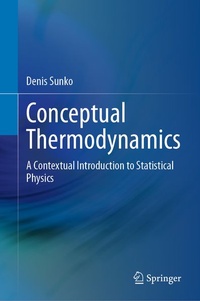
Conceptual Thermodynamics
Description

This book explores how thermodynamics, together with its statistical rationalization in terms of constituent atoms, provides a coherent framework for understanding contemporary developments in our increasingly digital world.
As traditional sources of meaning, family, community, nation, and religion have been reshaped by global digital communication, vast populations now experience macroscopic thermodynamic-like phenomena as part of daily life.
The human mind has adapted by framing this new reality through simple truisms such as "if you are not the customer, you are the product," while the growing presence of artificial intelligence has only intensified the need for clear and robust conceptual tools.
Within this context, thermodynamics emerges as a language whose coherence lies in shared meanings. Like any language, it can be learned, and the most accessible path to mastering it is through an introductory grounding in statistical physics.
The book is intended primarily for future researchers in physics encountering statistical physics as a standalone discipline for the first time, but it also speaks to all readers seeking a stable conceptual framework for interpreting the world around them.
More details
Other editions
Additional editions
Person
D. K. Sunko is a full professor (retired) at the University of Zagreb, Faculty of Science, Department of Physics. He taught Mathematical Methods of Physics (1992-2012) and Statistical Physics (2003-2023). After earning his PhD in nuclear physics in 1988, his research shifted to solid-state physics, focusing on high-temperature cuprate superconductors since 1992. Since 2016, he has explored fundamental quantum mechanics, notably discovering a free-module structure of many-body Hilbert space. Recently, he initiated the synthesis of a new class of sulfosalts based on murunskite, structurally akin to ferropnictides, and participates actively in their study. He has held numerous leadership roles, including vice-dean of the Faculty of Science (2002-2004), chair of the Department of Physics (2010-2012), and head of the condensed-matter section of graduate studies (2012-2024).
Content
Introduction.- Thermodynamics.- Statistical foundations.- Ensembles.- Quantum statistical physics.- Fermions.- Bosons.- Light.- Sound.- Applications.- Fluctuations and Nonequilibrium Processes.- Literature.
