

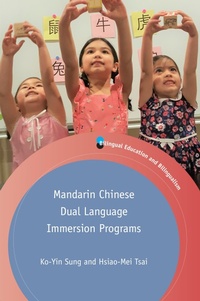
Mandarin Chinese Dual Language Immersion Programs
Published on 5. June 2019
216 pages
978-1-78892-397-2 (ISBN)
Description

The first dual language instruction book to focus on a non-alphabetical language, Mandarin Chinese.
This book discusses multiple aspects of Chinese dual language immersion (DLI) programs, with a focus on the controversial Utah model. The first part of the book focuses on the parents, teachers, and school administrators. It looks at the perceptions of the three groups toward the Utah model, how they build a supportive DLI classroom with an emphasis on teacher-teacher and teacher-parent communication, and how the teachers position themselves in teaching through their teacher identities.
The second part of the book emphasizes classroom research and explores teaching and learning strategies, corrective feedback and learner uptake and repair, translanguaging in authentic teacher-student interaction, and Chinese-character teaching.
As the first DLI book to include a non-alphabetical language, Chinese, it addresses the need for more research on DLI programs of languages other than Spanish. The book will benefit not only Chinese DLI educators and administrators in the US, but will also offer some useful suggestions and thoughts to educators and administrators of similar programs worldwide.
This book discusses multiple aspects of Chinese dual language immersion (DLI) programs, with a focus on the controversial Utah model. The first part of the book focuses on the parents, teachers, and school administrators. It looks at the perceptions of the three groups toward the Utah model, how they build a supportive DLI classroom with an emphasis on teacher-teacher and teacher-parent communication, and how the teachers position themselves in teaching through their teacher identities.
The second part of the book emphasizes classroom research and explores teaching and learning strategies, corrective feedback and learner uptake and repair, translanguaging in authentic teacher-student interaction, and Chinese-character teaching.
As the first DLI book to include a non-alphabetical language, Chinese, it addresses the need for more research on DLI programs of languages other than Spanish. The book will benefit not only Chinese DLI educators and administrators in the US, but will also offer some useful suggestions and thoughts to educators and administrators of similar programs worldwide.
Reviews / Votes
Bravo to Ko-Yin Sung and Hsiao-Mei Tsai for a book that gives us both a broad analysis of Utah's Chinese One-Way Immersion programs and the larger context in which they are situated, and an in-depth and fascinating look at Chinese dual language immersion from several important angles. This book makes an important contribution to our understanding of a still very much under-researched phenomenon that is growing in the US, in both importance and numbers. * Deborah K. Palmer, University of Colorado Boulder, USA * With the ever-increasing heritage language representation in the US, Sung and Tsai present the unique challenges and benefits of implementing an English-Chinese dual language program. Their comprehensive book, building on the English-Spanish dual language scholarship, serves to extend the field and is an outstanding resource for all bilingual educators. * Belinda Bustos Flores, University of Texas at San Antonio, USA * The book provides great insights into multiple aspects of the Chinese-English DLI programs in Utah through a series of empirical studies. One interesting contribution of this book is its study on students' translanguaging practices in Chinese-English DLI classrooms. -- Sunny Man Chu Lau, Bishop's University, Canada and Zhongfeng Tian, Boston College, USA * Journal of Immersion and Content-Based Language Education 8:1 *More details
Series
Language
English
Place of publication
Bristol
United Kingdom
Target group
College/higher education
Product notice
Reflowable
ISBN-13
978-1-78892-397-2 (9781788923972)
Copyright in bibliographic data and cover images is held by Nielsen Book Services Limited or by the publishers or by their respective licensors: all rights reserved.
Schweitzer Classification
Other editions
Additional editions
Ko-Yin Sung | Hsiao-Mei Tsai
Mandarin Chinese Dual Language Immersion Programs
Book
01/2025
Multilingual Matters
€42.00
Shipment within 3-4 weeks
Ko-Yin Sung | Hsiao-Mei Tsai
Mandarin Chinese Dual Language Immersion Programs
Book
06/2019
Multilingual Matters
€156.60
Shipment within 3-4 weeks
Persons
Ko-Yin Sung is an Associate Professor in the Department of Languages, Philosophy, and Communication Studies at Utah State University, USA. Her interests include learner motivation, language learning strategies, Chinese character instruction and technology-assisted language learning.
Hsiao-Mei Tsai is a Chinese teacher in the dual language immersion program in Cache County School District, Utah, USA. Her interests include instruction in dual language programs, language learning strategies and second language acquisition.
Hsiao-Mei Tsai is a Chinese teacher in the dual language immersion program in Cache County School District, Utah, USA. Her interests include instruction in dual language programs, language learning strategies and second language acquisition.
Content
Introduction
Benefits, Challenges, and Suggestions: Voices from Teachers and Administrators
Benefits, Challenges, and Suggestions: Voices from Parents
Exploring Chinese DLI Teachers' Identities
Creating an Effective and Supportive Dual Language Classroom
Language Teaching and Learning Strategies Employed in a First-year Chinese Dual Language Immersion Classroom
Applying the Concept of Chunking in Teaching and Learning Chinese Characters
Oral Interactions between Teacher and Students: Corrective Feedback, Learner-uptake, and Learner-repair
Translanguaging: A Documentation of how Emergent Bilinguals use Translanguaging in their Daily Communication
Conclusion
Benefits, Challenges, and Suggestions: Voices from Teachers and Administrators
Benefits, Challenges, and Suggestions: Voices from Parents
Exploring Chinese DLI Teachers' Identities
Creating an Effective and Supportive Dual Language Classroom
Language Teaching and Learning Strategies Employed in a First-year Chinese Dual Language Immersion Classroom
Applying the Concept of Chunking in Teaching and Learning Chinese Characters
Oral Interactions between Teacher and Students: Corrective Feedback, Learner-uptake, and Learner-repair
Translanguaging: A Documentation of how Emergent Bilinguals use Translanguaging in their Daily Communication
Conclusion
