

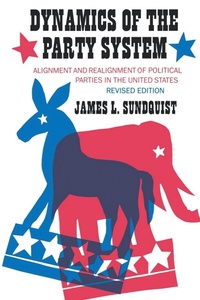
Dynamics of the Party System
Alignment and Realignment of Political Parties in the United States
3rd Edition
Published on 1. October 2011
466 pages
978-0-8157-2318-9 (ISBN)
Description

Since the original edition of Dynamics of the Party System was published in 1973, American politics have continued on a tumultuous course. In the vacuum left by the decline of the Democratic and Republican parties, single-interest groups have risen and flourished. Protest movements on the left and the New Right at the opposite pole have challenged and divided the major parties, and the Reagan Revolution--in reversing a fifty-year trend toward governmental expansion--may turn out to have revolutionized the party system too.
In this edition, as in the first, current political trends and events are placed in a historical and theoretical context. Focusing upon three major realignments of the past--those of the 1850s, the 1890s, and the 1930s--Sundquist traces the processes by which basic transformations of the country's two-party system occur. From the historical case studies, he fashions a theory as to the why and how of party realignment, then applies it to current and recent developments, through the first two years of the Reagan presidency and the midterm election of 1982.
The theoretical sections of the first edition are refined in this one, the historical sections are revised to take account of recent scholarship, and the chapters dealing with the postwar period are almost wholly rewritten. The conclusion of the original work is, in general, confirmed: the existing party system is likely to be strengthened as public attention is again riveted on domestic economic issues, and the headlong trend of recent decades toward political independence and party disintegration reversed, at least for a time.
In this edition, as in the first, current political trends and events are placed in a historical and theoretical context. Focusing upon three major realignments of the past--those of the 1850s, the 1890s, and the 1930s--Sundquist traces the processes by which basic transformations of the country's two-party system occur. From the historical case studies, he fashions a theory as to the why and how of party realignment, then applies it to current and recent developments, through the first two years of the Reagan presidency and the midterm election of 1982.
The theoretical sections of the first edition are refined in this one, the historical sections are revised to take account of recent scholarship, and the chapters dealing with the postwar period are almost wholly rewritten. The conclusion of the original work is, in general, confirmed: the existing party system is likely to be strengthened as public attention is again riveted on domestic economic issues, and the headlong trend of recent decades toward political independence and party disintegration reversed, at least for a time.
More details
Edition
3rd edition
Language
English
Place of publication
New York
United States
Publishing group
Bloomsbury Publishing Plc
ISBN-13
978-0-8157-2318-9 (9780815723189)
Copyright in bibliographic data and cover images is held by Nielsen Book Services Limited or by the publishers or by their respective licensors: all rights reserved.
Schweitzer Classification
Other editions
Additional editions

James L. Sundquist
Dynamics of the Party System
Alignment and Realignment of Political Parties in the United States
Book
08/1983
2nd Edition
Brookings Institution
€33.30
Shipment within 10-20 days
Person
James L. Sundquist is senior fellow emeritus in the Governmental Studies program at Brookings and the author of numerous books, including Constitutional Reform and Effective Government (Brookings, rev. ed., 1992).
Content
- Cover
- Contents
- 1. Party Realignment: What? When? How?
- The Muddied Concept of Party Realignment
- Causation, Process, and Data
- The Infinite Complexity of Political Alignments
- 2. Some Hypothetical Scenarios
- Formation of a Party System
- The Prerealignment Period
- Scenario 1: No Major Realignment
- Scenario 2: Realignment of the Two Existing Parties
- Scenario 3: Realignment of the Existing Parties through the Absorption of a Third Party
- Scenario 4: Realignment through the Replacement of One Major Party
- Scenario 5: Realignment through the Replacement of Both Old Parties
- 3. The Realignment Process: A Preliminary Statement
- Individuals and Groups
- Five Variables
- Searching the Past
- 4. Slavery Polarizes the Nation
- Ascendancy of the Compromisers
- The Disruption of the Old Parties
- Division of the Whig Party
- 5. The Realignment of the 1850s
- A New Major Party: The Republicans
- Substance of the Realignment
- Solidification of the New Alignment
- 6. The Agrarian Revolt and the Rise of Populism
- The Farmers Enter Politics
- Tensions within the Old Parties
- The Protest Forces Regather
- The Major Parties Respond Slowly
- The Prairie State Parties of 1890
- Democratic Radicalism in the South
- 7. The Realignment of the 1890s
- Creation of the People's Party
- Polarization of the Democratic Party
- Silver Democrats Capture the Party
- The Populists Are Absorbed
- The Critical Election of 1896
- Substance of the Realignment
- Persistence of the Civil War Alignment
- 8. Major Realignment Averted: The Progressive Era
- Diffuse Character of the Progressive Movement
- A Bipartisan Responsiveness
- The Accidents of Leadership
- The Deviations of 1912 and 1916
- 9. Minor Realignments of the 1920s
- The Minnesota Farmer-Labor Party
- La Follette, McNary-Haugenism, and Al Smith
- The "Al Smith Revolution" in the East
- 10. The Realignment of the 1930s
- Herbert Hoover and Limited Intervention
- Before 1932: The Democrats Move Slowly
- After 1932: The Democrats Commit Themselves
- Substance of the Realignment
- Conversion or Mobilization?
- 11. Aftershocks of the New Deal Earthquake-in the North
- North Dakota: The NPL Switches Parties
- Wisconsin: La Follette Progressivism Changes Parties
- Minnesota: The Farmer-Labor Movement Shifts Parties
- Pennsylvania: Patronage Republicans Switch Parties
- Two-Stage Realignment in Other States
- The Rise of the Programmatic Liberal Democrats
- 12. Aftershocks of the New Deal Earthquake-in the South
- The Anti-New Deal Southern Democrats
- The Dixiecrat Revolt
- Metropolitan Republicanism in the South
- The Second Stage of Southern Realignment
- The Programmatic Republican Conservatives
- Variations in the Second Stage
- 13. The Realignment Process: An Amplified Statement
- 14. Some Further Notes on Party Dynamics
- The Static, One-Dimensional Model
- An Open or a Closed Party System?
- 15. The New Deal Party System: Years of Stabilization
- The Retreat toward the Center
- Communism as a Crosscutting Issue
- Stability and Secular Change
- 16. Years of Disruption: Race and Southern Politics
- Polar Forces and Centrists
- Rise and Fall of a Third Party
- The Major Parties and the Segregationists
- The Post-Civil Rights Era in the South
- 17. Years of Disruption: Crosscutting Issues Nationwide
- Vietnam as a Realigning Issue
- Race and the Social Issue
- The Rise of Political Independence
- Who Were the New Independents?
- Dealignment, or Uncompleted Realignment?
- 18. The Reagan Revolution-and After
- The Rise of the New Right
- Conservatism Triumphant
- To Solidify the Reagan Coalition
- The Collapse of 1982
- Realigning Forces Old and New
- Whither the American Party System?
- Index
- A
- B
- C
- D
- E
- F
- G
- H
- I
- J
- K
- L
- M
- N
- O
- P
- Q
- R
- S
- T
- U
- V
- W
- Y
- Z
