

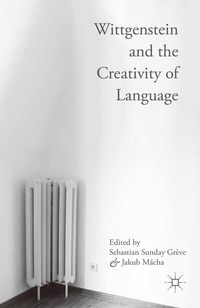
Wittgenstein and the Creativity of Language
Description

Reviews / Votes
'Wittgenstein and the Creativity of Language is an exceptionally stimulating collection on a crucial new subject, the creative potential of ordinary language (artistic, scientific, philosophical). Grève and Mácha bring together a powerful group of authors whose various approaches to the topic strike a perfect balance between interpretative scholarship and philosophical originality.'
- Sandra Laugier, Professor of Philosophy, Université Paris 1 Panthéon-Sorbonne, France
'These essays explore both the standing possibility of creative language use and Wittgenstein's own creative uses of language. In doing so they advance and enrich our understandings of distinctively human and discursive being-in-the-world as both emergent within practices and capable of exceeding them. They will captivate anyone with a sense of the uncanniness of the ordinary and the vicissitudes of the human.'
- Richard Eldridge, Charles and Harriett Cox McDowell Professor of Philosophy, Swarthmore College, US
'This book successfully challenges our received image of Wittgenstein as a closed philosopher closed language-games, a closed end-of-philosophy conception, closed possibilities of meaning and knowing. Using Wittgenstein's own philosophical practice as a springboard, the authors show him to have been an open philosopher. Their exploration of the theme of creativity artistic, linguistic, mathematical and philosophical offers us new perspectives on skepticism, artistic and philosophical style, method, modernism and idealism.'
- Juliet Floyd, Professor of Philosophy, Boston University, US
'A bold, exhilarating, and rewarding collection of essays that uses Wittgenstein's reflections on language to gain new, original insights into poetry, painting, architecture, philosophy, and language itself.'
- Hans Sluga, William and Trudy Ausfahl Professor of Philosophy, UC Berkeley, US
More details
Other editions
Additional editions
Persons
Content
- Cover
- Half-Title
- Title
- Copyright
- Contents
- Note on Cover Image
- Acknowledgements
- Notes on Contributors
- List of Abbreviations
- List of Figures
- Chapter Summaries
- Part I
- 1 The Good, the Bad and the Creative: Language in Wittgenstein's Philosophy
- Part II Overture
- 2 Cats on the Table, New Blood fo rOld Dogs: What Distinguishes Reading Philosophers (on Poets)
- Part III
- 3 Ludwig Wittgenstein and Us'Typical Western Sc
- 4 Wittgenstein on G?delian 'Incompleteness', Proofs and Mathematical Practice: Reading Remarks on the Foundations of Mathematics , Part I,
- 5 Wittgenstein: No Linguistic
- Part IV Philosophy and the Arts
- 6 Wittgenstein, Verbal Creativity and the Expa
- 7 Doubt and Display: A Foundation for a Wittgensteinian Approach to
- 8 The Urn and the Chamber Pot
- Part V
- 9 Wittgenstein and Diamond on Meaning and Experience: From Groundlessness t
- 10 Find It New: Aspect-Perception
- 11 Metaphysics Is Metaphorics: Philosophical and Ecological Reflections from Wittgenstein and Lakoff on the Pros and Cons of Lin
- Bibliography
- Index
