

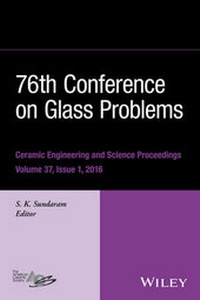
76th Conference on Glass Problems, Version A
Description

More details
Other editions
Additional editions

Person
S. K. SUNDARAM, PhD, is an Inamori Professor of Materials Science and Engineering at Alfred University. Before joining Alfred University, Dr. Sundaram was a chief materials scientist at the Pacific Northwest National Laboratory (PNNL). He joined the PNNL in 1994 as a post-doctoral fellow and became a senior research scientist in 1996. He was then promoted to chief materials scientist in January 2002. Dr. Sundaram is internationally recognized for interdisciplinary research. He has made over 100 technical presentations, edited/contributed to twelve books, published over eighty peer-reviewed publications and technical reports, mentored/supported over forty-five students, and organized/co-organized several national and international symposia on advanced topics in materials science. He is also a co-inventor in three issued patents and two provisional patent applications.
Content
STRENGTH OF GLASS AND GLASS FIBERS
Hong Li
Fiber Glass Science and Technology, PPG Industries, Inc.
Pittsburgh, Pennsylvania, USA
ABSTRACT
The article provides a selective review on strength of glass and glass fiber, covering effects of surface flaw and surface hydrolysis on the usable strength of glass (USG). Application of Griffith-Inglis-Orowan theory on fracture of solids is demonstrated, elucidating importance of stress-assisted hydrolytic effect on glass USG and associated change in glass surface energy. The fundamental understanding of glass fracture supports critical needs for development of new glasses and new durable and/or resin compatible hydrophobic coatings to significantly improve USG of glass and fiberglass products, respectively.
1. FRACTURE OF GLASS AND GLASS FIBERS
1.1 Fundamental of Solid Fracture
Theoretical tensile strength of solids, according to Orowan [1], is proportional to Young's modulus (E) and surface energy (?0) of the material as
(1)where r0 is the equilibrium distance between atomic centers. Experimental measurements, however, report that glasses typically have tensile strengths much lower than the theoretical values by as much as one order of magnitude. Unlike crystalline materials, for which grain boundaries serve as one type of defect, glass defects mostly come from surface "damage" or surface flaw as one of the key factors of lowering the usable strength of glass (USG) from its expected theoretical level.
Surface flaws of a given size (c) serve as a stress concentrator when glass is subject to an applied tensile load; these weak spots cause glass to fail at a tensile stress level well below the theoretical expectation. By the Griffith energy-balance criterion, apparent or measured strength (sm) of a solid is defined by [2, 3]:
(2a) (2b)Inglis further demonstrated [4] that tip geometry of the flaw, in terms of its size c and radius, ?tip, can significantly magnify the stress applied onto the material, which affects sm, according to
(3a) (3b)Equation 3b implies that the maximum measured strength of "flaw-free" samples will be approximately 50% of its theoretical strength and the same size of a critical surface flaw with a sharper crack tip (or lower radius at the crack tip) will further reduce the material strength [5].
It becomes clear that experimentally measured glass strength is not an intrinsic property of the material. Besides composition, atomic structures of glass are affected by their thermal history in terms of melting temperature, cooling rate, degree of annealing, degree of aging under conditions under which they are stored before application, and fatigue in terms of test or application conditions, including temperature, humidity, and cleanness of laboratory, and sample strain rate [6-9]. Furthermore, it is expected that the glass "surface defects" can be generated from "contact damage" even from finger contact during sample handling.
When developing new glass and glass fiber compositions, keeping in mind the multiple factors that affect USG, it is critical to test all samples that are made by the same method under the same laboratory conditions in order to screen composition effect on glass strength.
In reporting and comparing glass strength, "pristine" strength refers to testing samples made under controlled humidity, not being "damaged" by any physical contacts in handling, and tested under the same humidity environment within a very short period of time after the samples are made. "Inert" strength means that the samples are tested in liquid nitrogen to minimize any moisture interaction with glass or glass fiber surface under an applied force. In this case, the samples can be tested after aging under specific conditions or as its "pristine" form without any treatment. "Inert" strength of the "pristine" glass is significantly higher than that of "pristine" glass and hence, closer to the glass intrinsic property.
1.2 Glass Fracture from Microscopic Defects
One of the most detrimental factors impacting glass strength is glass surface attack by corrosive media in the form of liquid or vapor, including water, acid, and base [10-14]. Figure 1 illustrates the effect of fiber surface flaw geometry on silica fiber "inert" tensile strength as the fibers treated in hydrofluoric acid vapor over time [5]. Prediction from the data set suggests that for the silica fibers with very sharp surface flaws, i.e. ?tip << c, its strength is approximately 35-40% of its theoretically predicted value of = 17 GPa.
Figure 1. Silica Glass Fiber Tensile Strength as a Function of Fiber Surface Defect Geometry Characterized by the Ratio of Tip Radius (?tip) of the Surface Flaw over the Flaw size (c) (solid line is determined by using least square linear regression analysis; the plot is constructed based on [5]).
Figure 2 shows fiber failure strain of boron-free E-CR fibers with and without aging up to 270 days at 50°C under 80% relative humidity (RH) [15]. The tests were conducted by using the two-point bending method [16] at room temperature (RT) under 50 %RH and in liquid nitrogen (LN), respectively. Several characteristics can be summarized from the results as follows: First, at semi-logarithmic scale, the two sets of data can be reasonably fit by using linear aggression least square method. The total reduction in fiber failure strain is about 12.5% for fibers tested at RT -50%RH and 13% for fiber tested in liquid nitrogen, respectively. Therefore, it is reasonable to conclude that fiber aging under stress-free conditions results in approximately 13% deterioration in terms of failure strain. Secondly, in terms of absolute failure strain comparing the two test conditions, ?f (LN) is significantly higher than ?f (RT-50%RH); the ratio of the average values for the same aging durations between the two cases is between 2.2 and 2.3, supporting that fiber failure at much higher load or applied stress once moisture of water is minimized or eliminated under which the samples are tested.
Figure 2. Fiber Failure Strain of E-CR Fibers Measured at Room Temperature under 50% RH and in Liquid Nitrogen as a Function of Fiber Aging under 50°C - 80% RH Conditions (open circle and triangle represent individual measurements; filled diamond and triangle represent average values; error bars represent one standard deviation; solid lines are obtained by using linear regression method fitting average values of the data sets; 20 measurements were performed per data set) [15].
Combining the aging test results, for E-CR glass with low alkali contents and free from boron and fluoride, the study demonstrated that moisture water interaction with the surfaces of fibers being under tensile strain or tensile stress plays a dominant role on its failure over hydration or aging treatment of the fibers without being stressed. It follows that the kinetics of stress-assisted hydrolysis on the fiber surfaces should not be significantly affected by the preexisting "layer" of hydration created from the aging treatment. In turn, one can reason that the hydroxyl groups (Si-OH) formed on the fiber surfaces during aging should be immobile during the growth of crack under the applied stress or strain and hence, newly generated Si-OH groups at the front of surface flaws, i.e., stress-assisted hydrolysis, should dominate the fiber failure strain or failure stress. The mechanism of glass fatigue in a humid environment was proposed and experimentally demonstrated by Hillig & Charles [17] and Wiederhorn [18, 19].
The stress-assisted hydrolysis of the glass near the tip of surface flaws can result in significant glass surface energy (?) reduction; literature data shows that quartz crystals change in surface energy with and without hydration by as much as 10 times [20-23]. Structure of crystalline quartz and fused quartz glass is very different; in dry liquid nitrogen their perspective ratio is about 0.43 (2.0 J/m2 for crystalline quartz over 4.6 J/m2 for fused quartz glass) [24]. However, their perspective changes in surface energy to hydration are expected to follow the same trend [25]. Therefore, the glass fibers tested should become much weaker under ambient conditions over liquid nitrogen. Our estimation on the surface energy ratio, ?(LN)/?(RT-50%RH), derived from the study [15] was close to 3.4 ± 0.2 for fibers aged up to 180 days. The surface energy ratio can be derived from Eq. 3a, in which fiber modulus is considered as a strain-dependent variable, i.e., Secant Modulus, according to Gupta and Kurkjian [26].
1.3 Glass Fracture from Macroscopic Defects
As the size of glass surface flaws becomes larger, glasses fail at lower applied stresses, i.e., lower USG, as illustrated in Figure 3 [27]. Within each flaw size range, instantaneous strength represents the samples without any aging effect, and endurance limit represents the samples experienced some levels of aging event before or during the...
