

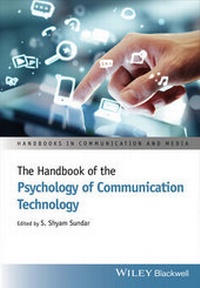
The Handbook of the Psychology of Communication Technology
Description

Reviews / Votes
"This is a book many scholars and several academic disciplineshave been waiting for: It connects the latest knowledge andexpertise about using new technologies with the psychologicalconditions and effects of it." Peter Vorderer, ICA PresidentMore details
Other editions
Additional editions
Person
Content
Biographical Notes
Cristina Botella is Full Professor of Clinical Psychology at Universitat Jaume I, Spain. Her main research line is the design and testing of clinical applications based on information and communication technologies for the treatment of emotional disorders. She has published over 100 papers and participated in various research projects granted by national as well as European funds.
Jeremy N. Bailenson is Founding Director of VHIL and an Associate Professor in the Department of Communication at Stanford. His main area of interest is the phenomenon of digital human representation. His findings have been published in over 70 academic papers in the fields of communication, computer science, education, and psychology.
Juana Bretón-López is an Assistant Professor of Psychological Treatments at the Universitat Jaume I, Spain. Her main research interests are anxiety disorders or behavioral addictions and the application of new technologies to treat these. She has published over 27 papers and participated in several research projects.
Pam Briggs holds a Research Chair at Northumbria University, where she explores identity, trust, privacy, and security and inclusion issues in social media. Her current projects address trust issues in peer-to-peer health care, the influence of social media in message dissemination during pandemics, location-based services and technologies, and cybersecurity identity management and digital personhood.
Judee K. Burgoon is a Professor and Director of Human Communication Research, Center for the Management of Information at the University of Arizona and a Distinguished Visiting Professor with the Department of Communication at the University of Oklahoma. She is the most prolific female scholar in communication in the twentieth century.
Jenna L. Clark is a Graduate Student and Royster Fellow at the University of North Carolina at Chapel Hill. Her research explores how individuals' perceptions of online relationships (perceived reality) can affect the outcomes of those relationships.
Antonios Dakanalis is currently Post-Doc Researcher at the University of Pavia, Pavia, Italy. His research interests are related to the concept of self-objectification and its role in the etiology of eating disorders. More, he is interested to explore the potential of positive technologies in the field of well-being and health care.
Kathleen M. Cumiskey is Associate Professor at the College of Staten Island, City University of New York. She is an expert in the social consequences of mobile technology. Her latest publications focus on the role that mobile phones play in changing people's perception of their Social and emotive environments. She is the coeditor (with Larissa Hjorth) on a volume published by Routledge entitled: Mobile Media Practices, Presence, and Politics: The Challenge of Being Seamlessly Mobile (2013).
Nicole B. Ellison (Ph.D., University of Southern California) is an Associate Professor in the School of Information at the University of Michigan. Her research focuses on how individuals and groups use online tools to initiate, maintain, and benefit from their social relationships.
Andrew J. Flanagin is Professor in the Department of Communication at the University of California at Santa Barbara. His research focuses on the ways in which information and communication technologies structure and extend human interaction, with particular emphasis on the processes of organizing and information evaluation and sharing.
Azucena García-Palacios is Professor of Abnormal Psychology at Universitat Jaume I, Spain. One of her main line of research is the design and testing of clinical applications based on information and communication technologies for the treatment of emotional disorders. She has published over 50 papers and she has participated in several research projects.
Melanie C. Green is an Assistant Professor of Communication at the University of Buffalo (SUNY). Her research examines the reasons why individuals choose online or ersatz interactions, and the consequences of these actions.
Mark D. Griffiths is Professor of Gambling Studies at the Nottingham Trent University. Dr. Griffiths has published over 450 refereed journal papers mainly in the area of behavioral addiction and has won 14 national and/or international awards for his work.
Jamie Guillory (Ph.D., Cornell University) is a Postdoctoral Fellow at the University of California, San Francisco, in the Center for Tobacco Control Research & Education (http://tobacco.ucsf.edu/users/jeg258). She studies the influence of technology on emotions, social behavior, and health using big data, experiments, surveys, and mobile Apps (https://sites.google.com/site/jamieguillory/home).
Anouk den Hamer (VU University Amsterdam) is a Ph.D. student in Media Psychology and Lecturer in Statistics and Methods at VU University Amsterdam. She holds a B.A. in Media Studies and an M.A. in Communication Science. She studies victimization and the role of media use in cyberbullying behavior among adolescents.
Jeffrey T. Hancock is a Professor in the Department of Communication and Cochair of the Department of Information Science at Cornell University. His work is concerned with how social media affect psychological and interpersonal processes, with a particular emphasis on understanding how language can reveal psychological and social dynamics.
Brandon Van Der Heide is an Assistant Professor of communication at Michigan State University. His primary interests include investigating how impression formation and social influence processes are changed when people interact using communication technologies and how these communication processes affect areas of practical interest such as electronic commerce.
Laura Hoffmann is doing her Ph.D. on social robotics. She is working as a Research Associate at the Department of Social Psychology: Media and Communication at the University of Duisburg-Essen, Germany. Her research interests lie in the area of social psychology and media psychology, with a particular focus on human-robot interaction (https://www.uni-due.de/sozialpsychologie/Hoffmann.shtml).
Johan F. Hoorn (D.Litt., D.Sc.) is Senior Associate Professor of Communication Science at VU University, Amsterdam. He is the principal investigator and project leader of Services of Electro-Mechanical Care Agencies (SELEMCA) directed at the creation of android robots in the care domain, so called "Caredroids."
Yan Huang is a doctoral student at the Pennsylvania State University. Her current research focuses on the psychological effects of media technologies. She is especially interested in how technological affordances influence the processes and outcomes of online persuasion in a variety of contexts such as health communication, advertising, and e-commerce.
Haiyan Jia (PhD, Penn State University) is a post-doctoral scholar at the Penn State University in the College of Information Sciences and Technology. Her research interest primarily focuses on the social and psychological effects of communication technology ranging from Web to mobile apps to smart objects. She also researches technology use in cross-cultural and international communication contexts.
Benjamin K. Johnson (M.A., Michigan State University) is a doctoral candidate at the School of Communication, The Ohio State University. His research is focused on selective exposure in new media settings, especially as it relates to social comparison and impression management (http://www.comm.ohio-state.edu/component/comprofiler/userprofile/106.html).
Sriram "Sri" Kalyanaraman is a Professor of journalism at the University of Florida's College of Journalism and Communications. His primary research focuses on persuasion and attitude change in online environments, particularly as informed by customized and interactive messages. He currently serves as co-editor of Media Psychology.
Cody O. Karutz is the Manager of Stanford University's Virtual Human Interaction Lab (VHIL). His main areas of interest are how virtual reality technologies and devices can be utilized to create new educational platforms.
Silvia Knobloch-Westerwick (Ph.D., University of Music, Theater, and Media, Hanover, Germany) is Professor at the School of Communication at The Ohio State University and Director of the Graduate Studies Program. She serves as Editor of Media Psychology. Her research examines media uses and effects, with a focus on selective exposure in the contexts of political communication, health communication, news, entertainment, and communication technologies (http://www.comm.ohio-state.edu/sknoblochwesterwick). Her latest monograph is titled "Choice and Preference in Media Use: Advances in Selective Exposure Theory and Research" (http://www.routledge.com/9780805855159).
Nicole C. Krämer (Ph.D., University of Cologne) has been leading the team of Social Psychology: Media and Communication as a Professor at the University of Duisburg-Essen, Germany. Her research interests include social aspects of human technology interaction and computer-mediated communication (https://www.uni-due.de/sozialpsychologie/ kraemer.shtml).
Elly A. Konijn (Ph.D., Utrecht University, the Netherlands) is...
