

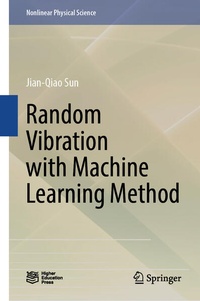
Random Vibration with Machine Learning Method
Description

The book presents the theoretical foundation of random vibration of dynamic systems and new machine learning methods for the analysis of linear and nonlinear random vibration problems. This is the first book on the market that introduces the tools of artificial intelligence, i.e. neural networks, to engineering problems of random vibration.
The first part of the book briefly reviews probability theory, stochastic processes, spectral analysis of stochastic processes, stochastic calculus, and a brief and general discussion of the response process viewed as a mapping of random excitation and uncertainties, equations for response probability distribution and reliability problems. The second part of the book presents studies of linear and nonlinear random vibration problems. In particular, the radial basis neural networks solution is introduced. Extensive examples are presented to demonstrate the neural network solution. Data-driven random vibration problems are also discussed, including density estimation, model identification and model-free generalized cell mapping. Finally, Monte Carlo simulation is discussed from a new perspective.
This book can be adopted as an advanced reference book of an undergraduate random vibration class. The entire book is an excellent choice for a graduate random vibration course, and is also a good reference book for practice engineers and researchers.
More details
Other editions
Additional editions
Person
Jian-Qiao Sun was born in Wuhan, Hubei, China, in 1956. He received the B.S. degree in solid mechanics from the Huazhong University of Science and Technology, in 1982, and the Ph.D. degree in mechanical engineering from University of California, Berkeley, in 1988. In 1994, he joined the University of Delaware as a Faculty Member, until 2007, when he moved to the University of California at Merced. His research interests include vibrations, controls, energy harvesting, and data-driven modeling and analysis of complex systems. He serves as the Editor-in-Chief for the International Journal of Dynamics and Control.
Content
Introduction.- Theoretical Foundation.- Simulation.- Response Process.- Response Moment.- Response Distribution.- Classical Random Vibration.- Random Vibration with Neural Networks.- Method of Feynman-Kac.- Green's Operator.- Data-Driven Random Vibration.- Data-Driven Generalized Cell Mapping.- New Application of Simulation.
