

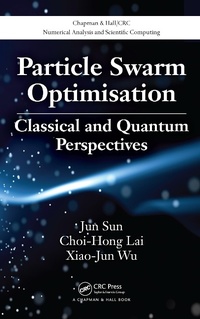
Particle Swarm Optimisation
Classical and Quantum Perspectives
1st Edition
Published on 19. April 2016
419 pages
978-1-040-05770-4 (ISBN)
Description

Although the particle swarm optimisation (PSO) algorithm requires relatively few parameters and is computationally simple and easy to implement, it is not a globally convergent algorithm. In Particle Swarm Optimisation: Classical and Quantum Perspectives, the authors introduce their concept of quantum-behaved particles inspired by quantum mechanics, which leads to the quantum-behaved particle swarm optimisation (QPSO) algorithm. This globally convergent algorithm has fewer parameters, a faster convergence rate, and stronger searchability for complex problems.
The book presents the concepts of optimisation problems as well as random search methods for optimisation before discussing the principles of the PSO algorithm. Examples illustrate how the PSO algorithm solves optimisation problems. The authors also analyse the reasons behind the shortcomings of the PSO algorithm.
Moving on to the QPSO algorithm, the authors give a thorough overview of the literature on QPSO, describe the fundamental model for the QPSO algorithm, and explore applications of the algorithm to solve typical optimisation problems. They also discuss some advanced theoretical topics, including the behaviour of individual particles, global convergence, computational complexity, convergence rate, and parameter selection. The text closes with coverage of several real-world applications, including inverse problems, optimal design of digital filters, economic dispatch problems, biological multiple sequence alignment, and image processing. MATLAB (R), Fortran, and C++ source codes for the main algorithms are provided on an accompanying downloadable resources.
Helping you numerically solve optimisation problems, this book focuses on the fundamental principles and applications of PSO and QPSO algorithms. It not only explains how to use the algorithms, but also covers advanced topics that establish the groundwork for understanding.
The book presents the concepts of optimisation problems as well as random search methods for optimisation before discussing the principles of the PSO algorithm. Examples illustrate how the PSO algorithm solves optimisation problems. The authors also analyse the reasons behind the shortcomings of the PSO algorithm.
Moving on to the QPSO algorithm, the authors give a thorough overview of the literature on QPSO, describe the fundamental model for the QPSO algorithm, and explore applications of the algorithm to solve typical optimisation problems. They also discuss some advanced theoretical topics, including the behaviour of individual particles, global convergence, computational complexity, convergence rate, and parameter selection. The text closes with coverage of several real-world applications, including inverse problems, optimal design of digital filters, economic dispatch problems, biological multiple sequence alignment, and image processing. MATLAB (R), Fortran, and C++ source codes for the main algorithms are provided on an accompanying downloadable resources.
Helping you numerically solve optimisation problems, this book focuses on the fundamental principles and applications of PSO and QPSO algorithms. It not only explains how to use the algorithms, but also covers advanced topics that establish the groundwork for understanding.
More details
Series
Edition
1. Auflage
Language
English
Place of publication
London
United Kingdom
Publishing group
Taylor & Francis Ltd
Target group
College/higher education
Professional and scholarly
ISBN-13
978-1-040-05770-4 (9781040057704)
Copyright in bibliographic data and cover images is held by Nielsen Book Services Limited or by the publishers or by their respective licensors: all rights reserved.
Schweitzer Classification
Other editions
Additional editions
Book
09/2019
1st Edition
CRC Press
€96.90
Shipment within 15-20 days
Book
12/2011
1st Edition
CRC Press
€222.84
Shipment within 15-20 days
Persons
Jun Sun is an associate professor in the Department of Computer Science and Technology at Jiangnan University. He is also a researcher at the Key Laboratory of Advanced Process Control for Light Industry in China. He has a Ph.D. in control theory and control engineering. His research interests include computational intelligence, numerical optimisation, and machine learning.
Choi-Hong Lai is a professor of numerical mathematics in the Department of Mathematical Sciences at the University of Greenwich. He has a Ph.D. in computational aerodynamics and PDEs. His research interests include numerical PDEs, numerical algorithms, and parallel algorithms for industrial applications, such as aeroacoustics, inverse problems, computational finance, and image processing.
Xiao-Jun Wu is a professor at Jiangnan University. He has a Ph.D. in pattern recognition and intelligent systems. He has published more than 150 papers on pattern recognition, computer vision, fuzzy systems, neural networks, and intelligent systems.
Choi-Hong Lai is a professor of numerical mathematics in the Department of Mathematical Sciences at the University of Greenwich. He has a Ph.D. in computational aerodynamics and PDEs. His research interests include numerical PDEs, numerical algorithms, and parallel algorithms for industrial applications, such as aeroacoustics, inverse problems, computational finance, and image processing.
Xiao-Jun Wu is a professor at Jiangnan University. He has a Ph.D. in pattern recognition and intelligent systems. He has published more than 150 papers on pattern recognition, computer vision, fuzzy systems, neural networks, and intelligent systems.
Content
Introduction. Particle Swarm Optimisation. Some Variants of Particle Swarm Optimisation. Quantum-Behaved Particle Swarm Optimisation. Advanced Topics. Industrial Applications. Index.
