

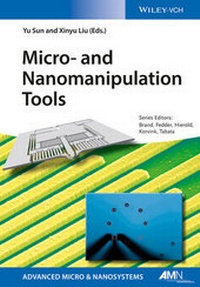
Micro- and Nanomanipulation Tools
1st Edition
Published on 10. September 2015
XXXVI, 570 pages
978-3-527-69025-1 (ISBN)
Description

Combining robotics with nanotechnology, this ready reference summarizes the fundamentals and emerging applications in this fascinating research field. This is the first book to introduce tools specifically designed and made for manipulating micro- and nanometer-sized objects, and presents such examples as semiconductor packaging and clinical diagnostics as well as surgery.
The first part discusses various topics of on-chip and device-based micro- and nanomanipulation, including the use of acoustic, magnetic, optical or dielectrophoretic fields, while surface-driven and high-speed microfluidic manipulation for biophysical applications are also covered. In the second part of the book, the main focus is on microrobotic tools. Alongside magnetic micromanipulators, bacteria and untethered, chapters also discuss silicon nano- and integrated optical tweezers. The book closes with a number of chapters on nanomanipulation using AFM and nanocoils under optical and electron microscopes. Exciting images from the tiniest robotic systems at the nano-level are used to illustrate the examples throughout the work.
A must-have book for readers with a background ranging from engineering to nanotechnology.
The first part discusses various topics of on-chip and device-based micro- and nanomanipulation, including the use of acoustic, magnetic, optical or dielectrophoretic fields, while surface-driven and high-speed microfluidic manipulation for biophysical applications are also covered. In the second part of the book, the main focus is on microrobotic tools. Alongside magnetic micromanipulators, bacteria and untethered, chapters also discuss silicon nano- and integrated optical tweezers. The book closes with a number of chapters on nanomanipulation using AFM and nanocoils under optical and electron microscopes. Exciting images from the tiniest robotic systems at the nano-level are used to illustrate the examples throughout the work.
A must-have book for readers with a background ranging from engineering to nanotechnology.
More details
Other editions
Additional editions
Yu Sun | Xinyu Liu
Micro- and Nanomanipulation Tools
Software
11/2015
Wiley-VCH
€239.57
No shipping information available
Yu Sun | Xinyu Liu
Micro- and Nanomanipulation Tools
Book
10/2015
1st Edition
Wiley-VCH
from
€175.00
Article exhausted; check different version
Persons
Yu Sun is professor in the Department of Mechanical and Industrial Engineering at the University of Toronto (Canada), with joint appointments in the Institute of Biomaterials and Biomedical Engineering and the Department of Electrical and Computer Engineering. After obtaining his PhD in mechanical engineering from the University of Minnesota, Yu Sun stayed for a postdoctoral research at the Swiss Federal Institute of Technology (ETH-Zürich). Currently, he is a McLean Senior Faculty Fellow at the University of Toronto and the Canada Research Chair in Micro and Nano Engineering Systems.
Xinyu Liu is assistant professor in the Department of Mechanical Engineering at the McGill University in Montreal (Canada). After obtaining his PhD from the University of Toronto, he was post-doc at Harvard university before taking his current position at the McGill University. His research interests are robotics, MEMS/NEMS, and applied microfluidics, also referred to as lab-on-a-chip technologies, with a strong focus on bio-oriented applications.
Xinyu Liu is assistant professor in the Department of Mechanical Engineering at the McGill University in Montreal (Canada). After obtaining his PhD from the University of Toronto, he was post-doc at Harvard university before taking his current position at the McGill University. His research interests are robotics, MEMS/NEMS, and applied microfluidics, also referred to as lab-on-a-chip technologies, with a strong focus on bio-oriented applications.
Editor
Albert-Ludwigs-University, Freiburg, Germany
Albert-Ludwigs-University, Freiburg, Germany
Series Editor
Albert-Ludwigs-University, Freiburg, Germany
Albert-Ludwigs-University, Freiburg, Germany
Albert-Ludwigs-University, Freiburg, Germany
Albert-Ludwigs-University, Freiburg, Germany
Albert-Ludwigs-University, Freiburg, Germany
Content
PART I: On-Chip and Device-Based Micro-Nanomanipulation
High-Speed Microfluidic Manipulation of Cells for Biophysical Measurements
Surface Force-Driven Large-Scale Assembly of Micro Parts
Manipulation of Micro-Nano Objects Using Acoustic Field
Large-Scale Cell Manipulation Using Dielectrophoretic Fields
Dielectrophoretic Carbon Nanotubes
Digital Microfluidics for Manipulating Objects Inside Micro Droplets
Nano-Optical DNA
Fluidic Alignment of Cnts
Optical Manipulation of Cells and Molecules
On-Chip Magnetic Cell Manipulators
MEMS Microgrippers
Untethered Microgrippers
Self-Sensing MEMS-Based AFM Imaging and Manipulation
PART II: Robotic Tools for Micro-Nanomanipulation
Untethered Magnetic Micromanipulators
Untethered Artificial Flagella Control
Magnetic Bacteria Used as Micromanipulators
Piezoelectric Actuators for Micro-Nanomanipulation
Robotic Manipulation of Cells and Small Organisms
MEMS-Based Force Feedback for Micromanipulation
Robotic Optical Tweezers for Micromanipulation
Nanomanipulation Using AFM
Nanomanipulation Using AFM
Nanomanipulation of Nano Coils Under SEM
Nanomanipulation Under SEM
Manipulating Biomaterials Under FSEM
High-Speed Microfluidic Manipulation of Cells for Biophysical Measurements
Surface Force-Driven Large-Scale Assembly of Micro Parts
Manipulation of Micro-Nano Objects Using Acoustic Field
Large-Scale Cell Manipulation Using Dielectrophoretic Fields
Dielectrophoretic Carbon Nanotubes
Digital Microfluidics for Manipulating Objects Inside Micro Droplets
Nano-Optical DNA
Fluidic Alignment of Cnts
Optical Manipulation of Cells and Molecules
On-Chip Magnetic Cell Manipulators
MEMS Microgrippers
Untethered Microgrippers
Self-Sensing MEMS-Based AFM Imaging and Manipulation
PART II: Robotic Tools for Micro-Nanomanipulation
Untethered Magnetic Micromanipulators
Untethered Artificial Flagella Control
Magnetic Bacteria Used as Micromanipulators
Piezoelectric Actuators for Micro-Nanomanipulation
Robotic Manipulation of Cells and Small Organisms
MEMS-Based Force Feedback for Micromanipulation
Robotic Optical Tweezers for Micromanipulation
Nanomanipulation Using AFM
Nanomanipulation Using AFM
Nanomanipulation of Nano Coils Under SEM
Nanomanipulation Under SEM
Manipulating Biomaterials Under FSEM
List of Contributors
- Alex Abramson
- Johns Hopkins University
- Department of Chemical and Biomolecular Engineering
- 3400 N Charles Street
- Baltimore
- MD 21218
- USA
- Mohd Ridzuan Ahmad
- Universiti Teknologi Malaysia
- Department of Control and Mechatronics Engineering
- Faculty of Electrical Engineering
- Malaysia
- Fumihito Arai
- Nagoya University
- Department of Micro-Nano Systems Engineering
- Furo-cho, Chikusa-ku
- Nagoya
- Aichi 464-8603
- Japan
- Malte Bartenwerfer
- University of Oldenburg
- Division Microrobotics and Control Engineering
- AMiR, Department of Computing Science
- Ammerländer Heerstraße 114-118
- 26129 Oldenburg
- Lower Saxony
- Germany
- Shuxun Chen
- City University of Hong Kong
- Department of Mechanical and Biomedical Engineering
- 83 Tat Chee Avenue
- Kowloon Tong
- Hong Kong
- China
- Andrew Choi
- Johns Hopkins University
- Department of Chemical and Biomolecular Engineering
- 3400 N Charles Street
- Baltimore
- MD 21218
- USA
- Aram J. Chung
- Rensselaer Polytechnic Institute
- Department of Mechanical
- Aerospace and Nuclear Engineering
- 110 8th Street
- Troy
- NY 12180
- USA
- Cédric Clévy
- Université Bourgogne Franche-Comté / CNRS
- Institute FEMTO-ST
- Département AS2M
- 24 rue Savary
- 25000 besançon
- France
- Dominique Collard
- The University of Tokyo
- Institute of Industrial Science
- LIMMS/CNRS-IIS (UMI 2820)
- 4-6-1 Komaba
- Meguro Ku
- Tokyo 153-8505
- Japan
- and
- The University of Tokyo
- Institute of Industrial Science
- Center for International Research on Micronano Mechatronics (CIRMM)
- 4-6-1 Komaba
- Meguro-ku
- Tokyo 153-8505
- Japan
- Eric Diller
- University of Toronto
- Department of Mechanical and Industrial Engineering
- 5 King's College Road
- Toronto
- ON M5S 3G8
- Canada
- Lixin Dong
- Michigan State University
- College of Engineering
- Department of Electrical and Computer Engineering
- 428 S. Shaw Lane
- East Lansing
- MI 48824-1226
- USA
- Xianke Dong
- McGill University
- Department of Mechanical Engineering
- Sherbrooke Street West 817
- Montreal
- QC H3A 0C3
- Canada
- Sergej Fatikow
- University of Oldenburg
- Division Microrobotics and Control Engineering
- AMiR
- Department of Computing Science
- Ammerländer Heerstraße 114-118
- 26129 Oldenburg
- Lower Saxony
- Germany
- Dimitrios Felekis
- ETH Zurich
- Institute of Robotics and Intelligent Systems
- Tannenstrasse 3
- CH-8092 Zurich
- Switzerland
- Hiroyuki Fujita
- The University of Tokyo
- Institute of Industrial Science
- Center for International Research on Micronano Mechatronics (CIRMM)
- 4-6-1 Komaba
- Meguro-ku
- Tokyo 153-8505
- Japan
- Toshio Fukuda
- Nagoya University
- Institute for Advanced Research
- Furo-cho
- Chikusa-ku
- Nagoya 464-8601
- Aichi
- Japan
- and
- Meijo University
- Department of Mechatronics Engineering
- Shiogamaguchi
- Tempaku-ku
- Nagoya 468-8502
- Aichi
- Japan
- Michaël Gauthier
- Université Bourgogne Franche-Comté / CNRS
- Institute FEMTO-ST
- Département AS2M
- 24 rue Savary
- 25000 besançon
- France
- David H. Gracias
- Johns Hopkins University
- Department of Chemical and Biomolecular Engineering
- 3400 N Charles Street
- Baltimore
- MD 21218
- USA
- and
- Johns Hopkins University
- Department of Materials Science and Engineering
- 3400 N Charles Street
- Baltimore
- MD 21218
- USA
- Ueli Grossniklaus
- University of Zurich
- Institute of Plant Biology
- Zollikerstrasse 107
- CH-8008 Zurich
- Switzerland
- Hervé Guillou
- The University of Tokyo
- Institute of Industrial Science
- LIMMS/CNRS-IIS (UMI 2820)
- 4-6-1 Komaba
- Meguro Ku
- Tokyo 153-8505
- Japan
- and
- Université Grenoble Alpes
- Institut NEEL
- F-38000 Grenoble
- France
- and
- CNRS
- Institut NEEL
- F-38042 Grenoble
- France
- Evin Gultepe
- Johns Hopkins University
- Department of Chemical and Biomolecular Engineering
- 3400 N Charles Street
- Baltimore
- MD 21218
- USA
- Qiuquan Guo
- South China University of Technology
- School of Electronic and Information Engineering
- 380 Wushan Road
- Guangzhou
- Guangdong 510640
- China
- Masaya Hagiwara
- Osaka Prefecture University
- Nanoscience and Nanotechnology Research Center
- 1-2 Gakuen-cho
- Naka-ku
- Osaka 599-8570
- Japan
- David Hériban
- Percipio Robotics SA
- 18 rue Savary
- 25000 Besançon
- France
- Soojung Claire Hur
- The Rowland Institute at Harvard University
- 100 Edwin H. Land Boulevard
- Cambridge
- MA 02142
- USA
- Laurent Jalabert
- The University of Tokyo
- Institute of Industrial Science
- LIMMS/CNRS-IIS (UMI 2820)
- 4-6-1 Komaba
- Meguro Ku
- Tokyo 153-8505
- Japan
- Qianru Jin
- Johns Hopkins University
- Department of Chemical and Biomolecular Engineering
- 3400 N Charles Street
- Baltimore
- MD 21218
- USA
- Wes Johnson
- University of Toronto
- Department of Mechanical and Industrial Engineering
- 5 King's College Road
- Ontario
- ON M5S 3G8
- Canada
- Pasi Kallio
- Institute of Automation and Control
- Tampere University of Technology
- P.O. Box 692
- 33101 Tampere
- Finland
- Tomohiro Kawahara
- Kyushu Institute of Technology
- Department of Biological Functions Engineering
- 2-4 Hibikino
- Wakamatsu-ku
- Kitakyushu
- Fukuoka 808-0196
- Japan
- Momoko Kumemura
- The University of Tokyo
- Institute of Industrial Science
- LIMMS/CNRS-IIS (UMI 2820)
- 4-6-1 Komaba
- Meguro Ku
- Tokyo 153-8505
- Japan
- and
- The University of Tokyo
- Institute of Industrial Science
- Center for International Research on Micronano Mechatronics (CIRMM)
- 4-6-1 Komaba
- Meguro-ku
- Tokyo 153-8505
- Japan
- Nicolas Lafitte
- The University of Tokyo
- Institute of Industrial Science
- LIMMS/CNRS-IIS (UMI 2820)
- 4-6-1 Komaba
- Meguro Ku
- Tokyo 153-8505
- Japan
- and
- The University of Tokyo
- Institute of Industrial Science
- Center for International Research on Micronano Mechatronics (CIRMM)
- 4-6-1 Komaba
- Meguro-ku
- Tokyo 153-8505
- Japan
- Sam Lai
- City University of Hong Kong, College of Science and Engineering
- Department of Mechanical and Biomedical Engineering
- 83 Tat Chee Avenue
- Kowloon Tong
- Hong Kong 999077
- China
- Gwo-Bin Lee
- National Tsing Hua University
- Institute of Biomedical Engineering
- Institute of NanoEngineering and Microsystems
- Department of Power Mechanical Engineering
- 101, Section 2, Kuang-Fu Road
- Hsinchu 30013
- Taiwan
- Mi Li
- State Key Laboratory of Robotics
- Shenyang Institute of Automation
- Chinese Academy of Sciences
- No. 114 Nanta Street
- Shenyang 110016
- Liaoning Province
- China
- and
- University of Chinese Academy of Sciences
- No. 19A Yuquan Road
- Shijingshan District
- Beijing 100049
- China
- Wen Jung Li
- Chinese Academy of Sciences
- Shenyang Institute of Automation
- 114 Nanta street
- Shenhe District, Shenyang City
- Liaoning Province
- P. R. China
- and
- City University of Hong Kong
- College of Science and...
