

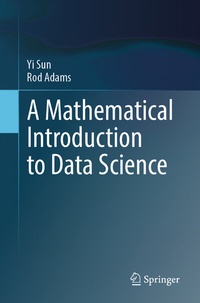
A Mathematical Introduction to Data Science
Description

This textbook provides a comprehensive foundation in the mathematics needed for data science for students and self-learners with a basic mathematical background who are interested in the principles behind computational algorithms in data science. It covers sets, functions, linear algebra, and calculus, and delves deeply into probability and statistics, which are key areas for understanding the algorithms driving modern data science applications. Readers are guided toward unlocking the secrets of algorithms like Principal Component Analysis, Singular Value Decomposition, Linear Regression in two and more dimensions, Simple Neural Networks, Maximum Likelihood Estimation, Logistic Regression and Ridge Regression, illuminating the path from mathematical principles to algorithmic mastery.
It is designed to make the material accessible and engaging, guiding readers through a step-by-step progression from basic mathematical concepts to complex data science algorithms. It stands out for its emphasis on worked examples and exercises that encourage active participation, making it particularly beneficial for those with limited mathematical backgrounds but a strong desire to learn. This approach facilitates a smoother transition into more advanced topics.
The authors expect readers to be proficient in handling numbers in various formats, including fractions, decimals, percentages, and surds. They should also have a knowledge of introductory algebra, such as manipulating simple algebraic expressions, solving simple equations, and graphing elementary functions, along with a basic understanding of geometry including angles, trigonometry and Pythagoras' theorem.
More details
Other editions
Additional editions
Persons
Dr. Yi Sun, Reader in Data Science, in the Department of Computer Science, at the University of Hertfordshire. She has extensive teaching experience in machine learning and data science since 2006. Her research focuses on machine learning applications, with additional interests in image processing, natural language processing, and time series analysis.
Prof. Rod Adams, Emeritus Professor, in the Department of Computer Science, at University of Hertfordshire. He has extensive experience in teaching both mathematics and computer science since the 1970s. His initial research was in mathematical logic and the maths behind compilers, especially for functional languages. Most of his research, however, has centred on neural modelling and machine learning in many application domains.
Content
Chapter 1 Introduction.- Chapter 2 Sets and Functions.- Chapter 3 Liner Algebra.- Chapter 4 Matrix Decomposition.- Chapter 5 Calculus.- Chapter 6 Advanced Calculus.- Chapter 7 Algorithms 1 - Principal Component Analysis.- Chapter 8 Algorithms 2 - Liner Regression.- Chapter 9 Algorithms 3 - Neural Networks.- Chapter 10 Probability.- Chapter 11 Further Probability.- Chapter 12 Elements of Statistics.- Chapter 13 Algorithms 4 - Maximum Likelihood Estimation and its Application to Regression.- Chapter 14 Data Modelling in Practice.
