

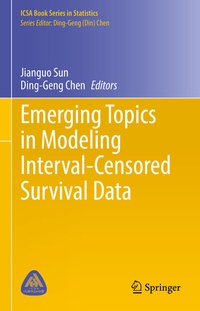
Emerging Topics in Modeling Interval-Censored Survival Data
Description

This book primarily aims to discuss emerging topics in statistical methods and to booster research, education, and training to advance statistical modeling on interval-censored survival data. Commonly collected from public health and biomedical research, among other sources, interval-censored survival data can easily be mistaken for typical right-censored survival data, which can result in erroneous statistical inference due to the complexity of this type of data. The book invites a group of internationally leading researchers to systematically discuss and explore the historical development of the associated methods and their computational implementations, as well as emerging topics related to interval-censored data. It covers a variety of topics, including univariate interval-censored data, multivariate interval-censored data, clustered interval-censored data, competing risk interval-censored data, data with interval-censored covariates, interval-censored data from electric medical records, and misclassified interval-censored data. Researchers, students, and practitioners can directly make use of the state-of-the-art methods covered in the book to tackle their problems in research, education, training and consultation.
More details
Other editions
Additional editions
Persons
Professor (Tony) Jianguo Sun is a Curators' Distinguished Professor in the Department of Statistics at the University of Missouri, USA. He is a world-leading researcher in survival data analysis and has in particular been working on the analysis of interval-censored data for over 30 years. He has published over 200 papers and three books and has been invited several times to write review articles on the analysis of interval-censored data. Professor Sun is a Fellow of the American Statistical Association and the Institute of Mathematical Statistics and an Elected Member of the International Statistical Institute.
Professor (Din) Ding-Geng Chen received his Ph.D. in Statistics from the University of Guelph (Canada) in 1995 and is now executive director and professor in Biostatistics at the College of Health Solutions, Arizona State University. He served as a professor in biostatistics at the University of North Carolina-Chapel Hill, a biostatistics professor at the University of Rochester Medical Center, and held the Karl E. Peace endowed eminent scholar chair in biostatistics at the Jiann-Ping Hsu College of Public Health at Georgia Southern University. Dr. Chen is an elected fellow of the American Statistical Association and a senior expert consultant for biopharmaceuticals and government agencies with extensive expertise in clinical trial biostatistics. He has more than 200 scientific publications and has co-authored/co-edited 33 books on clinical trials, survival data, meta-analysis, Monte-Carlo simulation-based statistical modeling, causal inference, big data analytics, and statistical modeling for public health applications. His research has been funded as PI/Co-PI from NIH R01s and other multi-milliondollar state and federal government agencies.
