

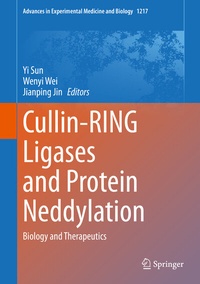
Cullin-RING Ligases and Protein Neddylation
Description

More details
Other editions
Additional editions
Persons
Dr. Yi Sun completed his medical training in China in the early 1980s, his Ph.D. at the University of Iowa, USA, in 1989, and his postdoctorate at the NCI. Currently, he is a Lawrence-Krause Research Professor of Radiation Oncology, and Director of the Division of Radiation & Cancer Biology, Department of Radiation Oncology at the University of Michigan. His main research aims are validating SAG-Cullin RING Ligase (CRL) and neddylation as cancer targets, and identifying small molecule inhibitors against these targets for anticancer therapy. Dr. Sun is the author of 222 peer- reviewed articles published in various prestigious journals, including Dev Cell, eLife, J Cell Biol, J Clin Invest , Mol Cell,Nature Communications, PNAS, and Cancer Res. He serves as editorial board member of several scientific journals. He was elected as a fellow of the AAAS (American Association for the Advancement of Science) in 2012.
Dr. Wenyi Wei received his B.A. degree from Shandong University in 1993 and pursued his M.S. at the Chinese Academy of Science from 1993 to 1996. Afterwards, Dr. Wei completed his Ph.D. at the MCB department at Brown University and his postdoctorate at the laboratory of Dr. William Kaelin, Jr. at DFCI, Harvard Medical School. In 2006, Dr. Wei moved to the Department Pathology at Beth Israel Deaconess Medical Center, Harvard Medical School, where his research focuses on understanding how aberrant cell signaling events contribute to cell cycle dysregulation and subsequent tumorigenesis, to provide the molecular basis and the rationale to develop novel anti-cancer therapies targeting specific cell signaling pathways.
Dr. Jianping Jin completed his PhD at Texas A&M University at College Station in 2000, and his postdoctorate in Dr. J Wade Harper's Laboratory at Baylor College of Medicine and then at Harvard Medical School. Currently, he is a Professor and senior investigatorat the Life Science Institute, Zhejiang University, China. His main research projects focus on the ubiquitin signaling pathway, and its roles in cancer and inflammation. He discovered Uba6, the second ubiquitin E1 gene (humans only have two ubiquitin E1 genes), and its specific E2 gene, Use1 (also called Ube2Z). He was among the first to identify the family of DCAF genes, which are substarte adaptors of the Cullin4 ubiquitin ligases. Dr. Jin has published more than 50 peer-reviewed articles, and serves as an editorial member of the Journal of Biological Chemistry . He was a co-organizer for three Cold Spring Harbor Asia meetings on the ubiquitin family.
