

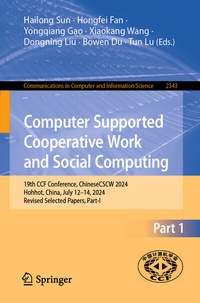
Computer Supported Cooperative Work and Social Computing
Description

This two part LNCS volumes constitutes the refereed proceedings of the 19th CCF Conference on Computer Supported Cooperative Work and Social Computing, ChineseCSCW 2024, held in Hohhot, China, in July 12-14, 2024.
The 52 full papers and 18 short papers included in this book were carefully reviewed and selected from 200 submissions. They were organized in topical sections as follows :
Part-I : Trend; CSCW and Social Computing, and Human-Machine-Things Fusion and Human-AI Collaborative Computing.
Part-II : Crowd Cooperative Computing and Evolutionary Computation, and Collaborative Data, Software and Services.
More details
Other editions
Additional editions
Persons
Content
.- Trend .
.- AISCW: Artificial Intelligence Supported Cooperative Work - The New Frontier of CSCW.
.- CSCW and Social Computing .
.- A Centrality-Guided Modularity Optimization Algorithm for Overlapping and Nested Community Detection in Opportunistic Networks.
.- Weakly Supervised Video Anomaly Detection Method based on Multi-scale Feature Fusion and Contrastive Loss.
.- Heterogeneous Information Network Embedding Based on Adaptive Meta-schema Considering Relation Distinction and Semantic Preservation.
.- RoleScan: Enhancing Social Bot Detection Using Social Role Vector.
.- Blockchain-based Traffic Accident Evidence Management Scheme.
.- Statistical Analysis of Human Mobility in Online Communities.
.- SFSGNN: Soft Feature Selection Graph Neural Network for Alleviating Data Sparsity in Click-Through Rate Prediction.
.- How Effective Is the Shorts Transformation of Traditional Media? An Analysis From the Perspective of User-Generated Content.
.- On the Prediction of Open Source Software Ecosystem Health Based on Time Series Analysis.
.- Knowledge Graph-Enhanced Session-Based Recommendation with Two-Stage Feature Filtering.
.- Interactive Programming Knowledge Tracing with Adversarial Training.
.- An Energy-Aware IoT Functions Offloading Strategy in Solar-Powered Edge Environment for Smart Agriculture.
.- Understanding the Use of Collaboration Tables in Crisis Response.
.- An Inference Method for Professional Texts with Computational Expressions under Few-shot Scenarios.
.- Who are the Blockchain Pioneers? A Framework for Measuring Scholars' Influence.
.- Adaptive DeepWalk and Prior-Enhanced Graph Neural Network for Scholar Influence Maximization in Social Networks.
.- Community-Aware Heterogeneous Graph Contrastive Learning.
.- UGCM-LU: A Unified Stream and Batch Graph Computing Model with Local Update for Community Detection.
.- D-FGNAE: Decentralized Federated Graph Normalized AutoEncoder.
.- Community Evolution Tracking Based on High-Order Neighbor Consideration and Node Change Identification.
.- NOBGP: A Novel Optimized Balanced Graph Partitioning Algorithm.
.- Secure and Efficient Federated Multi-Label Propagation via Secret Sharing.
.- Multi-UAVs Reconnaissance Task Assignment Based on GLS-IGA.
.- MEH-GNN: Meta-Path Enhanced Heterogeneous Graph Neural Network for Dual-Target Cross-Domain Recommendation.
.- Human-Machine-Things Fusion and Human-AI Collaborative Computing .
.- Meta-Instance Incorporated Chinese Composition Review Generation.
.- TEmory: A Temporal-Memory Approach to Weakly Supervised Colonic Polyp Frame Detection.
.- RGB+Skeleton: Cross-Modal Fusion Training for Human Action Recognition.
.- A Domain-Adapted Brain-Computer Interface for Implicit Emotion Tagging of Multimedia Content.
.- FuNEUA: An Intelligent Edge User Allocation Approach Based on Fuzzy Neural Networks.
.- A Class Incremental Network Based on Conditional Strategy for Personalized Feature Combination.
.- DeepSORT for Human and Cage Vehicle Tracking in Tobacco Logistics.
.- MindMemory: Augmented LLM with Long-Term Memory and Mental Personality.
.- FPSFT: Frame-Patch-Select Fusion Transformer for Action Recognition.
