

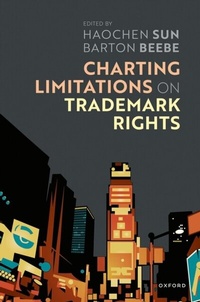
Charting Limitations on Trademark Rights
1st Edition
Published on 27. April 2023
336 pages
978-0-19-264470-1 (ISBN)
Description

Trademark scholarship has focused largely on the protection of trademark rights against consumer confusion and the dilution of trademarks. Studies of limitations on trademark rights, meanwhile, have remained relatively peripheral, especially in jurisdictions outside of the United States. However, this reality is incongruous with the importance of the limitations, such as descriptive and nominative uses, in promoting freedom of commerce, market competition, free speech, and cultural dynamics.
Against this backdrop, Charting Limitations on Trademark Rights is the first comprehensive academic volume detailing limitations in trademark rights from both theoretical and comparative perspectives. The book presents new theoretical perspectives to justify trademark rights limitations, re-examines the nature of these limitations, delineates the scope of the limitations, and offers comparative studies of the limitations.
With contributions from leading trademark scholars in the EU, US, and Asia, this is a must read for scholars, students, practitioners, and policymakers with an interest in the theories, policies, and doctrines of trademark law.
More details
Other editions
Additional editions
Haochen Sun | Barton Beebe
Charting Limitations on Trademark Rights
Book
05/2023
Oxford University Press
€121.50
Shipment within 15-20 days
Persons
Haochen Sun is Professor of Law at the University of Hong Kong. He specializes in intellectual property, technology law, and Chinese law. Haochen's opinions about intellectual property and technology law have appeared in numerous media outlets including BBC News, Forbes, The Los Angeles Times, The New York Times, South China Morning Post, Ming Pao, and The Wall Street Journal.
Barton Beebe is the John M. Desmarais Professor of Intellectual Property Law at NYU School of Law and co-Director of the Engelberg Center on Innovation Law & Policy at NYU. Previously, he has been the James S. Carpentier Visiting Professor of Law at Columbia Law School, the Anne Urowsky Visiting Professor of Law at Yale Law School, the Cheng Yu Tung Visiting Professor at The University of Hong Kong Faculty of Law, a Visiting Professor of Law at Stanford Law School, and a Visiting Research Fellow at Merton College, Oxford.
Content
- Introduction: Charting Limitations
- Part I: Justifications for Limitations
- 1: Mark McKenna: Externalizing Trademark's Limits
- 2: Jeanne Fromer: The Role of Creativity in Granting and Limiting Trademark Rights
- 3: David Tan: Logo Hacking, Downmarket Irony, Counterfeit Chic: A Study of Contemporary Fashion Trends and Their Implications for Trademark Law
- Part II: Nature of Limitations
- 4: Carys Craig: Gripe Sites and Trademark User Rights: Lessons from Canada's Cooperstock Case
- 5: Mark Lemley: Fame, Parody, and Policing in Trademark Law
- 6: Martin Senftleben: Safeguarding Freedom of Artistic Expression in the EU: Towards a Legal Presumption of Fair Use
- Part III: Scope of Limitations
- 7: Lionel Bently: Limitations on Pharmaceutical Trade Marks in Britain in the Twentieth Century
- 8: Robert G. Burrell: The Exceptional Nature of the Right to Control Use in Advertising
- 9: Michael Handler: : Reimagining Trade Mark Exhaustion: Does Australia's New Defence Offer a Way Forward?
- Part IV: Comparative Studies of Limitations
- 10: Haochen Sun: Creative Destruction of the Civil Law Tradition: Lessons from Chinese Trademark Law
- 11: Kung-Chung Liu: Limitations of Trademark Rights in Major Asian Jurisdictions
- 12: Arpan Banerjee: The Constitutional Basis for Trademark Parodies in India and South Africa
- 13: Christoph Rademacher and Roberto Carapeto: Trademark Parody under Japanese Trademark Law: Finding the Line of Japanese Humor
