

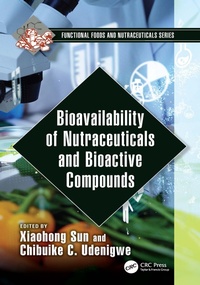
Bioavailability of Nutraceuticals and Bioactive Compounds
Published on 30. September 2025
284 pages
978-1-040-41637-2 (ISBN)
Description

Nutraceuticals and bioactive compounds are gaining increased attention from scientists, industry professionals, and consumers for their significant biological functions and health benefits beyond basic nutrition. Oral bioavailability is a key determinant of their physiological effects, making it essential to optimize their benefits and translate scientific discoveries into practical applications.
This comprehensive book provides an in-depth exploration of the bioavailability of nutraceuticals and bioactive compounds. It covers the fundamental principles, assessment methods, influencing factors, and strategies to enhance bioavailability. The book places particular emphasis on the individual forms of nutraceuticals and bioactive compounds. By bridging the gap between fundamental science and practical applications, it highlights cutting-edge research and emerging technologies in nutraceuticals and functional foods. What sets this book apart is its targeted focus on oral bioavailability, integrating perspectives from food science, biochemistry, and pharmacokinetics. It offers actionable insights and strategies to support the development of more effective nutraceuticals and dietary supplements.
This comprehensive book provides an in-depth exploration of the bioavailability of nutraceuticals and bioactive compounds. It covers the fundamental principles, assessment methods, influencing factors, and strategies to enhance bioavailability. The book places particular emphasis on the individual forms of nutraceuticals and bioactive compounds. By bridging the gap between fundamental science and practical applications, it highlights cutting-edge research and emerging technologies in nutraceuticals and functional foods. What sets this book apart is its targeted focus on oral bioavailability, integrating perspectives from food science, biochemistry, and pharmacokinetics. It offers actionable insights and strategies to support the development of more effective nutraceuticals and dietary supplements.
More details
Series
Language
English
Place of publication
London
United Kingdom
Publishing group
Taylor & Francis Ltd
Target group
Professional and scholarly
Adult education
Illustrations
13 Tables, black and white; 21 Line drawings, color; 11 Line drawings, black and white; 1 Halftones, color; 22 Illustrations, color; 11 Illustrations, black and white
File size
9,66 MB
ISBN-13
978-1-040-41637-2 (9781040416372)
Copyright in bibliographic data and cover images is held by Nielsen Book Services Limited or by the publishers or by their respective licensors: all rights reserved.
Schweitzer Classification
Other editions
Additional editions
Xiaohong Sun | Chibuike Udenigwe
Bioavailability of Nutraceuticals and Bioactive Compounds
Book
09/2025
1st Edition
CRC Press
€281.90
Shipment within 10-20 days
Persons
Dr. Xiaohong Sun is an Assistant Professor in the Department of Plant, Food, and Environmental Sciences at Dalhousie University, Faculty of Agriculture, Canada. She earned her Ph.D. in Food Science and Technology from the University of Alberta and has been recognized with prestigious awards, including the NSERC Postdoctoral Fellowship (2019) and the Nutrition and Mental Health Postdoctoral Fellowship (2021). Dr. Sun's research focuses on food-derived bioactive peptides, emerging processing technologies, food matrix interactions, and adding value to agro-food byproducts. She has published over 50 peer-reviewed articles in high-impact journals and contributed to five book chapters. In addition to her research achievements, Dr. Sun serves as the Editor of Food Chemistry X and Associate Editor of Food Chemistry International. She is also a member of the editorial boards for Food Chemistry and Food Reviews International.
Dr. Chibuike Udenigwe is a Full Professor and University Research Chair in Food Properties and Nutrient Bioavailability at the School of Nutrition Sciences, University of Ottawa, Canada, where he is also a Cross-appointed Professor at the Department of Chemistry and Biomolecular Sciences, and a Faculty Affiliate at the Institute for Science, Society and Policy. His research takes the chemical sciences approach in exploring food and health, with a focus on sustainable processing, alternative proteins, functional foods and nutraceuticals, especially bioactive peptides, functional biomaterials (peptide hydrogels, and protein-based nano-delivery systems and edible bioplastics), and their health effects. HIs interdisciplinary work focuses on advancing food science, technology and innovation at the food-health nexus towards achieving sustainable food systems. Professor Udenigwe is the Editor of the book, Food Proteins and Peptides: Emerging Biofunctions, Food and Biomaterial Applications (2021) and serves on several journal editorial boards. He is a Fellow of the African Academy of Sciences (AAS), a Fellow of the Royal Society of Chemistry (RSC), UK, and a Fellow of the Division of Agricultural and Food Chemistry, American Chemical Society (AGFD-ACS).
Dr. Chibuike Udenigwe is a Full Professor and University Research Chair in Food Properties and Nutrient Bioavailability at the School of Nutrition Sciences, University of Ottawa, Canada, where he is also a Cross-appointed Professor at the Department of Chemistry and Biomolecular Sciences, and a Faculty Affiliate at the Institute for Science, Society and Policy. His research takes the chemical sciences approach in exploring food and health, with a focus on sustainable processing, alternative proteins, functional foods and nutraceuticals, especially bioactive peptides, functional biomaterials (peptide hydrogels, and protein-based nano-delivery systems and edible bioplastics), and their health effects. HIs interdisciplinary work focuses on advancing food science, technology and innovation at the food-health nexus towards achieving sustainable food systems. Professor Udenigwe is the Editor of the book, Food Proteins and Peptides: Emerging Biofunctions, Food and Biomaterial Applications (2021) and serves on several journal editorial boards. He is a Fellow of the African Academy of Sciences (AAS), a Fellow of the Royal Society of Chemistry (RSC), UK, and a Fellow of the Division of Agricultural and Food Chemistry, American Chemical Society (AGFD-ACS).
Content
Chapter 1: Fundamental basis of absorption, distribution, metabolism, and excretion (ADME) of dietary compounds
Chapter 2: Methods for assessment of bioavailability of nutraceuticals
Chapter 3: Nutraceuticals' bioavailability: Impact of endogenous and exogenous factors
Chapter 4: Dual interactions between the gut microbiome and nutraceuticals
Chapter 5: The journey of phenolic compounds: From digestion to functionalization
Chapter 6: Bioavailability of resveratrol
Chapter 7: Metabolism and health benefits of quercetin: Recent advances in improving the bioavailability and bioactivity
Chapter 8: Recent advances in the bioaccessibility and bioavailability of bioactive peptides
Chapter 9: Bioavailability of carotenoids
Chapter 10: Bioavailability of bioactive lipids
Chapter 2: Methods for assessment of bioavailability of nutraceuticals
Chapter 3: Nutraceuticals' bioavailability: Impact of endogenous and exogenous factors
Chapter 4: Dual interactions between the gut microbiome and nutraceuticals
Chapter 5: The journey of phenolic compounds: From digestion to functionalization
Chapter 6: Bioavailability of resveratrol
Chapter 7: Metabolism and health benefits of quercetin: Recent advances in improving the bioavailability and bioactivity
Chapter 8: Recent advances in the bioaccessibility and bioavailability of bioactive peptides
Chapter 9: Bioavailability of carotenoids
Chapter 10: Bioavailability of bioactive lipids
