

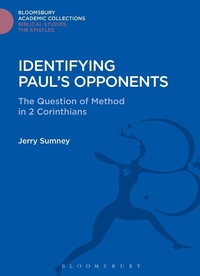
Identifying Paul's Opponents
The Question of Method in 2 Corinthians
1st Edition
Published on 29. January 2015
272 pages
978-1-4742-3091-9 (ISBN)
Description

To develop a method for identifying Paul's opponents it is first necessary to analyse procedures used by previous scholars. Too little attention has been paid in the past to issues of method, and many procedures have been used which violate the canons of historical research. In the first place, limits should be set upon the use of historical reconstructions and of external sources, and the determinative source for identifying the opponents of any letter must be that letter itself. Secondly, a satisfactory method will analyse passages within the primary text according to the nature of the section (e.g. polemical or didactic) and the types of statements they contain (e.g. explicit statements about opponents or allusions to them). Then each combination of context and statement type is evaluated to determine (1) how certain we can be about whether the passage refers to opponents and (2) how much distortion is likely to be present. The application of the proposed method to the two letters within 2 Corinthians indicates that Paul faced the same group of opponents in both letters. These opponents were pneumatics who demanded a particular manner of life as evidence that a person possesses the measure of the spirit which makes one an apostle.
More details
Series
Edition
1. Auflage
Language
English
Place of publication
London
United Kingdom
Publishing group
Bloomsbury Publishing PLC
Target group
Professional and scholarly
ISBN-13
978-1-4742-3091-9 (9781474230919)
Copyright in bibliographic data and cover images is held by Nielsen Book Services Limited or by the publishers or by their respective licensors: all rights reserved.
Schweitzer Classification
Other editions
Additional editions
Book
01/2015
Bloomsbury Academic
€192.70
Shipment within 15-20 days
Person
Jerry Sumney is Professor of Biblical Studies, Lexington Theological Seminary, Lexington, Kentucky.
Jerry L. Sumney is the Professor of Biblical Studies at Lexington Theological Seminary. He specializes in the historical-critical method of biblical interpretation and has written more than 40 articles and ten books on the Bible and New Testament texts including The Bible: An Introduction (Fortress 2010; third edition, 2021). He has contributed entries to the New Interpreter's Dictionary of the Bible and the Dictionary of the Later New Testament and Its Developments, and the Dictionary of Scripture and Ethics. He is a member of the Society of Biblical Literature and is past president for the Southeastern Region of the Society.
Jerry L. Sumney is the Professor of Biblical Studies at Lexington Theological Seminary. He specializes in the historical-critical method of biblical interpretation and has written more than 40 articles and ten books on the Bible and New Testament texts including The Bible: An Introduction (Fortress 2010; third edition, 2021). He has contributed entries to the New Interpreter's Dictionary of the Bible and the Dictionary of the Later New Testament and Its Developments, and the Dictionary of Scripture and Ethics. He is a member of the Society of Biblical Literature and is past president for the Southeastern Region of the Society.
Content
- Cover
- Contents
- Preface
- Chapter 1 INTRODUCTION
- PART I: A SURVEY OF THE METHODS USED TO IDENTIFY PAUL'S OPPONENTS
- Introduction
- Chapter 2 JUDAIZERS
- Chapter 3 GNOSTICS
- Chapter 4 DIVINE MEN
- Chapter 5 PNEUMATICS
- Chapter 6 CONCLUSION TO PART I
- PART II: PROPOSAL OF A SOUND METHOD FOR IDENTIFYING OPPONENTS
- Introduction
- Chapter 7 HISTORICAL RECONSTRUCTIONS
- Chapter 8. SOURCES OTHER THAN THE PRIMARY TEXT
- Chapter 9 ASSESSING PASSAGES WITHIN THE PRIMARY TEXT
- Chapter 10 CONCLUSION TO PART II
- PART III: APPLYING THE METHOD TO 2 CORINTHIANS
- Introduction
- Chapter 11 THE INTEGRITY OF 2 CORINTHIANS
- Chapter 12 2 CORINTHIANS 1-9
- Chapter 13 2 CORINTHIANS 10-13
- Chapter 14 CONCLUSION TO PART III
- Chapter 15 RESULTS
- Notes
- Select Bibliography
- Index of Biblical References
- Index of Authors
- A
- B
- C
- D
- E
- F
- G
- H
- J
- K
- L
- M
- N
- O
- P
- R
- S
- T
- V
- W
