

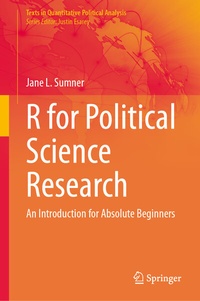
R for Political Science Research
Description

This text teaches basic R skills to political science students with no programming background. Intended specifically for the students who need to learn R for a class and who have no interest in R or may even be afraid of or hostile to it, this text builds an awareness of basics, confidence, and a skill set necessary to transition into more advanced texts.
To that end, in addition to standard topics, this book includes three chapters specific to the new or reluctant learner. The Introduction explicitly sets expectations for how to use the book and discusses fixed and growth mentalities, and why a growth mentality is crucial for learning R. Chapter 1 includes some basic information on programming, R, and their place in political science research. Chapter 2 explicitly discusses errors, warnings, and methods of debugging. Further chapters build on this by including new errors or warnings that students may encounter as they progress.
In service of the aim to give students a solid foundation in R and awareness of what it is and can do, this book teaches and uses both tidyverse and base R frameworks throughout. After completing the book, students should be prepared to learn more advanced materials.
More details
Other editions
Additional editions

Person
Jane Lawrence Sumner is an Associate Professor of Political Science at University of Minnesota, Twin Cities. She received her Ph.D. from Emory University in 2016. Her research focuses on the interactions between governments, companies, and the public. She's also interested broadly in measurement and data issues in political science. She is the author of 'The Cost of Doing Politics' (2022).
Content
.- 1 Introduction: How to use this book.
.- 2 Languages: Human and Computer.
.- 3 Installing and Setting Up R and RStudio.
.- 4 Getting Stuff Wrong.
.- 5 Types and Objects.
.- 6 Calculator.
.- 7 Functions and packages.
.- 8 Creating or Importing Data.
.- 9 Manipulating Data.
.- 10 Recoding, Leveling, and Cleaning.
.- 11 Describing data with numbers.
.- 12 Describing data with visuals.
.- 13 Cross-tabs and chi-squared tests, one- and two-sample t-tests.
.- 14 Linear Regression.
.- 15 Visualizing Results.
.- 16 Iteration.
.- 17 Bonus Material: Dealing with Text.
.- 18 Bonus Material: Web Scraping.
.- 19 Bonus Material: Presenting your results (RMarkdown).
.- 20 Bonus Material: Presenting your results (RShiny).
