

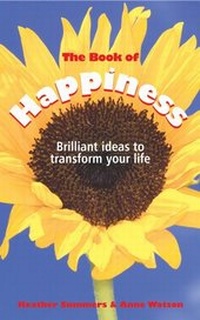
The Book of Happiness
Brilliant Ideas to Transform Your Life
1st Edition
Published on 19. January 2010
220 pages
978-1-907293-90-0 (ISBN)
Description

The acclaimed authors of The Book of Luck are back with somebrilliant ideas for bringing more happiness into your life.
The Book of Happiness is more than just a practical guide toimproving your happiness levels. It's a complete makeover, aimed atputting a spring in your step, and a permanent lift to yourspirits. We all know happiness is a state of mind, but few of usknow how to improve our share of it. Many people think thathappiness just comes out of nowhere. Not so. The reality is you cancreate your own happiness by choosing what you do, what you say,where you go, what you remember, who and what you surround yourselfwith, what you think and what you listen to.
The Book of Happiness kicks off with a Happiness Questionnaireto give you an instant snapshot of your current state of mind. Onceyou have scored yourself, you will learn the areas you need tofocus on. There is a workbook to complete at each key stage, aswell as stirring anecdotes, tips and happy thoughts to keep yougoing.
Just remember: it only takes 21 days to get rid of an unwantedhabit and to acquire a new one. Isn't it about time you got thehappiness habit?
Reviews / Votes
"...really make sense...." (Sunday Life, June 2006) "A book that's full of wisdom and common-sense ideas."(Prima, July 2006) "It's full of tips to lift your spirits and ensure you have ahappy New Year." (Slimming Worlds, December 2006)More details
Other editions
Additional editions

Book
04/2006
1st Edition
Capstone Publishing Ltd
€17.50
Shipment within 3-4 weeks
Persons
Heather Summers began her career with British Airways whereshe worked in a variety of sales, training and management rolesbefore leaving to run the training department at the then infamousLondon Borough of Islington. She was the first woman senior managerin Yorkshire Electricity, moving on from there to become ChiefExecutive of ABL (Bradford) Ltd. She is an experienced seniorexecutive and human resources consultant. She runs her ownsuccessful consultancy business specialising in training andpersonal growth coaching. Her qualifications include MBA, MasterPractitioner of NLP and a Diploma in Performance Coaching. She isalso qualified in psychometrics (Saville and Holdsworth Abilityand Personality tests - and Myers Briggs).
Anne- Watson spent 18 years building up a successfuland highly profitable research based headhunting business that wasfinally sold in March 1998. She now focuses on performancemanagement and performance enhancement consultancy. She runs LuckWorkshops with Heather Summers, challenging participants to takecharge of their own destiny and outperform their ownexpectations.
Content
About the Authors.
Acknowledgements.
Introduction: What is happiness and how to develop theHappiness Habit.
1 The Happiness Questionnaire.
2 The Stairway of Happiness.
3 Surroundings.
Creating an environment that will increase your happiness.
What we mean by Surroundings.
How your Surroundings affect your happiness.
Brilliant Ideas for improving your Surroundings and growing theHappiness Habit.
Workbook - practical actions you can take to increase theamount of happiness in your Surroundings. Take the HappinessChallenge!
4 Behaviour.
Changing what you do to create the Happiness Habit.
What we mean by Behaviour.
How your Behaviour affects your happiness.
Brilliant Ideas for improving your Behaviour and growing theHappiness Habit.
Workbook - practical actions to increase the amount ofhappiness that results from the things you do. Take the HappinessChallenge!
5 Skills and Capabilities.
Making the most of your talents and using them to develop newhappiness skills.
What we mean by Skills and Capabilities.
How your Skills and Capabilities affect your happiness.
Brilliant Ideas for improving your Skills and Capabilities togrow the Happiness Habit.
Workbook - practical actions you can take to make the mostof your Skills and Competencies and therefore increase yourhappiness. Take the Happiness Challenge!
6 Values and Beliefs.
Being true to what you value and believe so that it adds to thehappiness in your life.
What we mean by Values and Beliefs.
How Values and Beliefs affect your happiness.
Brilliant Ideas for living your life according to your trueValues and Beliefs - and therefore increasing yourhappiness.
Workbook - practical actions you can take to make the mostof the Values and Beliefs that work for you and which willresult in happiness. Take the Happiness Challenge!
7 Identity - Be Yourself.
Being yourself - seeing yourself for who you are and usingthis knowledge to get the happiness you truly deserve.
What we mean by Identity.
How your Identity affects your happiness.
Brilliant Ideas for getting to know who you are and to be happywithin yourself.
Workbook - practical actions you can take to increase theamount of happiness resulting from being true to yourself. Take theHappiness Challenge!
8 Purpose.
Being more than yourself - finding the path to the Purposeand meaning in your life.
What we mean by Purpose.
How your Purpose affects your happiness.
Brilliant Ideas for fi nding your Purpose in life and feelinghappy about why you are here.
Workbook - practical actions you can take to set a coursefor happiness in your life. Take the Happiness Challenge!
Appendix 1: Happiness and Work - Questionnaire.
Appendix 2: Lancaster University Research Findings.
Index.
2 The Stairway of Happiness 'And they all lived happily ever after.' The end of the fairy tale is the beginning of life and this is where we are picking up the tale. A fairy tale assumes that happiness is an automatic follow on and an automatic right. Undiluted happiness in a cloudless sky with none of the problems of everyday life to cast a shadow - that's the world of fairy tales. The fairy-tale version of happiness does not match reality as most of us know it. Happiness comes and goes; sometimes it is more intense than others. Unhappiness can overshadow your life and it can infiltrate all areas. It can prevent you from experiencing pleasure. For example, if you are unhappy you are unlikely to appreciate many of the little things that would normally brighten your day such as the sun shining, or a special meal, the flowers in the window box, music on the radio, the company of a good friend. What is making you unhappy overshadows everything else in your life. It gains a momentum and an importance that is often disproportionate. Sadness is different to unhappiness. Sadness is part of life and we experience it as a result of difficult life events such as bereavement. If only we had a formula for happiness we could increase our level of happiness and decrease our level of unhappiness. How would it be if you could have more control over how happy you are day to day, week to week, month to month and year to year? This book is the best investment of your life but only if you follow our formula for it and commit to the actions we suggest. It takes 21 days to change a habit so think how happy you will be in three weeks time. Anthony lives in a new second-floor flat. One day he called his friend Howard and asked him if he would help him transport a wardrobe that he was going to buy in IKEA back to his flat and carry it up the stairs, as there was no lift in the building. They went to IKEA together and brought back the wardrobe, which was in typical IKEA flat-pack style. Howard said he would be glad to do it in exchange for a pint but made it very clear that he was not a natural DIY person and was allergic to flat packs. He said he would help him get the flat pack into the room and then the rest was up to him. Anthony agreed. A week later Howard called Anthony and asked if his wardrobe was all right. Anthony said, 'It's not up yet.' Howard asked why not and he said, 'Well it says on the box "self assembly" and nothing has happened so far.' You will find it is just the same with this book. Happiness does not assemble itself automatically. All the components are here for you to construct your own happiness. There are six clearly identifiable and separate Steps to happiness, which make up the Stairway of Happiness. Each Step is separate and unique; however, each is linked to all the others like all stairways. The reason for being on a stairway is because you are going somewhere. In this case your ultimate destination is happiness. By understanding what happiness means at each Step and by taking action to address the personal issues you identify, you will be using your own personal power to take control of and build your own happiness. This is not a moving escalator. To reach where you want to go you have to keep moving and that requires energy and effort. To increase your happiness or decrease your unhappiness, you need to do more than read a good book. Being happy includes getting rid of the attitudes and habits that are getting in your way. The Stairway of Happiness will help you identify those areas that you need to change and will show you how you can go about it. In addition, by using our Brilliant Ideas and the Workbook included in each chapter you will find hundreds of different ways to appreciate and make the most of all the things that already form part of your overall happiness. An exciting 21 days lie ahead - increased happiness is on the horizon.
You don't have to climb the Stairway from the bottom up. You can start where you want and read the chapters in any order. As you have already done the Happiness Questionnaire in Chapter 1 or the online version on our website www.switchtosuccess. co.uk you will have an idea of where you can make the greatest strides in the shortest time. You will have already have read the full definition of each Step at the end of Chapter 1. Use this to decide your starting point.
Louise Your Surroundings are everything you see, hear and feel when you look around you. It's your environment and the results you're getting. After 23 years of marriage, Louise's parents suddenly separated and divorced. The family home was sold and her parents each had a smaller flat, her mother in her home town and her father 50 miles away. Louise was extremely upset by the split and although she had the choice of living with either parent, she decided to leave school. She found a job in a hotel 150 miles away and was given a small room in an annexe of the hotel. The change from living in a family home was traumatic. She missed the family meals, the relaxing atmosphere of the house and all the comforts of home. She was miserable. Because of her difficulty in adjusting to the radical change in her Surroundings, Louise is unhappy. She needs to do something differently as the situation is unlikely to change of its own accord. In order to change she needs to move to Step 2 on the Stairway of happiness and take some action.
Philip Behaviour includes what you do, how you do it, who you do it with and how others behave with you. It's also about what you think, what you say and how you say it. Philip taught English at the local comprehensive school. He had moved into teaching straight from college, sure that he would love the job and make a difference to young people's lives. Fourteen years later he was disenchanted and disillusioned. Money was tight and he was struggling to maintain his wife and two children. Every day he dreaded going to work, feeling he was making no difference. All he was doing was working longer hours and getting more stressed. He hated his job. He felt he had no choice but to continue as a teacher to pay the mortgage. He was not qualified to do anything else. He had to continue. If Philip does nothing to change his behaviour, he will be sentenced to a lifetime in a job he now loathes. He runs the risk of ill health, depression and unhappiness. In order to change his circumstances, perhaps Philip needs to look at the Step above and assess what skills and capabilities he has and see what opportunities they might offer to change his life and increase his happiness.
Ben Skills and Capabilities are all the talents you have, or could have, given the opportunity. Ben comes from a good home with loving parents. He left school with good exam results and his parents fully expected him to go on and get a good job. He decided to take a year out to go travelling. He went off backpacking round Australia, working in bars and having fun. One year stretched to two, this time going to South America, living on a shoe string and finding life a little tougher. When he got back home, he got a job in a supermarket and was saving to go off to the Far East for another year. Ben was in perpetual motion. Was he happy? When asked, Ben simply said that he felt restless. He knew he had many skills that would get him a well paid job but something was holding him back. Ben had never really tested himself and found out what he was capable of. None of the jobs he had done stretched him so he had lost the confidence to aim higher. It was easier to carry on as he was. In order to change he would need to look at the Step above to find out which of his beliefs and attitudes was holding him back.
Joanne Values and beliefs are the programming, power, motivation and energy behind your actions. Joanne had an unhappy childhood and married young, delighted to escape from her home. Her husband Rob was good looking, had a good job and was fun to be around. It was after the birth of her last child that the violence started. At first it was only verbal abuse but it soon escalated into punches and kicks. Rob told her often that that she was hopeless and a failure and she believed it to be true. Her close friends urged her to leave and take the children with her but she never did. It was not a question of courage; Joanne somehow believed that it was her fault and therefore perhaps violence was part and parcel of the relationship. She did not value herself highly. This belief would have to change if she was to assert herself and her own rights. This could only be done by moving one Step up on the Stairway of Happiness to feel good about herself and who she was.
Michael Identity is about acknowledging your roots and accepting yourself for who you are. Michael had known from a very early age that he was adopted. He loved his adoptive parents dearly yet he was different from them in so many ways. They were both quiet bookish types whereas he was a practical person who loved sport and mixing with people. As time went on he felt the need to discover his genetic roots to find out who he really was. After...
The Stairway of Happiness
You don't have to climb the Stairway from the bottom up. You can start where you want and read the chapters in any order. As you have already done the Happiness Questionnaire in Chapter 1 or the online version on our website www.switchtosuccess. co.uk you will have an idea of where you can make the greatest strides in the shortest time. You will have already have read the full definition of each Step at the end of Chapter 1. Use this to decide your starting point.
People on the Steps
Step 1 - Surroundings
Louise Your Surroundings are everything you see, hear and feel when you look around you. It's your environment and the results you're getting. After 23 years of marriage, Louise's parents suddenly separated and divorced. The family home was sold and her parents each had a smaller flat, her mother in her home town and her father 50 miles away. Louise was extremely upset by the split and although she had the choice of living with either parent, she decided to leave school. She found a job in a hotel 150 miles away and was given a small room in an annexe of the hotel. The change from living in a family home was traumatic. She missed the family meals, the relaxing atmosphere of the house and all the comforts of home. She was miserable. Because of her difficulty in adjusting to the radical change in her Surroundings, Louise is unhappy. She needs to do something differently as the situation is unlikely to change of its own accord. In order to change she needs to move to Step 2 on the Stairway of happiness and take some action.
Step 2 - Behaviour
Philip Behaviour includes what you do, how you do it, who you do it with and how others behave with you. It's also about what you think, what you say and how you say it. Philip taught English at the local comprehensive school. He had moved into teaching straight from college, sure that he would love the job and make a difference to young people's lives. Fourteen years later he was disenchanted and disillusioned. Money was tight and he was struggling to maintain his wife and two children. Every day he dreaded going to work, feeling he was making no difference. All he was doing was working longer hours and getting more stressed. He hated his job. He felt he had no choice but to continue as a teacher to pay the mortgage. He was not qualified to do anything else. He had to continue. If Philip does nothing to change his behaviour, he will be sentenced to a lifetime in a job he now loathes. He runs the risk of ill health, depression and unhappiness. In order to change his circumstances, perhaps Philip needs to look at the Step above and assess what skills and capabilities he has and see what opportunities they might offer to change his life and increase his happiness.
Step 3 - Skills
Ben Skills and Capabilities are all the talents you have, or could have, given the opportunity. Ben comes from a good home with loving parents. He left school with good exam results and his parents fully expected him to go on and get a good job. He decided to take a year out to go travelling. He went off backpacking round Australia, working in bars and having fun. One year stretched to two, this time going to South America, living on a shoe string and finding life a little tougher. When he got back home, he got a job in a supermarket and was saving to go off to the Far East for another year. Ben was in perpetual motion. Was he happy? When asked, Ben simply said that he felt restless. He knew he had many skills that would get him a well paid job but something was holding him back. Ben had never really tested himself and found out what he was capable of. None of the jobs he had done stretched him so he had lost the confidence to aim higher. It was easier to carry on as he was. In order to change he would need to look at the Step above to find out which of his beliefs and attitudes was holding him back.
Step 4 - Beliefs
Joanne Values and beliefs are the programming, power, motivation and energy behind your actions. Joanne had an unhappy childhood and married young, delighted to escape from her home. Her husband Rob was good looking, had a good job and was fun to be around. It was after the birth of her last child that the violence started. At first it was only verbal abuse but it soon escalated into punches and kicks. Rob told her often that that she was hopeless and a failure and she believed it to be true. Her close friends urged her to leave and take the children with her but she never did. It was not a question of courage; Joanne somehow believed that it was her fault and therefore perhaps violence was part and parcel of the relationship. She did not value herself highly. This belief would have to change if she was to assert herself and her own rights. This could only be done by moving one Step up on the Stairway of Happiness to feel good about herself and who she was.
Step 5 - Identity
Michael Identity is about acknowledging your roots and accepting yourself for who you are. Michael had known from a very early age that he was adopted. He loved his adoptive parents dearly yet he was different from them in so many ways. They were both quiet bookish types whereas he was a practical person who loved sport and mixing with people. As time went on he felt the need to discover his genetic roots to find out who he really was. After...
