

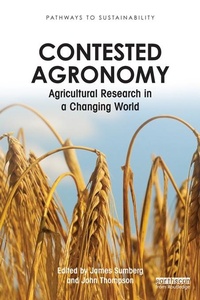
Contested Agronomy
Agricultural Research in a Changing World
1st Edition
Published on 15. March 2012
232 pages
978-1-136-45026-6 (ISBN)
Description

The dramatic increases in food prices experienced over the last four years, and their effects of hunger and food insecurity, as well as human-induced climate change and its implications for agriculture, food production and food security, are key topics within the field of agronomy and agricultural research. Contested Agronomy addresses these issues by exploring key developments since the mid-1970s, focusing in particular on the emergence of the neoliberal project and the rise of the participation and environmental agendas, taking into consideration how these have had profound impacts on the practice of agronomic research in the developing world especially over the last four decades. This book explores, through a series of case studies, the basis for a much needed 'political agronomy' analysis that highlights the impacts of problem framing and narratives, historical disjunctures, epistemic communities and the increasing pressure to demonstrate 'success' on both agricultural research and the farmers, processors and consumers it is meant to serve.
Whilst being a fascinating and thought-provoking read for professionals in the Agriculture and Environmental sciences, it will also appeal to students and researchers in agricultural policy, development studies, geography, public administration, rural sociology, and science and technology studies.
Whilst being a fascinating and thought-provoking read for professionals in the Agriculture and Environmental sciences, it will also appeal to students and researchers in agricultural policy, development studies, geography, public administration, rural sociology, and science and technology studies.
Reviews / Votes
"Explored through compelling case studies, this book is a gripping account of the recent history of agronomy and agricultural research, and how these disciplines have been shaped by emerging challenges such as climate change, erratic weather, and increasing food prices." - Prof. Judi W Wakhungu, Executive Director African Centre for Technology Studies"This is an important and necessary book. For too long agronomy has been used as a means to increase productivity of only a few crops responsive to high inputs. By contextualizing the science economically, socially and politically, we learn of its potential as a system science that can serve more than the stockholders of major input providers" - Professor Cornelia Flora - Iowa State University
"It has been a long time since there was consensus in agricultural development approaches. Contested Agronomy lays out the difference between different practitioner groups and marks an important step forward in the continuing dialogue" - Dr Tom Remington, Principal Agriculture Advisor, Catholic Relief Services
"Contested Agronomy shows how much both the technical questions asked by practitioners and the broader questions asked by supporters of and detractors from agronomic research have changed over the past several decades. Moreover, it asks tough questions about the contested politics that drive particular research agendas globally. Not only agronomists, but anyone interested in the future provision of food should read this book" - Lawrence Busch, Michigan State University
"This book is a much needed contribution to the discourse on science in society and a challenge to agricultural scientists. Previously the invention of 'political ecology' has provided a focus for scholars from different academic disciplines to explore understandings derived from environmental science and to relate them to the needs of society. In this book we are presented with a much needed 'political agronomy' analysis which enables us to ask how we can make agricultural science respond better to the needs of society as we grapple with problems of future food security. I congratulate the authors in occupying the challenging interdisciplinary space of science in society and providing us with evidence to inform the debate on the complexities surrounding agricultural research and sustainable development" - John Gowing, Reader in Agricultural Water Management, Newcastle University
A book for all those involved at the heart of agricultural research.If you think themes such as Biofortification and Conservation Agriculture are driven mainly by technical discussions, think again. Development policy, vested interests and even religion may also mould how investigation unfolds. The book's main message: how to get Research back on course - Prof. Louisa Sperling, Principal Researcher, International Center for Tropical Agriculture
More details
Series
Language
English
Place of publication
London
United Kingdom
Publishing group
Taylor & Francis Ltd
Target group
College/higher education
Illustrations
12 s/w Tabellen
12 Tables, black and white
File size
2,63 MB
ISBN-13
978-1-136-45026-6 (9781136450266)
Copyright in bibliographic data and cover images is held by Nielsen Book Services Limited or by the publishers or by their respective licensors: all rights reserved.
Schweitzer Classification
Other editions
Additional editions
Book
03/2012
1st Edition
Routledge
€54.40
Shipment within 15-20 days
Book
03/2012
Routledge
€240.80
Shipment within 15-20 days
Persons
James Sumberg is Research Fellow in the Knowledge, Technology and Society Team at the Institute of Development Studies (IDS) and a member of the STEPS Centre, University of Sussex, UK.
John Thompson is Research Fellow in the Knowledge, Technology and Society Team at the Institute of Development Studies (IDS) and a member of the STEPS Centre, University of Sussex, UK.
John Thompson is Research Fellow in the Knowledge, Technology and Society Team at the Institute of Development Studies (IDS) and a member of the STEPS Centre, University of Sussex, UK.
Content
1. Contested Agronomy: Agricultural Research in a Changing World 2. On Heretics and God's Blanket Salesmen: Contested Claims for Conservation Agriculture and the Politics of its Promotion in African Smallholder Farming 3. Conservation Agriculture-Based Technologies and the Political Economy: Lessons from South Asia 4. Anthropogenic Dark Earths and Africa: A Political Agronomy of Research Disjunctures 5. Contestation as Continuity? Biofortification Research and the CGIAR 6. Water in African Agronomy 7. Understanding Agricultural Intensification on a Forest Frontier in Madagascar: Elements of a Malthusian/Boserupian Synthesis 8. Alternative Configurations of Agronomic Experimentation 9.'This Field is our Church': The Social and Agronomic Challenges of Knowledge Generation in a Participatory Soil Fertility Management Project 10. Contesting Agronomy through Dissent: Experiences from India 11. Success-Making and Success Stories: Agronomic Research in the Spotlight 12. Nullius In Verba: Contestation, Pathways and Political Agronomy
