

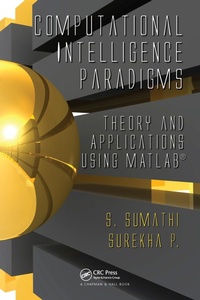
Computational Intelligence Paradigms
Theory & Applications using MATLAB
Published on 5. January 2010
851 pages
978-1-4398-0903-7 (ISBN)
Description

Offering a wide range of programming examples implemented in MATLAB, Computational Intelligence Paradigms: Theory and Applications Using MATLAB presents theoretical concepts and a general framework for computational intelligence (CI) approaches, including artificial neural networks, fuzzy systems, evolutionary computation, genetic algorithms and pr
More details
Language
English
Place of publication
Baton Rouge
United States
Publishing group
Taylor & Francis Inc
Target group
Professional and scholarly
Researchers and graduate students in computational intelligence, machine learning, and fuzzy systems; electronic and electrical engineers.
Illustrations
202 s/w Abbildungen, 65 s/w Tabellen
202 b/w images and 65 tables
File size
12,06 MB
ISBN-13
978-1-4398-0903-7 (9781439809037)
Copyright in bibliographic data and cover images is held by Nielsen Book Services Limited or by the publishers or by their respective licensors: all rights reserved.
Schweitzer Classification
Other editions
Additional editions
S. Sumathi | Surekha Paneerselvam
Computational Intelligence Paradigms
Theory & Applications using MATLAB
Book
10/2019
1st Edition
CRC Press
€97.90
Shipment within 15-20 days
S. Sumathi | Surekha Paneerselvam
Computational Intelligence Paradigms
Theory & Applications using MATLAB
Book
01/2010
1st Edition
CRC Press
€204.27
Shipment within 15-20 days
Persons
S. Sumathi is an assistant professor in the Department of Electrical and Electronics Engineering at PSG College of Technology, Coimbatore, India. Her research interests include neural networks, fuzzy systems, genetic algorithms, pattern recognition and classification, data warehousing and mining, operating systems, and parallel computing.
Surekha Paneerselvam is a lecturer in the Department of Electronics and Communication Engineering at Adhiyamaan College of Engineering, Hosur, India. Her research interests include robotics, virtual instrumentation, mobile communication, and computational intelligence.
Surekha Paneerselvam is a lecturer in the Department of Electronics and Communication Engineering at Adhiyamaan College of Engineering, Hosur, India. Her research interests include robotics, virtual instrumentation, mobile communication, and computational intelligence.
Content
Computational Intelligence. Artificial Neural Networks with MATLAB. Artificial Neural Network Architectures and Algorithms. Classification and Data Association Neural Networks. MATLAB Programs to Implement Neural Networks. MATLAB-Based Fuzzy Systems. Fuzzy Inference and Expert Systems. MATLAB Illustrations on Fuzzy Systems. Neuro-Fuzzy Modeling. Neuro-Fuzzy Modeling Using MATLAB. Evolutionary Computation Paradigms. Evolutionary Algorithms Implemented Using MATLAB. MATLAB-Based Genetic Algorithm. Genetic Programming with MATLAB. MATLAB-Based Swarm Intelligence. Appendices. Bibliography.
