

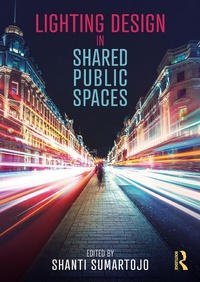
Lighting Design in Shared Public Spaces
1st Edition
Published on 12. May 2022
238 pages
978-1-000-56617-8 (ISBN)
Description

This book advocates an approach to lighting design that focuses on how people experience illumination. Lighting Design in Shared Public Spaces contextualises light, dark and lighting design within the settings, sensations, ideas and imaginaries that form our understandings of ourselves and the world around us.
The chapters in this collection bring a new perspective to lighting design, arguing for an approach that addresses how lighting is experienced, understood and valued by people. Across a range of new case studies from Australia, Germany, Denmark, and the United Kingdom, the authors account for lighting design's crucial role in shaping our dynamic and messy experiential worlds. With many turning to innovative ethnographic methodologies, they powerfully demonstrate how feelings of comfort, safety, security, vulnerability, care and well-being can configure in and through how people experience and manipulate light and dark. By focusing on how lighting is improvised, arranged, avoided and composed in relation to the people and things it acts upon, the book advances understandings of lighting design by showing how improved experiences of the built environment can result from more sensitive and context-specific illumination.
The book is intended for social scientists who are interested in the lit or sensory world, as well as designers, architects, urban planners and others concerned with how the experience of light, dark and lighting might be both better understood and implemented in our shared public spaces.
The chapters in this collection bring a new perspective to lighting design, arguing for an approach that addresses how lighting is experienced, understood and valued by people. Across a range of new case studies from Australia, Germany, Denmark, and the United Kingdom, the authors account for lighting design's crucial role in shaping our dynamic and messy experiential worlds. With many turning to innovative ethnographic methodologies, they powerfully demonstrate how feelings of comfort, safety, security, vulnerability, care and well-being can configure in and through how people experience and manipulate light and dark. By focusing on how lighting is improvised, arranged, avoided and composed in relation to the people and things it acts upon, the book advances understandings of lighting design by showing how improved experiences of the built environment can result from more sensitive and context-specific illumination.
The book is intended for social scientists who are interested in the lit or sensory world, as well as designers, architects, urban planners and others concerned with how the experience of light, dark and lighting might be both better understood and implemented in our shared public spaces.
Reviews / Votes
"This book responds to the important and urgent need to improve our understanding of lighting design and its application in built environments. By examining the experiential, complex relationships we have with light, it illustrates new interdisciplinary ways for conceptualizing and designing lighting towards a more sensitive and context-specific practice."Nick Dunn, Executive Director, ImaginationLancaster
"This is a major book that provides an original alternative to the ideology of full light and to the dominance of technology in lighting design. By developing an atmospheric conceptual framework, this collective work subtly explores the diversity and complexity of the everyday lit world. This book will undoubtedly become a reference work."
Jean-Paul Thibaud, CNRS Research Director, ENSA Grenoble
"Everyday has been turned on its head as a result of the pandemic. This has presented an opportunity for most people to realize how crucial light is in modulating their experiences - from a video call to their sleep-wake cycles to shifting an atmosphere from an office setting to a relaxing evening. We have all been confronted with the need to engage
with light in new ways and intentionally shape how it affects us. Sumartojo's powerful collection provides new tools and frameworks for designers, researchers and others to take their practices and experiences to the next level."
Dr. Suzanne Seitinger, President of the Illuminating Engineering Society; Director of Public Sector Marketing at Verizon
More details
Edition
1. Auflage
Language
English
Place of publication
London
United Kingdom
Publishing group
Taylor & Francis Ltd
Target group
Professional and scholarly
College/higher education
Illustrations
2 Line drawings, color; 46 Halftones, color; 48 Illustrations, color
ISBN-13
978-1-000-56617-8 (9781000566178)
Copyright in bibliographic data and cover images is held by Nielsen Book Services Limited or by the publishers or by their respective licensors: all rights reserved.
Schweitzer Classification
Other editions
Additional editions
Shanti Sumartojo
Lighting Design in Shared Public Spaces
Book
05/2022
1st Edition
Routledge
€282.25
Shipment within 10-20 days
Shanti Sumartojo
Lighting Design in Shared Public Spaces
Book
05/2022
1st Edition
Routledge
€64.55
Shipment within 10-20 days
Person
Shanti Sumartojo is Associate Professor of Design Research in the Faculty of Art, Design and Architecture, and a member of the Emerging Technologies Research Lab at Monash University. Grounded in human geography, and with a strong commitment to interdisciplinary and collaborative scholarship, her research includes theoretically informed inquiry into how people experience design and technology in their surroundings, particularly in shared, public spaces. Her recent books include Atmospheres and the Experiential World (2018) and Geographies of Commemoration in a Digital World (2021).
Content
1. Light, dark and lighting design for shared public spaces: new perspectives on experiences of the lit world Shanti Sumartojo 2. Illuminating experiences: lighting design as an epistemic approach Nona Schulte-Roemer 3. Light and Value: A Design Anthropology of Light and Wellbeing in Hospital Building Sarah Pink, Melisa Duque, Shanti Sumartojo and Laurene Vaughan 4. The Midwifery Feel of Light Stine Louring Nielsen 5. Perceptions of safety in cities after dark Hoa Yang, Jess Berry and Nicole Kalms 6. How the city feels: workshopping lighting design in public space Shanti Sumartojo 7. At the margins of attention: Security lighting and luminous art interventions in Copenhagen Mikkel Bille and Olivia Norma Jorgensen 8. Lights out? Lowering urban lighting levels and increasing atmosphere at a Danish tram station Mette Hvass, Karen Waltorp and Ellen Kathrine Hansen 9. Towers for the night Casper Laing Ebbensgaard 10. Dark Designs: Creating Shadow, Gloomy Spaces and Enchanting Light Tim Edensor
