

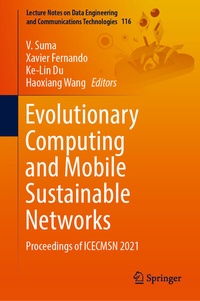
Evolutionary Computing and Mobile Sustainable Networks
Description

This book mainly reflects the recent research works in evolutionary computation technologies and mobile sustainable networks with a specific focus on computational intelligence and communication technologies that widely ranges from theoretical foundations to practical applications in enhancing the sustainability of mobile networks. Today, network sustainability has become a significant research domain in both academia and industries present across the globe. Also, the network sustainability paradigm has generated a solution for existing optimization challenges in mobile communication networks. Recently, the research advances in evolutionary computing technologies including swarm intelligence algorithms and other evolutionary algorithm paradigms are considered as the widely accepted descriptors for mobile sustainable networks virtualization, optimization, and automation. To deal with the emerging impacts on mobile communication networks, this book discusses about the state-of-the research works on developing a sustainable design and their implementation in mobile networks.
With the advent of evolutionary computation algorithms, this book contributes varied research chapters to develop a new perspective on mobile sustainable networks.
More details
Other editions
Additional editions
Persons
Dr. Suma. V has obtained her B.E. in Information Science and Technology, M.S. in Software Systems, and her Ph.D. in Computer Science and Engineering. She has a vast experience of more than 17 years of teaching. She has published more than183 international publications which include her research articles published in world class international journals such as ACM, ASQ, Crosstalk, IET Software, and International journals from Inderscience publishers, from journals released in MIT, Darmout, USA, etc. Her research results are published in NASA, UNI trier, Microsoft, CERN, IEEE, ACM portals, Springer, and so on.
Dr. Xavier Fernando is Director of Ryerson Communications Lab that has received total research funding of $3,185,000.00 since 2008 from industry and government (including joint grants). He has (co-)authored over 200 research articles, three books (one translated to Mandarin), and several chapters and holds few patents. The present and past members and affiliates of this laboratory can be found at this LinkedIn group and Facebook page. He was IEEE Communications Society Distinguished Lecturer and has delivered over 50 invited talks and keynote presentations all over the world. He was Member in the IEEE Communications Society (COMSOC) Education Board Working Group on Wireless Communications. He was Chair of IEEE Canada Humanitarian Initiatives Committee 2017-18. He was also Chair of the IEEE Toronto Section and IEEE Canada Central Area.
Dr. Ke-Lin Du received a Ph.D. degree in electrical engineering from Huazhong University of Science and Technology (HUST) with a thesis on artificial intelligence and robotics in 1998. Currently, Ke-Lin Du is Member of editorial board of IEEE Spectrum Chinese Edition and is Associate Editor of IET Signal Processing and Circuits, Systems & Signal Processing. Ke-Lin Du also served on program committees of dozens of international conferences. His current research interest is in signal processing for wireless communications, machine learning, and intelligent systems. On February 14, 2018, Ke-Lin Du was included in Marquis Who's Who for professional excellence.
Dr. Haoxiang Wang is currently Director and Lead Executive Faculty Member of GoPerception Laboratory, NY, USA. His research interests include multimedia information processing, pattern recognition and machine learning, remote sensing image processing and data-driven business intelligence. He has co-authored over 60 journal and conference papers in these fields on journals such as Springer MTAP, Cluster Computing, SIVP; IEEE TII, Communications Magazine; Elsevier Computers & Electrical Engineering, Computers, Environment and Urban Systems, Optik, Sustainable Computing: Informatics and Systems, Journal of Computational Science, Pattern Recognition Letters, Information Sciences, Computers in Industry, Future Generation Computer Systems; Taylor & Francis International Journal of Computers and Applications and conference such as IEEE SMC,ICPR, ICTAI, ICICI, CCIS, and ICACI. He is Guest Editor for IEEE Transactions on Industrial Informatics, IEEE Consumer Electronics Magazine, Multimedia Tools and Applications, MDPI Sustainability, International Journal of Information and Computer Security, Journal of Medical Imaging and Health Informatics, and Concurrency and Computation: Practice and Experience.
