

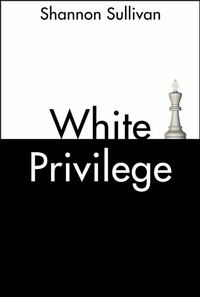
White Privilege
Description

Some embrace the idea of white privilege as an important concept that helps us to make sense of the connection between race and social and political disadvantages, while others are critical or even hostile. Regardless of personal views, it can be difficult to agree on what 'white privilege' even means.
Philosopher Shannon Sullivan cuts through the confusion and cross-talk to challenge what 'everybody knows' about white privilege. Using real-life examples, she offers a candid assessment of the advantages and disadvantages of the term, to present a better understanding of how race functions in our societies. She argues that white privilege is about more than race, that not only white people can have white privilege, and that feeling guilty about privilege can have a negative effect on the very people you feel guilty towards. In the end, she offers practical solutions for eliminating white privilege and building a fairer society.
Sullivan's forcefully argued book will inspire you to think again about white privilege and what it entails.
More details
Other editions
Additional editions
Person
Content
1 "White privilege is only about race"
2 "Only white people have white privilege"
3 "White people should feel guilty"
4 "White people should figure out how to get rid of their white privilege"
5 "White people should figure out how to help people of color"
References
1
"White privilege is only about race"
Nothing could seem more obvious than the belief that white privilege is about race. Isn't white privilege about white people having unfair advantages because of their whiteness? Take the example of white people's ability to browse in a department store without being tailed by undercover security guards. Black people in the United States often report being surreptitiously followed in public spaces such as this, treated as implicitly criminal, while white people generally do not have that experience. Isn't this an example of social advantage that white people have over Black people because of their different races?
The answer is "yes" in that white people's race is an important factor in white privilege. But it also is "no" in that white privilege is just as much about the middle-to-upper-class privilege of certain white people as it is about their race. We misunderstand white privilege if we try to separate race and class to focus only on race. Many examples of white privilege are better understood as white class privilege. We should not assume that poor and working-class white people benefit from white privilege in the same ways that middle-to-upper-class white people do.
That does not mean, however, that poor and working-class white people never benefit from their whiteness. We misunderstand white privilege in the opposite way if we reduce race to class and think that white privilege is really only about economic and educational privilege. When it comes to white privilege, race and class are inevitably entangled. They cannot be reduced to each other, and this holds true not just for white people but also for people of color. (More on people of color and white privilege in the next chapter.) This chapter focuses on the tangle of race and class in white people's lives and demonstrates how white privilege is not just about whiteness.
White privilege tends to be found in places and spaces where laws don't apply. Benefitting from white privilege generally is not illegal, in other words, and that's one of the things that gives it so much power. It operates outside explicit legal codification. This makes white privilege different from the racial advantages that white people had when discrimination against Black people and other people of color was legal, as it was in the United States, South Africa, and other countries well into the latter half of the twentieth century. There were laws explicitly naming race that could be fought or defended or whatever-but in any case, it was clear that they existed. They could be identified, pointed to, reckoned with.
That all changed with the end of Jim Crow, apartheid, and other laws legalizing racial discrimination and segregation. When it became illegal to grant social, educational, financial, and other advantages to white people, white people's racial advantages became more difficult to identify. Many white people thought that perhaps those advantages really had been eliminated and the new laws were working to ensure equal opportunity no matter what one's race. (Note that I did not say "equality," as if the new laws assumed that all individuals and their aptitudes were the same. This sometimes is how anti-discrimination laws are criticized, even ridiculed, for allegedly operating with a fundamental misunderstanding of human nature.) For example, it could easily seem that equal opportunity for all races was achieved in the United States in the 1950s and 1960s if you are looking for racial advantages and disadvantages in their old forms. Black people don't have to ride at the back of the bus or use "colored" water fountains anymore. But looking for racial advantage in that form today as evidence of white privilege is like looking for horse-drawn carriages on the highway as evidence of transportation. There isn't anything there. Or so it might seem-because what you are looking for is a barrier to seeing what is there. Just as there are all kinds of horsepower on roads today that don't look like the horsepower of yesteryear, there are all kinds of implicit white privileges that don't look like the legalized white advantages and open white supremacy of yesterday. Of course, there still are examples of open white supremacy to be found today, just as there still are horse-drawn carriages on some roads. That does not change the fact that for the most part, white racial advantage has radically-and deceptively-changed its form. This is how it has survived, how it has ensured its ongoing existence amid a great deal of social change.
What do those implicit, extralegal racial privileges look like? Consider two real-life examples that recently happened to me or to people I know:
- I was pulled over in my hometown for speeding one recent Sunday afternoon, driving an older hybrid SUV and dressed in jeans, looking like a harried suburban mom rushing to the grocery store between the kids' events (which I was). While I didn't realize the extent to which I was speeding-57 mph on a road that had dropped from 55 mph to 35 mph some distance back from where I was-I instantly knew what the problem was when I saw the officer's flashing lights behind me. After examining my license and asking me if I had a good driving record as I murmured an apology about rushing to the grocery store, the white male officer let me go with a warning and no ticket or court appearance. (I was so far over the speed limit that a court appearance would have been mandatory if he had ticketed me.)
- A colleague of mine who is African American, "Melinda" (a pseudonym), recently flew on a major airline in the United States that now requires passengers to pay extra for luggage space in the overhead bin. She was dressed professionally, ready for the academic event that she was attending. Her husband, who is white, had flown on the same airline the week before and told her not to worry about it. The carry-on bag he used was the same one she would use, and they let him carry it on without quibbling over whether it was an inch too long. When Melinda tried to board the plane, however, the gate agents very precisely applied the sizing rules to her bag and would not let her carry it on. She had to pay $50 at the gate to check the bag instead.
In each of these situations, nothing illegal happened. And in each of them, white people benefitted from their whiteness, giving them an advantage over people of color. Police officers and airline gate attendants are allowed to use discretion in their jobs, deciding, for example, when to strictly apply the laws or rules and when to bend them or let someone go with a warning. That is not necessarily a bad thing. It's hard to imagine a world in which every situation encountered in a job could or should be governed by an explicit rule. Frankly, that kind of world sounds like bureaucratic hell. Using discretion isn't the problem. The problem is using it unfairly to benefit one racial group over others.
This often isn't a conscious decision. I doubt that the police officer who stopped me consciously thought to himself, "Hmm, she's white, so I think I'll cut her some slack." I also doubt that the gate attendant consciously said to herself, "I'm going to let the white people on the plane with their slightly oversized bags, but not the Black ones." Decisions to privilege white people instead tend to be made unconsciously, without explicitly invoking race. They often are made by "good" people who wouldn't consider themselves to be racist or to be privileging white people at all (Sullivan 2006 and 2014). In my case, the officer likely saw me as a relatively harmless person who was just having a stressful day, not a dangerous lawbreaker. And in Melinda's case, the gate attendant likely saw her-but not her white husband-as an aggressive rule breaker, someone who was trying to get away with something that wasn't allowed.
That difference gets at the heart of white privilege: white people generally are seen as embodying a society's standards of truth and goodness. (And standards of beauty, it should be added, although I will not discuss the aesthetics of white privilege much here. For more on this topic, see Robinson 2011.) White people generally are perceived as upstanding, law-abiding citizens while people of color-particularly Black and Hispanic/Latinx people, at least in the United States-tend to be seen as criminals. This perception is independent of the particular situation; in fact, it often shapes how a particular situation is understood. If a white person breaks the law or rule, it is a sign that a law-abiding person needs a little reminder of what the law or rule is. But if a Black person breaks the law or rule, it confirms their inherent criminality, which existed before the law or rule was broken and which the broken law or rule merely revealed. White privilege means being given the benefit of the doubt because a white person is (seen as) trustworthy and respectable.
Of course, in an ideal world, all people would receive respect and be treated as trustworthy unless they did something to violate that respect and trust. My point is not that there is something inherently wrong with respecting or trusting white people. We might say that being treated respectfully ought to be a basic, unearned entitlement that every person...
