

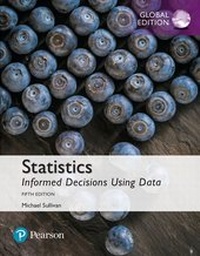
Statistics: Informed Decisions Using Data, Global Edition
Description

For courses in introductory statistics.
Statistics: Informed Decisions Using Dat, gives students the tools to see a bigger picture and make informed choices. As a current introductory statistics instructor, Mike Sullivan III presents a text that is filled with ideas and strategies that work in today's classroom. His practical emphasis resonates with students and helps them see that statistics is connected, not only to individual concepts, but also with the world at large.
The full text downloaded to your computer
With eBooks you can:
- search for key concepts, words and phrases
- make highlights and notes as you study
- share your notes with friends
eBooks are downloaded to your computer and accessible either offline through the Bookshelf (available as a free download), available online and also via the iPad and Android apps.
Upon purchase, you'll gain instant access to this eBook.
Time limit
The eBooks products do not have an expiry date. You will continue to access your digital ebook products whilst you have your Bookshelf installed.
All prices
More details
Other editions
New editions
Additional editions
Content
- PART 1: GETTING THE INFORMATION YOU NEED
- 1. Data Collection
- 1.1 Introduction to the Practice of Statistics
- 1.2 Observational Studies versus Designed Experiments
- 1.3 Simple Random Sampling
- 1.4 Other Effective Sampling Methods
- 1.5 Bias in Sampling
- 1.6 The Design of Experiments
- PART 2: DESCRIPTIVE STATISTICS
- 2. Organizing and Summarizing Data
- 2.1 Organizing Qualitative Data
- 2.2 Organizing Quantitative Data: The Popular Displays
- 2.3 Additional Displays of Quantitative Data
- 2.4 Graphical Misrepresentations of Data
- 3. Numerically Summarizing Data
- 3.1 Measures of Central Tendency
- 3.2 Measures of Dispersion
- 3.3 Measures of Central Tendency and Dispersion from Grouped Data
- 3.4 Measures of Position and Outliers
- 3.5 The Five-Number Summary and Boxplots
- 4. Describing the Relation between Two Variables
- 4.1 Scatter Diagrams and Correlation
- 4.2 Least-Squares Regression
- 4.3 Diagnostics on the Least-Squares Regression Line
- 4.4 Contingency Tables and Association
- 4.5 Nonlinear Regression: Transformations (online) 4-1
- PART 3: PROBABILITY AND PROBABILITY DISTRIBUTIONS
- 5. Probability
- 5.1 Probability Rules
- 5.2 The Addition Rule and Complements
- 5.3 Independence and the Multiplication Rule
- 5.4 Conditional Probability and the General Multiplication Rule
- 5.5 Counting Techniques
- 5.6 Putting It Together: Which Method Do I Use?
- 5.7 Bayes's Rule (online) 5-1
- 6. Discrete Probability Distributions
- 6.1 Discrete Random Variables
- 6.2 The Binomial Probability Distribution
- 6.3 The Poisson Probability Distribution
- 6.4 The Hypergeometric Probability Distribution (online) 6-1
- 7. The Normal Probability Distribution
- 7.1 Properties of the Normal Distribution
- 7.2 Applications of the Normal Distribution
- 7.3 Assessing Normality
- 7.4 The Normal Approximation to the Binomial Probability Distribution
- PART 4: INFERENCE: FROM SAMPLES TO POPULATION
- 8. Sampling Distributions
- 8.1 Distribution of the Sample Mean
- 8.2 Distribution of the Sample Proportion
- 9. Estimating the Value of a Parameter
- 9.1 Estimating a Population Proportion
- 9.2 Estimating a Population Mean
- 9.3 Estimating a Population Standard Deviation
- 9.4 Putting It Together: Which Procedure Do I Use?
- 9.5 Estimating with Bootstrapping
- 10. Hypothesis Tests Regarding a Parameter
- 10.1 The Language of Hypothesis Testing
- 10.2 Hypothesis Tests for a Population Proportion
- 10.3 Hypothesis Tests for a Population Mean
- 10.4 Hypothesis Tests for a Population Standard Deviation
- 10.5 Putting It Together: Which Method Do I Use?
- 10.6 The Probability of a Type II Error and the Power of the Test
- 11. Inferences on Two Samples
- 11.1 Inference about Two Population Proportions
- 11.2 Inference about Two Means: Dependent Samples
- 11.3 Inference about Two Means: Independent Samples
- 11.4 Inference about Two Population Standard Deviations
- 11.5 Putting It Together: Which Method Do I Use?
- 12. Inference on Categorical Data
