

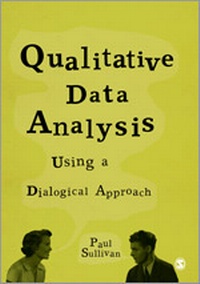
Qualitative Data Analysis Using a Dialogical Approach
1st Edition
Published on 9. December 2011
208 pages
978-1-4462-5439-4 (ISBN)
Description

In this important new text, Paul Sullivan introduces readers to a qualitative methodology rooted in the analysis of dialogue and subjectivity: the dialogical approach. Sullivan unpacks the theory behind a dialogical approach to qualitative research, and relates issues of philosophy and methodology to the practical process of actually doing qualitative research.
Sullivan's book foregrounds the role of atmosphere, subjectivity and authorial reflection within texts. His work also enables the researcher to attend to the conflicts, judgments and interpretive activities that take place in language use. Practically speaking, the dialogical approach enables analysis of direct and indirect discourse, speech genres, hesitations, irony and a variety of other conditions that shape our understanding of dialogue in context.
As well as exploring the theory behind this innovative method, Sullivan provides sound practical advice that recognises the everyday analytic needs of the reader.
Topics include:
* The theoretical foundations of the approach
* The role of subjectivity in qualitative research
* Data preparation and analysis
* The future of the approach
Theoretical discussion is consistently accompanied by research examples and suggestions as to how the dialogical approach could be used in the reader's own research. This important and timely book is ideal for any reader who wants to do research with dialogue and who is keen to attend to the full nuances and complexities of discourse.
Sullivan's book foregrounds the role of atmosphere, subjectivity and authorial reflection within texts. His work also enables the researcher to attend to the conflicts, judgments and interpretive activities that take place in language use. Practically speaking, the dialogical approach enables analysis of direct and indirect discourse, speech genres, hesitations, irony and a variety of other conditions that shape our understanding of dialogue in context.
As well as exploring the theory behind this innovative method, Sullivan provides sound practical advice that recognises the everyday analytic needs of the reader.
Topics include:
* The theoretical foundations of the approach
* The role of subjectivity in qualitative research
* Data preparation and analysis
* The future of the approach
Theoretical discussion is consistently accompanied by research examples and suggestions as to how the dialogical approach could be used in the reader's own research. This important and timely book is ideal for any reader who wants to do research with dialogue and who is keen to attend to the full nuances and complexities of discourse.
Reviews / Votes
Dr Sullivan provides an accessible and pragmatic, yet sophisticated, introduction to dialogical analysis. This book will be of great interest to students and researchers looking to expand their skills in qualitative analysis and offers many novel and creative ideas for approaching qualitative dataDr Anna Madill
Reader in Qualitative Inquiry, University of Leeds
Sullivan delivers a compelling set of arguments in favour of the use of a dialogical approach in qualitative data collection and analysis. His work is well-argued and supported by the use of relevant literature and examples of the approach in practice through reference to case studies. Sullivan achieves his aim of making the book as accessible and user-friendly as possible through: the provision of a detailed contents section; clearly communicated chapters using little jargon; reference to examples of how to apply the approach in practice; tables summarising key information and, links to further recommended reading. Despite the complex nature of the dialogical approach the above format suggests that there is potential for successfully using the approach. This would apply to practitioners, academics and students from a range of disciplinary backgrounds engaged in differing forms of qualitative research. Based on this I would recommend Sullivan's text as an introduction to a challenging yet accessible, innovative and rewarding way of undertaking and analysing future qualitative research studies
Emma Smith
Methodspace Book Reviews Group
The book can easily be read because the author employs terms carefully, using a simple and clear language. He avoids too technical terms and uses a simplified style to guarantee that readers understand its objectives. Sullivan's style is illustrative and uses examples all along the book about dialogical logic through diverse disciplines...To sum up; Sullivan offers an important material for qualitative methods' users...His work is a rich source of illustrations, figures, tables, examples and further readings, fulfilled by a rich, consistent and updated bibliography.
Nadia IDRI
Methodspace Book Reviews Group
I enjoyed this book very much. It is well written and is suitable for lecturers, researchers and students who wish to know more not just about the Bakhtinian dialogical approach but also other more mainstream and favoured qualitative research methodologies. It is highly readable and being written by the same author, rather than being a series of edited chapters by disparate writers, means that the chapters link well together... Sullivan uses copious examples from his own research and brings us from the very beginning, the planning stage, right through to the writing up stage of a number of his and other researchers' work. At all times it is written in a clear accessible, and at times humorous, manner... This is a good book on an important area which will contribute to the increasing presence of qualitative research in academic departments throughout the world.
Joe MacDonagh
Qualitative Methods in Psychology
All prices
More details
Language
English
Place of publication
London
United Kingdom
Target group
College/higher education
Professional and scholarly
ISBN-13
978-1-4462-5439-4 (9781446254394)
Copyright in bibliographic data and cover images is held by Nielsen Book Services Limited or by the publishers or by their respective licensors: all rights reserved.
Schweitzer Classification
Other editions
Additional editions
Paul Sullivan
Qualitative Data Analysis Using a Dialogical Approach
Book
12/2011
1st Edition
SAGE Publications Ltd
€200.40
Shipment within 15-20 days
Paul Sullivan
Qualitative Data Analysis Using a Dialogical Approach
Book
12/2011
1st Edition
SAGE Publications Ltd
€94.30
Shipment within 15-20 days
Person
Dr Paul Sullivan lectures psychology at the University of Bradford. His research is concerned with the significance of dialogue in understanding interpersonal as well as intrapersonal relationships and its applications for doing qualitative psychology. He is the 2009 winner of the Qualitative Methods in Psychology Section Prize for: 'Outstanding Early Career Scholar'.
Content
Introducing Dialogue to Qualitative Analysis
Analyzing Subjectivity in Qualitative Research
Using Dialogue to Explore Subjectivity
Data Preparation and Analysis
Writing up an Analysis
Double-Voiced Discourse and Focus Group Data
Analyzing Commentaries on Subjectivity
Evaluation
Discussion
Analyzing Subjectivity in Qualitative Research
Using Dialogue to Explore Subjectivity
Data Preparation and Analysis
Writing up an Analysis
Double-Voiced Discourse and Focus Group Data
Analyzing Commentaries on Subjectivity
Evaluation
Discussion
