

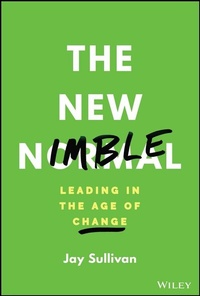
The New Nimble
Description

In The New Nimble: Leading in the Age of Change, accomplished author, professor, and consultant Jay Sullivan delivers a clear, tangible, and actionable guide to implementing flexibility and creativity in your enterprise. Through interviews with senior leaders from a variety of industries and disciplines, the author shows you the trends and behaviors that allowed successful companies to navigate the changing realities and complexities that have defined recent years, including the COVID-19 crisis, the increasing awareness of racial injustice in society, and the January 6th insurrection.
The New Nimble demonstrates how organizations can internalize and institutionalize lessons from recent paradigm shifts in thinking and learn how to apply those lessons to their everyday operations and to prepare for the next major challenge. You'll discover:
* How crucial it is to clearly articulate your mission, values, and parameters as an organization
* How to gather the types of data and insights that will allow you to make decisions quickly when the next change takes us all by surprise
* How building trust within your organization and with your external stakeholders gives you the confidence to take action in times of crisis
The questions at the end of each chapter become your playbook for debriefing how your organization handled the myriad shifting realities of the last few years. That ongoing discussion with your team will prepare you to be more nimble as the next change appears.
As managers, executives, founders, directors, and entrepreneurs, we will all face enormous decisions in the coming years regarding environmental challenges, shifts in the supply chain and the global economy, and the runaway freight train that is AI. As those and other issues come fast and furious, The New Nimble is the hands-on leadership guide that we'll all need as we do our best to manage our way through chaotic and volatile environments.
More details
Other editions
Additional editions
Content
Part I Understand Your Essence 1
Chapter 1 Know Yourself (and Let Others Know You, Too) 3
Chapter 2 Be Your Better Self 21
Chapter 3 Accept Your Limits 39
Part II Ask the Right Questions 59
Chapter 4 Think Beyond Yourself 61
Chapter 5 Learn What Others Value 77
Chapter 6 Seek "Meaningful Knowledge" 99
Part III Be Bold 123
Chapter 7 Keep It Moving 125
Chapter 8 Get It Done 145
Chapter 9 See the Opportunity 157
Conclusion 171
Acknowledgments 175
About the Author 179
Notes 181
Index 185
INTRODUCTION: THE NEW NIMBLE - LEADING IN THE AGE OF CHANGE
We're all a little bit Martha.
For more than 15 years, my wife, Mary, and I have hosted a neighborhood open-house holiday party. We missed 2019 because a family member was sick, and then 2020 because the entire world was sick. By the fall of 2021, with the hint of the world returning to normal, we decided it was time to try again.
We set the date for December 19, rented two tall space heaters for the patio so people could stay outdoors if that made them feel safer, suggested people should only come if they were vaccinated, and started making Mary's signature fudge. About a week after we mailed the invitations, Omicron reared its ugly head. As the date of the party drew closer and the news of another Covid spike grew more worrisome, a few regrets trickled in. Mary thought we should cancel the party. I wanted to move forward.
On December 16, still not sure what to do, we got a call from Martha, a sweet, elderly neighbor up the street. Martha is a wise and sound voice of reason who ran the annual science fair at the high school here in Pleasantville, New York. She and her husband, Chuck, had always attended our party and enjoyed the chance to catch up with so many people at once.
After a simple, "Hi, Mary. It's Martha." She got to the point. "I got your invitation. ARE YOU OUT OF YOUR MINDS!" She launched into a polite but firm tirade about the dangers of the disease, the threat to everyone right before the holidays, and the likelihood we would be hosting a super-spreader event.
Mary assured her we had space outside and that we were confident that people would only attend if they were vaccinated. In any case, Mary emphasized, we mailed the invitations before Omicron burst on the scene.
Martha shared how much she had missed seeing everyone lately, but still insisted that this was a bad idea and that we were irresponsible for moving forward with the party. She ended hurriedly with a frustrated, "Well, look, don't take us off the list because we still might come, but this is crazy," and hung up.
For three years, the entire world has been a little bit Martha, and a little bit Mary and Jay - not sure what to do, what information to weigh, what personal interests to weigh, how to make our decisions, and how to have confidence in our next steps. If we could, we delayed our decisions until we had some - even if not enough - information. If our decisions couldn't wait, we plowed ahead on whatever information we had. The pandemic changed so much of our lives and the way we made decisions. It forced us to abandon old ways of doing things and figure out and adopt novel approaches to connecting with each other and the various aspects of our lives.
But the pandemic only highlighted and exacerbated what's been happening in our personal and business lives for more than a decade. Those of us in leadership roles have been asked to make decisions faster, with both too much and not enough information, and with consequences that then lead to even more decisions. The only thing faster than the pace of our decisions has been the blowback from whoever didn't like the decisions. It sounds like a no-win situation. Welcome to leadership.
For the last 25+ years, I've had the privilege of both leading my own firm, and coaching business leaders on their communication skills, either in one-on-one sessions or in group classes. I have listened to thousands of professionals talk about the changes they incorporated into their work and personal lives. We've talked through how they can explain their new plans, their company's revised objectives, and their strategy for the moment, all while their situations remained in flux. We've had those conversations in the face of changing economic situations, changing regulations for their industry, and, most recently, an attack on our democracy, a war in Europe, and a global pandemic.
With each major event a company or team faced, the leader would talk about achieving a "new normal." The great frustration for everyone seemed to be that once they felt they had the situation figured out, the rules would change. They would have to start all over again. It became apparent that our "new normal" was actually all of us learning to achieve a "new nimble."
A "new normal" suggests we have achieved a new plateau, a place of stasis and stability, albeit at a place we don't really know yet. Ditch that idea. Please. We're in The New Nimble, where we will need to constantly adapt to change and to changing standards.
We've all become accustomed to making decisions in a fluid environment. The rules keep changing, the factors to consider become more complex, or, in some cases, completely out of control, and the structural underpinnings of how we think about issues no longer apply.
That shift isn't about just one aspect of our lives. It's not just about new rules about working remotely; that's just the business issue du jour. The real shift is about how business leaders are issuing "definitive" directives on Monday, and then backtracking on Tuesday because of the social media response from employees. It's about believing deeply in the stability and integrity of our democratic institutions one day and having doubts the next. It's about not just surface changes regarding how we attend meetings, but philosophical changes to how we relate to our employers and our colleagues.
In 2020, the terms social distancing and essential worker entered the world's vocabulary. Many of us, me included, humbly learned how "non-essential" the world considered us. Well prior to that, the Me Too movement and heightened awareness about racial injustice caused many of us to realize we needed to rethink our thinking - not about a particular topic, but literally about how to think.
We each have honed our analytic abilities from our education and life experiences. Mine come from two distinct privileges. I practiced law for nine years, first in the public interest sphere and then at a large corporate law firm. Prior to law school, I taught English grammar at a boys' high school in Kingston, Jamaica. I was able to share important grammar nuggets and my own grammar neuroses not only with my students, but to help my own four kids through high school and college. (Oddly, they were never as grateful as I would have thought.) The dual disciplines of law and grammar form the way I think through problems and structure ideas. All of the people you'll meet in this book have their own reasons for solving problems the way they do, and their own instincts for communicating their ideas for your benefit.
During Covid, many of us became more nimble in how to deal with an avalanche of work, as roles shifted and new demands arose. Others found themselves with too much time on their hands and became nimbler at finding ways to contribute to a world in pain. Regardless of which camp you found yourself in, we all needed to figure out how to be more nimble leaders in the unexpected world in which we found ourselves.
Having coached thousands of professionals dealing with an ever-changing landscape, I have observed similarities and differences in how leaders have made decisions in The New Nimble. I have gathered here the experiences of nine organizations or individuals, each from a different industry or profession. There are common elements that impact each entity's ability to succeed. There are also nuanced differences that give each unique challenges and advantages. Their experiences, insights, and innovations hold lessons for all of us as we learn to adapt, adjust, and evolve in rapidly changing times.
The "cast of characters" you'll meet on the following pages will give you insight into the specific challenges facing their industries and professions.
Universities have to adapt to new ways of teaching. But that's the least of their challenges. The remote learning model forced on us all by Covid raised questions about why we gather in person at college at all. What's the added learning we experience by coming together? Is it worth the cost? More importantly, a changing demographic in the United States will dramatically impact how universities approach recruiting and retaining students and position their value. The ivy on their walls was always taken as a sign of stability and permanence. Now, the discussions and decisions within those walls require nimble maneuvering to stay relevant and stay open.
Those in the supply chain struggle to keep our store shelves stocked and our machine parts at the ready. But pandemics, wars, and the occasional surveillance balloon disrupt supply chains or heighten concern that the links in those chains might snap. Our product delivery systems have to work with simultaneous challenges of too much of some products and not enough of others.
The staff at hospitals and homeless shelters alike are inundated with sick and suffering sisters and brothers who need care and compassion. During the pandemic, in particular, they did so while just as frightened and uncertain as everyone else. In a world where "displaced persons" is becoming part of the demographic profile, those institutions need to adapt more nimbly than ever before. Whether your own city's downtrodden population is in need or care, or someone just bussed a few hundred homeless people to your doorstep, you're now conscious of reacting in the moment to crises...
