

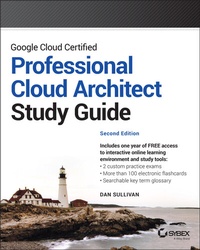
Google Cloud Certified Professional Cloud Architect Study Guide
Description

The newly revised Second Edition of the Google Cloud Certified Professional Cloud Architect Study Guide delivers a proven and effective roadmap to success on the latest Professional Cloud Architect accreditation exam from Google. You'll learn the skills you need to excel on the test and in the field, with coverage of every exam objective and competency, including focus areas of the latest exam such as Kubernetes, Anthos, and multi-cloud architectures. The book explores the design, analysis, development, operations, and migration components of the job, with intuitively organized lessons that align with the real-world job responsibilities of a Google Cloud professional and with the PCA exam topics. Architects need more than the ability to recall facts about cloud services, they need to be able to reason about design decisions. This study guide is unique in how it helps you learn to think like an architect: understand requirements, assess constraints, choose appropriate architecture patterns, and consider the operational characteristics of the systems you design. Review questions and practice exams use scenario-based questions like those on the certification exam to build the test taking skills you will need.
In addition to comprehensive material on compute resources, storage systems, networks, security, legal and regulatory compliance, reliability design, technical and business processes, and more, you'll get:
* The chance to begin or advance your career as an in-demand Google Cloud IT professional
* Invaluable opportunities to develop and practice the skills you'll need as a Google Cloud Architect
* Access to the Sybex online learning center, with chapter review questions, full-length practice exams, hundreds of electronic flashcards, and a glossary of key terms
The ideal resource for anyone preparing for the Professional Cloud Architect certification from Google, Google Cloud Certified Professional Cloud Architect Study Guide, 2nd Edition is also a must-read resource for aspiring and practicing cloud professionals seeking to expand or improve their technical skillset and improve their effectiveness in the field.
More details
Other editions
Additional editions
Person
DAN SULLIVAN is a software architect specializing in data analytics, machine learning, and cloud computing. He is the author of Google Cloud certification study guides for the Professional Architect, Professional Data Engineer, and Associate Cloud Engineer exams. Dan is also an instructor with LinkedIn Learning, where he develops courses on data science, machine learning, and data management as well as with Udemy where he provides Google Cloud certification preparation courses.
Content
- Cover
- Title Page
- Copyright Page
- Contents at a Glance
- Contents
- Introduction
- What Does This Book Cover?
- Interactive Online Learning Environment and Test Bank
- Additional Resources
- Objective Map
- Assessment Test
- Answers to the Assessment Test
- Chapter 1 Introduction to the Google Professional Cloud Architect Exam
- Exam Objectives
- Analyzing Business Requirements
- Reducing Operational Expenses
- Accelerating the Pace of Development
- Reporting on Service-Level Objectives
- Reducing Time to Recover from an Incident
- Improving Compliance with Industry Regulations
- Analyzing Technical Requirements
- Functional Requirements
- Exam Case Studies
- EHR Healthcare
- Helicopter Racing League
- Mountkirk Games
- TerramEarth
- Summary
- Exam Essentials
- Review Questions
- Chapter 2 Designing Solutions to Meet Business Requirements
- Business Use Cases and Product Strategy
- EHR Healthcare
- Helicopter Racing League
- Mountkirk Games Strategy
- TerramEarth Strategy
- Application Design and Cost Considerations
- Managed Services
- Reduced Levels of Services
- Data Lifecycle Management
- Systems Integration and Data Management
- Systems Integration Business Requirements
- Data Management Business Requirements
- Compliance and Regulation
- Privacy Regulations
- Data Integrity Regulations
- Security
- Confidentiality
- Integrity
- Availability
- Success Measures
- Key Performance Indicators
- Return on Investment
- Summary
- Exam Essentials
- Review Questions
- Chapter 3 Designing Solutions to Meet Technical Requirements
- High Availability
- Compute Availability
- Storage Availability
- Network Availability
- Application Availability
- Scalability
- Scaling Compute Resources
- Scaling Storage Resources
- Network Design for Scalability
- Reliability
- Measuring Reliability
- Reliability Engineering
- Summary
- Exam Essentials
- Review Questions
- Chapter 4 Designing Compute Systems
- Compute Services and Use Cases
- Compute Engine
- App Engine
- Cloud Functions
- Cloud Run
- Kubernetes Engine
- Anthos
- Overview of Anthos
- Anthos Service Mesh
- Anthos Multi Cluster Ingress
- Anthos Deployment Options
- AI and Machine Learning Services
- Vertex AI
- Cloud TPU
- Data Flows and Pipelines
- Cloud Pub/Sub Pipelines
- Cloud Dataflow Pipelines
- Cloud Dataproc
- Cloud Workflows
- Cloud Data Fusion
- Cloud Composer
- Compute System Provisioning
- Additional Design Issues
- Managing State in Distributed Systems
- Synchronous and Asynchronous Operations
- Summary
- Exam Essentials
- Review Questions
- Chapter 5 Designing Storage Systems
- Overview of Storage Services
- Object Storage with Google Cloud Storage
- Organizing Objects in a Namespace
- Cloud Storage FUSE
- Storage Tiers
- Cloud Storage Use Cases
- Network-Attached Storage with Google Cloud Filestore
- Cloud Filestore Service Tiers
- Cloud Filestore Networking
- Cloud Filestore Access Controls
- Databases
- Relational Database Overview
- Cloud SQL
- Cloud Spanner
- Analytical Database: BigQuery
- NoSQL Databases
- Caching with Cloud Memorystore
- Data Retention and Lifecycle Management
- Networking and Latency
- Summary
- Exam Essentials
- Review Questions
- Chapter 6 Designing Networks
- IP Addressing, Firewall Rules, and Routers
- IP Address Structure
- Public vs. Private Addressing
- Firewall Rules
- Cloud Router
- Cloud Armor
- Virtual Private Clouds
- VPC Subnets
- Shared VPC
- VPC Network Peering
- Hybrid-Cloud Networking
- Hybrid-Cloud Design Considerations
- Hybrid-Cloud Implementation Options
- Service-Centric Networking
- Private Service Connect for Google APIs
- Private Service Connect for Google APIs with Consumer HTTP(S)
- Private Google Access
- Private Google Access for On-Premises Hosts
- Private Service Connect for Published Services
- Private Service Access
- Serverless VPC Access
- Load Balancing
- Regional Load Balancing
- Global Load Balancing
- Additional Network Services
- Service Directory
- Cloud CDN
- Cloud DNS
- Summary
- Exam Essentials
- Review Questions
- Chapter 7 Designing for Security and Legal Compliance
- Identity and Access Management and Related Access Control Services
- Identities and Groups
- Resources
- Permissions
- Roles
- Policies
- Cloud IAM Conditions
- IAM Best Practices
- Identity-Aware Proxy
- Workload Identity Federation
- Organization Constraints
- Data Security
- Encryption
- Key Management
- Cloud Storage Data Access
- Security Evaluation
- Penetration Testing
- Auditing
- Security Design Principles
- Separation of Duties
- Least Privilege
- Defense in Depth
- Major Regulations
- HIPAA/HITECH
- General Data Protection Regulation
- Sarbanes-Oxley Act
- Children's Online Privacy Protection Act
- ITIL Framework
- Summary
- Exam Essentials
- Review Questions
- Chapter 8 Designing for Reliability
- Improving Reliability with Cloud Operations Suite
- Monitoring with Cloud Monitoring
- Alerting with Cloud Monitoring
- Logging with Cloud Logging
- Open Source Observability Tools
- Release Management
- Continuous Delivery
- Continuous Integration
- Systems Reliability Engineering
- Overload
- Cascading Failures
- Testing for Reliability
- Incident Management and Post-Mortem Analysis
- Summary
- Exam Essentials
- Review Questions
- Chapter 9 Analyzing and Defining Technical Processes
- Software Development Lifecycle Plan
- Analysis
- Design
- Continuous Integration/Continuous Delivery
- Business Drivers to Adopt CI/CD
- CI/CD Building Blocks
- Troubleshooting and Post-Mortem Analysis Culture
- Incident Post-Mortems
- Project Post-Mortems
- IT Enterprise Processes
- Business Continuity Planning and Disaster Recovery
- Business Continuity Planning
- Disaster Recovery
- Summary
- Exam Essentials
- Review Questions
- Chapter 10 Analyzing and Defining Business Processes
- Stakeholder Management
- Interests and Influence
- Projects, Programs, and Portfolios
- Stages of Stakeholder Management
- Change Management
- Reasons for Change
- Change Management Methodologies
- Team Skill Management
- Customer Success Management
- Cost Optimization/Resource Optimization
- Summary
- Exam Essentials
- Review Questions
- Chapter 11 Development and Operations
- Application Development Methodologies
- Waterfall
- Spiral
- Agile
- Technical Debt
- API Best Practices
- Resources and Standard Methods
- API Security
- Testing Frameworks
- Testing Framework Models
- Automated Testing Tools
- Data and System Migration Tooling
- Types of Cloud Migrations
- Migration Services and Tools
- Interacting with Google Cloud Programmatically
- Google Cloud SDK
- Google Cloud Shell
- Cloud Emulators
- Summary
- Exam Essentials
- Review Questions
- Chapter 12 Migration Planning
- Integrating Cloud Services with Existing Systems
- Migrating Systems and Data to Support a Solution
- Planning for Systems Migrations
- Planning for Data Migration
- Software Licensing Mapping
- Network Planning
- Virtual Private Clouds
- Network Access Controls
- Scaling
- Connectivity
- Summary
- Exam Essentials
- Review Questions
- Appendix Answers to the Review Questions
- Chapter 1: Introduction to the Google Professional Cloud Architect Exam
- Chapter 2: Designing Solutions to Meet Business Requirements
- Chapter 3: Designing Solutions to Meet Technical Requirements
- Chapter 4: Designing Compute Systems
- Chapter 5: Designing Storage Systems
- Chapter 6: Designing Networks
- Chapter 7: Designing for Security and Legal Compliance
- Chapter 8: Designing for Reliability
- Chapter 9: Analyzing and Defining Technical Processes
- Chapter 10: Analyzing and Defining Business Processes
- Chapter 11: Development and Operations
- Chapter 12: Migration Planning
- Index
- Online Test Bank
- EULA
Introduction
The Google Cloud Platform is a diverse and growing set of services. To pass the Google Cloud Professional Cloud Architect exam, you will need to understand how to reason about both business requirements and technical requirements. This is not so much a test of knowledge about how to do specific tasks in GCP, such as attaching a persistent disk to a VM instance, which is the type of question you are more likely to get or see on the Google Cloud Associate Cloud Engineer exam. The Google Cloud Professional Architect exam tests your ability to perform high-level design and architecture tasks related to the following:
- Designing applications
- Planning migrations
- Ensuring feasibility of proposed designs
- Optimizing infrastructure
- Building and deploying code
- Managing data lifecycles
You will be tested on your ability to design solutions using a mix of compute, storage, networking, and managed services. The design must satisfy both business and technical requirements. If you find a question that seems to have two correct technical answers, look closely at the business requirements. There is likely a business consideration that will make one of the options a better choice than the other. For example, you might have a question about implementing a stream processing system, and the options include a solution based on Apache Flink running in Compute Engine and a solution using Cloud Dataflow. If the business requirements indicate a preference for managed services, then the Cloud Dataflow option is a better choice.
You will be tested on how to plan the execution of work required to implement a cloud solution. Migrations to the cloud are often done in stages. Consider the advantages of starting with low-risk migration tasks, such as setting up a test environment in the cloud before moving production workloads to GCP.
The business and technical requirements may leave you open to proposing two or more different solutions. In these cases, consider the feasibility of the implementation. Will it be scalable and reliable? Even if GCP services have high SLOs, your system may depend on a third-party service that may go down. If that happens, what is the impact on your workflow? Should you plan to buffer work in a Cloud Pub/Sub queue rather than sending it directly to the third-party service? Also consider costs and optimizations, but only after you have a technically viable solution that meets business requirements. As computer science pioneer Donald Knuth realized, "The real problem is that programmers have spent far too much time worrying about efficiency in the wrong places and at the wrong times; premature optimization is the root of all evil (or at least most of it) in programming."1 The same can be said for architecture as well-meet business and technical requirements before trying to optimize.
The exam guide states that architects should be familiar with the software development lifecycle and agile practices. These will be important to know when answering questions about developing and releasing code, especially how to release code into production environments without shutting down the service. It is important to understand topics such as Blue/Green deployments, canary deployments, and continuous integration/continuous delivery.
In this context, managing is largely about security and monitoring. Architects will need to understand authentication and authorization in GCP. The IAM service is used across GCP, and it should be well understood before attempting the exam. Cloud Monitoring and Cloud Logging are the key services for monitoring and logging in GCP.
How Is the Professional Cloud Architect Exam Different from the Associate Cloud Engineer Exam?
There is some overlap between the Professional Cloud Architect and Associate Cloud Engineer exams. Both exams test for an understanding of technical requirements and the ability to build, deploy, and manage cloud resources. In addition, the Professional Cloud Architect exam tests the ability to work with business requirements to design, plan, and optimize cloud solutions.
The questions on the Professional Cloud Architect exam are based on the kinds of work cloud architects do on a day-to-day basis. This includes deciding which of several storage options is best, designing a network to meet industry regulations, or understanding the implications of horizontally scaling a database.
The questions on the Associate Cloud Engineer exam are based on the tasks that cloud engineers perform, such as creating instance groups, assigning roles to identities, or monitoring a set of VMs. The engineering exam is more likely to have detailed questions about gcloud, gsutil, and bq commands. Architects need to be familiar with these commands and their function, but a detailed knowledge of command options and syntax is not frequently needed on the Professional Cloud Architect exam.
This book is designed to help you pass the Professional Cloud Architect certification exam. If you'd like additional preparation, review the Official Google Cloud Certified Associate Cloud Engineer Study Guide (Sybex, 2019).
What Does This Book Cover?
This book covers the topics outlined in the Professional Cloud Architect exam guide available here:
cloud.google.com/certification/guides/professional-cloud-architect
- Chapter 1: Introduction to the Google Professional Cloud Architect Exam This chapter outlines the exam objectives, scope of the exam, and case studies used in the exam. One of the most challenging parts of the exam for many architects is mapping business requirements to technical requirements. This chapter discusses strategies for culling technical requirements and constraints from statements about nontechnical business requirements. The chapter also discusses the need to understand functional requirements around computing, storage, and networking as well as nonfunctional characteristics of services, such as availability and scalability.
- Chapter 2: Designing Solutions to Meet Business Requirements This chapter reviews several key areas where business requirements are important to understand, including business use cases and product strategies, application design and cost considerations, systems integration and data management, compliance and regulations, security, and success measures.
- Chapter 3: Designing Solutions to Meet Technical Requirements This chapter discusses ways to ensure high availability in compute, storage, and applications. It also reviews ways to ensure scalability in compute, storage, and network resources. The chapter also introduces reliability engineering.
- Chapter 4: Designing Compute Systems This chapter discusses Compute Engine, App Engine, Kubernetes Engine, Anthos, and Cloud Functions. Topics in this chapter include use cases, configuration, management, and design. Other topics include managing state in distributed systems, data flows and pipelines, and data integrity. Monitoring and alerting are also discussed.
- Chapter 5: Designing Storage Systems This chapter focuses on storage and database systems. Storage systems include object storage, network-attached storage, and caching. Several databases are reviewed, including Cloud SQL, Cloud Spanner, BigQuery, Cloud Firestore, and Bigtable. It is important to know how to choose among storage and database options when making architectural choices. Other topics include provisioning, data retention and lifecycle management, and network latency.
- Chapter 6: Designing Networks This chapter reviews VPCs, including subnets and IP addressing, hybrid cloud networking, VPNs, peering, Shared VPCs, and direct connections. This chapter also includes a discussion of regional and global load balancing. Hybrid cloud computing and networking topics are important concepts for the exam.
- Chapter 7: Designing for Security and Legal Compliance This chapter discusses IAM, data security including encryption at rest and encryption in transit, key management, security evaluation, penetration testing, auditing, and security design principles. Major regulations and ITIL are reviewed.
- Chapter 8: Designing for Reliability This chapter begins with a discussion of Cloud Operations (formerly Stackdriver) for monitoring, logging, and alerting. Next, the chapter reviews continuous deployment and continuous integration. Systems reliability engineering is discussed, including overloads, cascading failures, and testing for reliability. Incident management and post-mortem analysis are also described.
- Chapter 9: Analyzing and Defining Technical Processes This chapter focuses on software development lifecycle planning. This includes troubleshooting, testing and validation, business continuity, and disaster recovery.
- Chapter 10: Analyzing and Defining Business Processes This chapter includes several business-oriented skills including stakeholder management, change management, team skill management, customer success management, and cost management.
- Chapter 11: Development and Operations This chapter reviews application development methodologies, API best practices, and testing frameworks, including load, unit, and integration testing. The chapter also discusses...
