

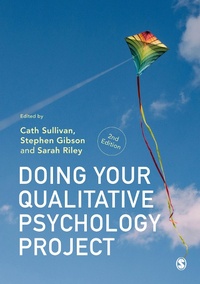
Doing Your Qualitative Psychology Project
2nd Edition
Published on 29. November 2023
264 pages
978-1-5297-8449-7 (ISBN)
Description

Embarking on your own psychology research? This book equips you with the skills you need to complete a qualitative project confidently.
The book takes you through the process of doing your project, showing how to plan and execute each stage. It helps you make good decisions about key steps such as choosing a research topic, designing your project, doing ethical research and writing up.
This second edition:
Offers a host of learning features including 'in a nutshell' summaries, further reading, activities and top tips to help you develop your understanding and skills.
Devotes more space to the important topics of project planning and doing ethical research with a new chapter on each.
Enables you to critically evaluate your work, helping you conduct high-quality research.
Discusses student success stories and cautionary tales illustrating, from start to finish, how qualitative projects are done in the real world.
This is the perfect guide for undergraduates doing a final project or dissertation, and postgraduates who are relatively new to qualitative research.
The book takes you through the process of doing your project, showing how to plan and execute each stage. It helps you make good decisions about key steps such as choosing a research topic, designing your project, doing ethical research and writing up.
This second edition:
Offers a host of learning features including 'in a nutshell' summaries, further reading, activities and top tips to help you develop your understanding and skills.
Devotes more space to the important topics of project planning and doing ethical research with a new chapter on each.
Enables you to critically evaluate your work, helping you conduct high-quality research.
Discusses student success stories and cautionary tales illustrating, from start to finish, how qualitative projects are done in the real world.
This is the perfect guide for undergraduates doing a final project or dissertation, and postgraduates who are relatively new to qualitative research.
More details
Edition
Second Edition
Language
English
Place of publication
London
United Kingdom
Publishing group
Sage Publications Ltd (Digital)
Target group
College/higher education
ISBN-13
978-1-5297-8449-7 (9781529784497)
Copyright in bibliographic data and cover images is held by Nielsen Book Services Limited or by the publishers or by their respective licensors: all rights reserved.
Schweitzer Classification
Other editions
Additional editions
Cath Sullivan | Stephen Gibson | Sarah Riley
Doing Your Qualitative Psychology Project
Book
11/2023
2nd Edition
SAGE Publications Ltd
€48.79
Shipment within 15-20 days
Cath Sullivan | Stephen Gibson | Sarah Riley
Doing Your Qualitative Psychology Project
Book
11/2023
2nd Edition
SAGE Publications Ltd
€164.40
Shipment within 15-20 days
Persons
Cath Sullivan is Senior Lecturer in Psychology in the University of Central Lancashire. Cath has been an actively involved in initiatives to support the teaching of qualitative research methods in psychology since 2005 and is a former Chair of the Higher Education Academy 'Teaching Qualitative Psychology' Special Interest Group. In addition to this work supporting and training psychology lecturers who teach qualitative methods, Cath has over 10 years' experience of teaching qualitative methods to undergraduate and postgraduate students. Her published articles and book chapters include empirical qualitative papers and pieces about qualitative methodology. She is co-editor of Doing Qualitative Research in Psychology (Sage, 2019). Stephen Gibson is Bicentennial Chair in Research Methods and Director of Doctoral Programmes in the School of Social Sciences, Heriot Watt University. He is a social psychologist with research interests in obedience and social influence, identity and citizenship, and representations of peace and conflict. In addition, he has been involved in numerous projects concerning the teaching of qualitative research methods. Between 2008 and 2011 he was chair of the TQRMUL group, and is co-editor (with Simon Mollan) of the volume Representations of Peace and Conflict (Palgrave, 2012).
Sarah Riley is a Professor in Critical Health Psychology at Massey University, Aotearoa New Zealand. Her award-winning, interdisciplinary research focuses on relationships between discourse, affect, technology, and materiality. Recent co-authored books include Technologies of Sexiness (OUP USA, 2014), Postfeminism and Health (Routledge, 2019), Postfeminism and Body Image (Routledge, 2022); and Digital Feeling (Palgrave, 2023); she chaired the British Psychology Society's Qualitative Methods in Psychology section (2017-19), and teaches qualitative research methods.
Sarah Riley is a Professor in Critical Health Psychology at Massey University, Aotearoa New Zealand. Her award-winning, interdisciplinary research focuses on relationships between discourse, affect, technology, and materiality. Recent co-authored books include Technologies of Sexiness (OUP USA, 2014), Postfeminism and Health (Routledge, 2019), Postfeminism and Body Image (Routledge, 2022); and Digital Feeling (Palgrave, 2023); she chaired the British Psychology Society's Qualitative Methods in Psychology section (2017-19), and teaches qualitative research methods.
Content
Chapter 1: Getting started - Cath Sullivan, Stephen Gibson and Sarah Riley
Chapter 2: Coming up with a research question - Sarah Riley and Kathy Kinmond
Chapter 3: Planning your project - Cath Sullivan and Sarah Riley
Chapter 4: Doing ethical research - Cath Sullivan and Sarah Riley
Chapter 5: Managing your project - Sarah Riley and Nigel King
Chapter 6: Doing a literature review - Jo Bryce and Michael Forrester
Chapter 7: Collecting your data - Stephen Gibson and Siobhan Hugh-Jones
Chapter 8: Analysing your data - Stephen Gibson and Siobhan Hugh-Jones
Chapter 9: Achieving quality in your project - Cath Sullivan, Nollaig Frost and Kathryn Kinmond
Chapter 10: Writing up a qualitative project - Sarah Riley
Chapter 11: Conclusion - Cath Sullivan, Stephen Gibson and Sarah Riley
Chapter 2: Coming up with a research question - Sarah Riley and Kathy Kinmond
Chapter 3: Planning your project - Cath Sullivan and Sarah Riley
Chapter 4: Doing ethical research - Cath Sullivan and Sarah Riley
Chapter 5: Managing your project - Sarah Riley and Nigel King
Chapter 6: Doing a literature review - Jo Bryce and Michael Forrester
Chapter 7: Collecting your data - Stephen Gibson and Siobhan Hugh-Jones
Chapter 8: Analysing your data - Stephen Gibson and Siobhan Hugh-Jones
Chapter 9: Achieving quality in your project - Cath Sullivan, Nollaig Frost and Kathryn Kinmond
Chapter 10: Writing up a qualitative project - Sarah Riley
Chapter 11: Conclusion - Cath Sullivan, Stephen Gibson and Sarah Riley
