

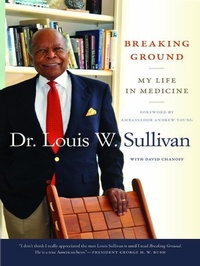
Breaking Ground
Description

While Louis W. Sullivan was a student at Morehouse College, Morehouse president Benjamin Mays said something to the student body that stuck with him for the rest of his life. "The tragedy of life is not failing to reach our goals," Mays said. "It is not having goals to reach."
In Breaking Ground, Sullivan recounts his extraordinary life beginning with his childhood in Jim Crow south Georgia and continuing through his trailblazing endeavors training to become a physician in an almost entirely white environment in the Northeast, founding and then leading the Morehouse School of Medicine in Atlanta, and serving as secretary of Health and Human Services in President George H. W. Bush's administration. Throughout this extraordinary life Sullivan has passionately championed both improved health care and increased access to medical professions for the poor and people of color.
At five years old, Louis Sullivan declared to his mother that he wanted to be a doctor. Given the harsh segregation in Blakely, Georgia, and its lack of adequate schools for African Americans at the time, his parents sent Louis and his brother, Walter, to Savannah and later Atlanta, where greater educational opportunities existed for blacks.
After attending Booker T. Washington High School and Morehouse College, Sullivan went to medical school at Boston University-he was the sole African American student in his class. He eventually became the chief of hematology there until Hugh Gloster, the president of Morehouse College, presented him with an opportunity he couldn't refuse: Would Sullivan be the founding dean of Morehouse's new medical school? He agreed and went on to create a state-of-the-art institution dedicated to helping poor and minority students become doctors. During this period he established long-lasting relationships with George H. W. and Barbara Bush that would eventually result in his becoming the secretary of Health and Human Services in 1989.
Sullivan details his experiences in Washington dealing with the burgeoning AIDS crisis, PETA activists, and antismoking efforts, along with his efforts to push through comprehensive health care reform decades before the Affordable Care Act. Along the way his interactions with a cast of politicos, including Thurgood Marshall, Jack Kemp, Clarence Thomas, Jesse Helms, and the Bushes, capture vividly a particular moment in recent history.
Sullivan's life-from Morehouse to the White House and his ongoing work with medical students in South Africa-is the embodiment of the hopes and progress that the civil rights movement fought to achieve. His story should inspire future generations-of all backgrounds-to aspire to great things.
More details
Other editions
Additional editions
Person
DR. LOUIS SULLIVAN is the founding dean and first president of Morehouse School of Medicine (now president emeritus). He was secretary of the U.S. Department of Health and Human Services during the George H. W. Bush administration. He is chair of the board of the National Health Museum in Atlanta and the Washington, D.C.-based Sullivan Alliance to Transform America's Health Professionals. He is author of The Morehouse Mystique: Becoming a Doctor at the Nation's Newest African American Medical School (with Marybeth Gasman).
David Chanoff (With)
DAVID CHANOFF has written for the New York Times Magazine, the Washington Post, New Republic, and the Wall Street Journal, among others. His twenty-four books include collaborations with former surgeon general Joycelyn Elders, former chairman of the Joint Chiefs of Staff Admiral William Crowe Jr., and Israeli prime minister Ariel Sharon. In addition to ghostwriting, he has also written a number of histories, including a history of Black medicine and health care that was awarded the Phillis Wheatley Prize for History from the Sons & Daughters of the U.S. Middle Passage. Chanoff lives in Boston.
Content
- Cover Page
- Title Page
- Copyright Page
- Dedication
- Contents
- Foreword
- Chapter 1. Blakely, Georgia
- Chapter 2. Morehouse College
- Chapter 3. Medical Student
- Chapter 4. The Kamikaze School of Medicine
- Chapter 5. Professor
- Chapter 6. An Offer
- Chapter 7. Founding Dean
- Chapter 8. Morehouse School of Medicine
- Chapter 9. President Bush Calls
- Chapter 10. Mr. Secretary
- Chapter 11. Reforming Health Care
- Chapter 12. Morehouse, a Model Black Institution
- Chapter 13. Missing Persons
- Epilogue
- Acknowledgments
- Index
