

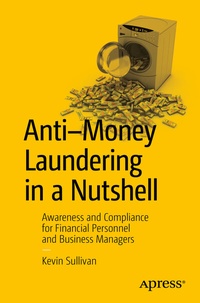
Anti-Money Laundering in a Nutshell
Description

Anti-Money Laundering in a Nutshell is a concise, accessible, and practical guide to compliance with anti-money laundering law for financial professionals, corporate investigators, business managers, and all personnel of financial institutions who are required, under penalty of hefty fines, to get anti-money laundering training.
Money laundering is endemic. As much as 5 percent of global GDP ($3.6 trillion) is laundered by criminals each year. It's no wonder that every financial institution in the United States-including banks, credit card companies, insurers, securities brokerages, private funds, and money service businesses-must comply with complex examination, training, and reporting requirements mandated by a welter of federal anti-money laundering (AML) laws. Ignorance of crime is no excuse before the law. Financial institutions and businesses that unknowingly serve as conduits for money launderingare no less liable to prosecution and fines than those that condone or abet it.
In Anti-Money Laundering in a Nutshell: Awareness and Compliance for Financial Personnel and Business Managers, Kevin Sullivan draws on a distinguished career as an AML agent and consultant to teach personnel in financial institutions what money laundering is, who does it, how they do it, how to prevent it, how to detect it, and how to report it in compliance with federal law. He traces the dynamic interplay among employees, regulatory examiners, compliance officers, fraud and forensic accountants and technologists, criminal investigators, and prosecutors in following up on reports, catching launderers, and protecting the integrity and reputations of financial institutions and businesses. In particular, corporate investigators will gain rich insights winnowed from the author's experiences as a New York State and federal investigator.
More details
Other editions
New editions
Additional editions
Person
Content
2 - About the Author [Seite 189]
3 - Acknowledgments [Seite 190]
4 - Introduction [Seite 4]
5 - Chapter 1: What Is Money Laundering? [Seite 6]
5.1 - Turning "Bad" Money into "Legitimate" Money [Seite 7]
5.2 - Money Laundering All Around Us [Seite 9]
5.3 - How Money Is Laundered [Seite 10]
5.4 - Why AML Efforts Are Important [Seite 11]
5.5 - The Three Stages of Money Laundering [Seite 11]
5.5.1 - Placement [Seite 12]
5.5.2 - Layering [Seite 13]
5.5.2.1 - Why Layering Works [Seite 14]
5.5.3 - Integration [Seite 15]
5.5.4 - Putting It All Together for a Payday [Seite 15]
5.6 - Who Launders Money [Seite 16]
5.7 - Summary [Seite 18]
6 - Chapter 2: Methods of Money Laundering [Seite 19]
6.1 - Structuring [Seite 20]
6.2 - Bulk Cash Smuggling [Seite 21]
6.2.1 - Gold [Seite 21]
6.3 - Money Service Businesses [Seite 22]
6.3.1 - Money Orders [Seite 22]
6.3.2 - Money Service Business [Seite 23]
6.3.3 - Regulations Involving Money Service Businesses [Seite 23]
6.4 - Wire Transfers [Seite 23]
6.4.1 - How a Wire Works [Seite 25]
6.5 - Casinos [Seite 26]
6.6 - Trade-Based Money Laundering [Seite 27]
6.6.1 - Over- and Under-Invoicing of Goods [Seite 28]
6.6.2 - Black Market Peso Exchange [Seite 29]
6.6.3 - Underground Banking System (Hawala) [Seite 29]
6.7 - Cyber Banking [Seite 31]
6.7.1 - Smart Cards [Seite 31]
6.7.2 - Internet [Seite 31]
6.8 - ATMs [Seite 32]
6.8.1 - Prepaid Cards [Seite 34]
6.8.2 - Autos [Seite 35]
6.8.3 - Correspondent Banking [Seite 36]
6.8.4 - Credit Cards [Seite 36]
6.8.5 - Real Estate [Seite 36]
6.8.6 - Cash-Intense Business [Seite 37]
6.8.7 - Insurance [Seite 38]
6.8.8 - Digital Currencies [Seite 38]
6.9 - Summary [Seite 39]
7 - Chapter 3: Federal Regulations [Seite 40]
7.1 - 1970: Bank Secrecy Act [Seite 41]
7.1.1 - What Constitutes a Financial Institution [Seite 41]
7.1.2 - Currency Transaction Report [Seite 41]
7.1.2.1 - Currency Transaction Exemptions [Seite 42]
7.1.2.2 - Why a CTR Is Important to Law Enforcement [Seite 42]
7.1.2.3 - United States to World Comparison: Currency Transaction Reporting [Seite 43]
7.1.2.4 - Form 8300 [Seite 43]
7.2 - 1986: Money Laundering Control Act [Seite 43]
7.3 - 1990: FinCEN [Seite 44]
7.4 - 1992: Annunzio-Wylie Act [Seite 44]
7.5 - 1994: Money Laundering Suppression Act [Seite 45]
7.6 - 1998: Money Laundering and Financial Crimes Strategy Act [Seite 45]
7.7 - 2001: USA PATRIOT Act [Seite 46]
7.8 - Office of Foreign Assets and Control [Seite 49]
7.9 - Foreign Account Tax Compliance Act [Seite 49]
7.10 - Summary [Seite 50]
8 - Chapter 4: Building a Quality AML Program [Seite 51]
8.1 - Recommended Elements of a Quality AML Program [Seite 54]
8.2 - The Four Pillars [Seite 55]
8.2.1 - Internal Policies and Procedures [Seite 55]
8.2.2 - Designated Compliance Officer [Seite 57]
8.2.3 - Independent Audit Function [Seite 59]
8.2.4 - Training [Seite 60]
8.3 - Risk Management [Seite 61]
8.4 - Conducting Due Diligence [Seite 65]
8.4.1 - Customer Risk [Seite 65]
8.4.2 - Product and Service Risk [Seite 66]
8.4.3 - Geographic Risk [Seite 67]
8.5 - Common Program Deficiencies [Seite 67]
8.6 - Summary [Seite 69]
9 - Chapter 5: Know Your Customer and Customer Identification Program [Seite 70]
9.1 - Elements of a KYC Program [Seite 72]
9.1.1 - Customer Identification [Seite 72]
9.1.2 - Basic Customer Due Diligence [Seite 74]
9.1.2.1 - Beware Shell Companies [Seite 75]
9.1.2.2 - Identifying Customers Online [Seite 76]
9.1.3 - Monitor Transactions [Seite 76]
9.2 - The Diligences [Seite 77]
9.2.1 - Start with a Checklist [Seite 79]
9.2.2 - Beware of "Voo-Due" Diligence [Seite 83]
9.2.3 - When to Perform Due Diligence or Enhanced Due Diligence [Seite 84]
9.3 - The Investigative Mind-Set [Seite 85]
9.3.1 - Trust Your Gut [Seite 86]
9.4 - Perform Risk-Based Due Diligence [Seite 88]
9.5 - Sources of Intelligence [Seite 92]
9.6 - Other Special Considerations [Seite 97]
9.6.1 - Transaction Monitoring [Seite 97]
9.6.2 - Correspondent Banking - Know Your Correspondents [Seite 98]
9.6.3 - Politically Exposed Persons [Seite 99]
9.7 - Summary [Seite 100]
10 - Chapter 6: A SAR Is Born [Seite 102]
10.1 - The Back Story [Seite 103]
10.1.1 - Getting to Suspicious [Seite 104]
10.1.2 - Hidden Value of SARs [Seite 105]
10.1.3 - 30/60/90 Rule [Seite 106]
10.1.4 - Completing the SAR [Seite 106]
10.2 - Why Financial Institutions Need to File [Seite 111]
10.3 - What Happens After You File [Seite 111]
10.3.1 - Law Enforcement Contact [Seite 112]
10.4 - Suspicious Activity Report Statistics [Seite 113]
10.5 - Summary [Seite 115]
11 - Chapter 7: Tips for Law Enforcement and Financial Crimes Investigators [Seite 116]
11.1 - The "You Must Be An Accountant Theory" [Seite 117]
11.2 - What Do Bankers Do [Seite 119]
11.3 - What Regulators Do [Seite 119]
11.3.1 - Who Are the Regulators? [Seite 121]
11.3.2 - Getting in Touch with Regulators [Seite 121]
11.4 - SAR Power [Seite 122]
11.5 - Other Information Financial Institutions May Provide [Seite 124]
11.6 - Developing the Investigative Mind [Seite 127]
11.6.1 - Use Your Instincts [Seite 129]
11.6.2 - Tips for Developing the Investigative Mind [Seite 130]
11.7 - How I Got Here [Seite 132]
11.8 - Summary [Seite 135]
12 - Chapter 8: International Standards [Seite 137]
12.1 - Various Organizations That Create Guidelines [Seite 138]
12.2 - The Financial Action Task Force [Seite 138]
12.3 - Basel Committee on Banking Supervision [Seite 140]
12.4 - Wolfsberg [Seite 141]
12.5 - Egmont [Seite 142]
12.6 - European Union [Seite 143]
12.7 - International Monetary Fund [Seite 144]
12.8 - Transparency International [Seite 145]
12.9 - Economic Sanctions [Seite 145]
12.10 - USA PATRIOT ACT [Seite 148]
12.10.1 - Section 311 [Seite 148]
12.10.2 - Section 312 [Seite 149]
12.10.3 - Section 313 [Seite 149]
12.10.4 - Section 319 [Seite 149]
12.11 - Summary [Seite 150]
13 - Chapter 9: Fraud and Anti-money Laundering [Seite 151]
13.1 - Merging the Fraud and AML Units [Seite 153]
13.2 - Law Enforcement's Role [Seite 154]
13.3 - A Suggestion for Dealing with Your Own Personnel [Seite 157]
13.4 - Types of Fraud [Seite 157]
13.5 - Summary [Seite 158]
14 - Appendix A: Money-Laundering Red Flags [Seite 159]
15 - Appendix B: Code of Federal Regulations Title 31 Section 103.18 [Seite 170]
16 - Glossary [Seite 173]
17 - Index [Seite 179]
