

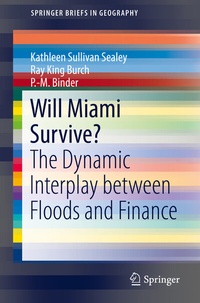
Will Miami Survive?
Description

This SpringerBrief uses a complexity perspective to integrate risk, finance, and ecological issues in Miami, USA. It focuses on how the modern financial system, particularly the mortgage market, perceives and manages the risk of climate change. Authors Kathleen Sealey, Ray King Burch and P.-M. Binder offer the case study of South Florida to illustrate how landscapes can be either re-purposed to function ecologically when residents relocate or rebuilt to reduce the threat of future flooding, the tools needed to make these decisions, and how financial systems view and influence them. While the need to integrate financial markets into coastal (and environmental) management is increasingly recognized, the difficulty of this task is made greater by the speed of financial innovation and the obscurity and complexity of its practices. This book will discuss the innovative Southeast Florida Regional Climate Compact, and the success of public-private partnerships in planning and adapting to sea level rise, but also the broad disconnect with the cash-and-credit-driven real estate market of South Florida.
The book presents an interdisciplinary approach to the understanding of the coupled human (including finance) and natural systems in coastal cities, thus breaking new ground in the approach towards sustainability research and education. The final chapter introduces the social component of resilience which include pre-disaster outreach with and the potential for decision theory to help people understand and manage risk.
More details
Other editions
Additional editions
Persons
Dr. Kathleen Sullivan Sealey is an Associate Professor at the University of Miami working in coastal ecology and island sustainability studies. She has worked in the wider Caribbean for over thirty years, and has duel US and Bahamian citizenship. Her research and community outreach programs have focused on reducing land-based sources of pollutants to coastal waters, especially nitrogen from sewage and waste dumping. She has worked on diverse projects such as the environmental sensitivity mapping of the Western Bahamas. She developed the methods, database structure and production of coastal resource maps for oil spill response planning.
Ray King Burch conducts independent research on the interactions between the financial system and natural systems. After a number of years of accumulated study and work experience in marine science, finance, and real estate, the onset of the housing and mortgage bubble convinced him of the need to unite these academic disciplines through a focus on sustainability. In addition to research on environmental-financial system connections, another of his special interests is the design of educational programs that combine mathematical finance and environmental sciences in order to assist practical solutions to environmental challenges.
P.-M. Binder is a Professor of Physics at the Hilo campus of the University of Hawaii. In addition to physics he teaches energy science courses and has an active research program involving undergraduates. He is one of the editors of "The Language Phenomenon" (Springer, 2013).
