

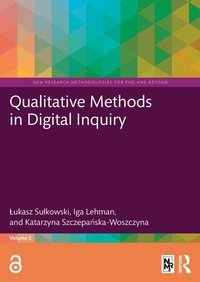
Qualitative Methods in Digital Inquiry
Will be published approx. on 3. July 2026
196 pages
E-Book
978-1-040-96060-8 (ISBN)
Description

Qualitative Methods in Digital Inquiry shows how to design, conduct, and analyse qualitative research in online and technology-rich settings, from virtual ethnography and netnography to visual and arts-based approaches.
Written for PhD students, early-career researchers, and instructors across the social sciences and management, the book also supports applied researchers in UX, market research, and organisational development.
Written for PhD students, early-career researchers, and instructors across the social sciences and management, the book also supports applied researchers in UX, market research, and organisational development.
More details
Series
Language
English
Place of publication
London
United Kingdom
Publishing group
Taylor & Francis Ltd
Target group
College/higher education
Professional and scholarly
Illustrations
3 Tables, black and white
ISBN-13
978-1-040-96060-8 (9781040960608)
Copyright in bibliographic data and cover images is held by Nielsen Book Services Limited or by the publishers or by their respective licensors: all rights reserved.
Schweitzer Classification
Other editions
Additional editions
Lukasz Sulkowski | Iga Lehman | Katarzyna Szczepanska-Woszczyna
Qualitative Methods in Digital Inquiry
Book
approx. 07/2026
1st Edition
Routledge
€191.50
Not yet published
Lukasz Sulkowski | Iga Lehman | Katarzyna Szczepanska-Woszczyna
Qualitative Methods in Digital Inquiry
Book
approx. 07/2026
1st Edition
Routledge
€52.50
Not yet published
Persons
Lukasz Sulkowski is a professor of economic sciences and humanities specializing in higher education management, social science methodology, HRM, and organizational culture, and serves as President of WSB University.
Iga Lehman is an associate professor at WSB University, specializing in discursive leadership, socio-cultural and linguistic marginalisation, and discourse community diversity.
Katarzyna Szczepanska-Woszczyna holds a postdoctoral degree in economic sciences and is a Vice-Rector for Research and Education at WSB University, specializing in management and quality sciences, with a focus on HRM, innovation, knowledge transfer, and sustainability
Iga Lehman is an associate professor at WSB University, specializing in discursive leadership, socio-cultural and linguistic marginalisation, and discourse community diversity.
Katarzyna Szczepanska-Woszczyna holds a postdoctoral degree in economic sciences and is a Vice-Rector for Research and Education at WSB University, specializing in management and quality sciences, with a focus on HRM, innovation, knowledge transfer, and sustainability
Content
Introduction, 1. Ethnography, 2. Case Study Research, 3. Grounded Theory, 4. Phenomenological Research, 5. Narrative Inquiry, 6. Discourse Analysis, 7. Conversation Analysis, 8. Action Research, 9. Autoethnography and Duo-autoethnography, 10. Netnography, 11. Visual and Arts-Based Qualitative Methods, 12. Conclusion, 13. References
