

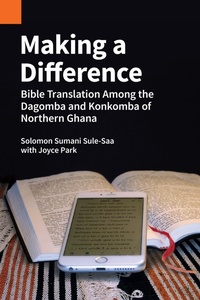
Making a Difference
Description

How did two very different language communitiesencounter and make early choices about Christianity? This book is a historicalrecord of the Dagomba and Konkomba people groups of Northern Ghana as theyembraced the Bible translated into their mother tongues. Author Dr. Sumani Sule-Saa employs Professor LaminSanneh's groundbreaking hermeneutic of 'mission as translation' as a grid toexamine the effect of Bible translation on the lives of these two veryimportant language groups. Sule-Saa first presents a brief history of theDagomba and Konkomba and describes their very different societal structures. Heanalyses early Christian mission involvement and documents the role of twoBible translation agencies among these people groups. Through a number of case studieshe illustrates the positive impact of the Bible in their mother tongues. Woventhroughout, Dr. Sule-Saa discusses to what degree the Christian faith has beenindigenised into the ethos and behaviour of the Dagomba and Konkomba. Theological students and those interested in missionswill find this book relevant as it deals with missiological issues and servesas a reference on the establishment of Christianity among the Dagomba andKonkomba. Its multi-disciplinary approach will also appeal to a wider audience.
More details
Other editions
Additional editions
Person
Content
- Intro
- Abbreviations
- 1 Introduction
- 1.1 The intellectual framework of, and motivation for, the writing of this book
- 1.2 How this study was conducted
- 1.3 Overview of the book
- 1.4 Review of relevant literature
- 1.5 Sanneh's perspective on translation
- 2 Christianity as a Vernacular Translation Movement
- 2.1 A brief academic biography of Lamin Sanneh
- 2.2 Sanneh's journey of faith and thought
- 2.3 A new reading of Christian mission history
- 2.4 The significance of vernacular Scripture translation in mission
- 2.5 New approach to Christian mission in Africa
- 2.6 Sanneh, on the effects of mission as translation
- 2.6.1 Translation and empowerment
- 2.6.2 Translation and the enhancement of identity and confidence
- 2.6.3 Bible translation preserves indigenous languages
- 2.6.4 Challenging Western hegemony
- 2.6.5 Sanneh, on World Christianity
- 3 The Dagomba of Northern Ghana
- 3.1 Introduction
- 3.2 Sources
- 3.2.1 Non-written sources
- 3.2.2 Written sources
- The Ajami literature
- Colonial records
- 3.3 History of the Dagomba
- 3.3.1 The jihads
- 3.3.2 Possible origins
- 3.3.3 The colonial era
- 3.4 Administrative capitals
- 3.5 Demographic data
- 3.6 Dagomba relationships with other ethnic groups
- 3.6.1 The Mamprusi
- 3.6.2 The Mossi and Nanumba
- 3.6.3 The Gonja
- 3.7 The impact of the Asante empire on the Dagomba and the Asante decline
- 3.8 Post-independence developments
- 3.8.1 Recent history
- 3.8.2 Urban Dagomba and rural Dagomba
- 3.9 Language
- 3.10 Social organisation
- 3.11 Rituals governing traditional life
- 3.11.1 Marriage
- 3.11.2 Beliefs around pregnancy
- 3.11.3 Birth
- 3.11.4 Circumcision
- 3.11.5 Death and burial
- 3.11.6 Festivals and celebrations
- 3.12 The Dagomba response to Western education and development
- 3.13 Dagomba Religion
- 3.13.1 Effect of migration on religions
- 3.13.2 Dagomba primal religion
- Buga '(lesser) divinities' and 'nature spirits'
- Baga 'diviners' or 'soothsayers'
- Son-nya 'witchcraft' or 'sorcery'
- Witch camps
- Tam and tiima 'traditional medicine'
- Saba 'amulets'
- 3.14 History of Islam in Dagbon
- 3.15 Dagbon chieftaincy and religion
- 3.16 The Dagomba of Northern Ghana: Conclusion
- 4 The Konkomba of Northern Ghana
- 4.1 Introduction
- 4.2 Sources
- 4.3 History: Origins of the Konkomba
- 4.4 The Konkomba under colonial authority
- 4.5 The Konkomba after Ghanean independence as a republic
- 4.6 Recent history
- 4.7 The Konkomba and their neighbours
- 4.8 Language
- 4.9 The Konkomba and related ethnic groups
- 4.9.1 The Mamprusi kingdom
- 4.9.2 The Nanumba
- 4.9.3 The Gonja
- 4.10 The stigmatisation of the Konkomba
- 4.11 The Konkomba and ethnic pride
- 4.12 Education and literacy
- 4.13 Social organisation
- 4.14 The traditional beliefs and worldview of the Konkomba
- 4.14.1 Uwumbor 'supreme God'
- 4.14.2 The kenjaa 'lesser gods' and 'nature spirits' of the Konkomba
- 4.14.3 Bininkpieb 'ancestors' of the Konkomba
- 4.14.4 Oubwa 'diviners'
- 4.14.5 Njog 'sorcerer's medicine'
- 4.14.6 Kesuo 'witchcraft/sorcery'
- 4.15 The Konkomba and Islam
- 4.16 The Konkomba traditional festivals
- 4.17 Traditional ritual and belief
- 4.17.1 Marriage
- 4.17.2 Circumcision
- 4.17.3 Death and burial
- 4.18 Conclusion
- 5 Christian Mission in Northern Ghana: The Dagomba Story
- 5.1 Introduction
- 5.2 Colonial authorities and Christian mission in the Northern Territories
- Relations between colonial authorities and Christian missions
- 5.3 Beginnings of Christian mission
- 5.3.1 The pioneer missions amongst the Dagomba
- The Basel Mission
- The Wesleyan Mission
- 5.3.2 Role of southern Christians
- 5.3.3 The challenges to the Christian mission enterprise
- 5.4 Another phase of the Christian mission to the Dagomba
- 5.4.1 The Assemblies of God mission to the Dagomba
- 5.4.2 The Catholic church
- 5.4.3 The Evangelical Presbyterian Church
- 5.4.4 The Baptist church
- 5.4.5 The second mission of the Presbyterian Church of Ghana to the Dagomba
- 5.4.6 The Scripture Union
- 5.5 Current challenges and opportunities in Christian mission to the Dagomba
- 5.5.1 The challenge of Islam
- 5.5.2 Initial perception of Christianity as alien
- 5.5.3 Poverty
- 5.5.4 Ethnic conflicts
- 5.5.5 Church structures and the Christian mission to the northern peoples
- 5.6 Good will towards Christianity
- Role of Christian NGOs
- 5.7 Translation of Christianity among the Dagomba
- 5.8 Early attempts at Dagbani Bible translation
- 5.8.1 The Basel Mission
- 5.8.2 The Assemblies of God Mission
- 5.9 The translation and use of the Dagbani Old Testament
- 5.9.1 The Bible Society of Ghana and Dagbani Bible translation
- 5.9.2 Faith Comes By Hearing and Scripture engagement
- 5.9.3 The role of GILLBT in the Dagbani Literacy Project
- 5.10 Conclusion
- 6 Christian Mission in Northern Ghana: The Konkomba Story
- 6.1 Introduction
- 6.2 Colonial policy and the evangelisation of the Konkomba
- 6.2.1 Assemblies of God mission to the Konkomba
- 6.2.2 The Evangelical Presbyterian Church
- 6.2.3 The Worldwide Evangelisation Crusade
- 6.3 An evaluation of the missionary enterprise among the Konkomba
- 6.4 Konkomba preference for Christianity
- 6.5 Mission as a translation movement: The Konkomba Christian Scriptures
- 6.5.1 Literacy among the Konkomba
- 6.5.2 SIL International and GILLBT
- 6.6 The role of the indigenous Konkomba in Bible translation
- The Konkomba traditional religion in the translation process
- 6.7 Some aspects of the translation process
- 6.7.1 Anthropological research
- 6.7.2 Sociolinguistic survey
- 6.7.3 Literacy
- 6.7.4 Securing funding
- 6.7.5 Personnel
- 6.7.6 Involvement of the churches
- 6.8 Conclusion
- 7 Sanneh's Hermeneutic of Mission as Translation and Anti-hegemony: Test Case of the Dagomba and the Konkomba
- 7.1 Introduction
- 7.2 The effect of mother-tongue Scriptures in light of Sanneh's paradigm
- 7.3 The Dagomba and Konkomba use of the Bible since publication
- 7.4 The effect of Bible translation on the Dagomba
- 7.4.1 Testimonies from Faith Comes By Hearing
- 7.4.2 Dagbani Scriptures and social change
- 7.5 The effect of the Likpakpaaln Scriptures on the Konkomba
- 7.6 The effect of Bible translation on the Bimoba people - a comparison
- 7.7 The mother-tongue Scriptures and conversion
- 7.8 The effect of the Scriptures on theological understanding
- 7.9 Socio-cultural effect
- 7.10 Mother-tongue Scriptures and modern challenges
- 7.11 Mother-tongue Scriptures and primal religious aspirations
- 7.12 Bible translation and renewal of Dagomba and Konkomba cultures
- 7.12.1 The vernacular Scriptures and festivals
- 7.12.2 The mother tongue and guidance
- 7.12.3 Mother-tongue Scriptures as the moral frame of reference
- 7.12.4 Mother-tongue Scriptures and subversion of hegemony
- 7.12.5 The Dagbani and Likpakpaaln Scriptures and holistic development
- 7.12.6 Bible translation as holistic mission
- 7.13 Summary
- 8 A Revitalised Indigenous Consciousness: The Fruit of Translation
- 8.1 The troubled beginnings of Christian mission in northern Ghana
- 8.2 Lamin Sanneh's new look at Christian mission
- 8.3 Christian mission against cultural hegemony
- 8.4 A new approach to evangelisation: learning the languages of the people
- 8.5 Translation of culture along with translation of Scriptures
- 8.5.1 The Dagomba response to vernacular Bible translation
- 8.5.2 The Konkomba response to vernacular Bible translation
- 8.6 Other effects of the translated Scriptures
- Appendix: Dagomba and Konkomba Anthems Sung in Churches
- 1. Two Dagomba anthems sung in churches
- 2. A Konkomba anthem sung in churches
- Archival Source References
- (FCBH) Faith Comes by Hearing
- (PCG) Presbyterian Church of Ghana
- (PRAAD) Public Records Administration and Archives Department
- Textual References
- Index
