

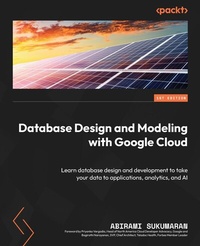
Database Design and Modeling with Google Cloud
Learn database design and development to take your data to applications, analytics, and AI
1st Edition
Published on 29. December 2023
234 pages
978-1-80461-786-1 (ISBN)
Description

Build faster and efficient real-world applications on the cloud with a fitting database model that's perfect for your needsKey Features - Familiarize yourself with business and technical considerations involved in modeling the right database
- Take your data to applications, analytics, and AI with real-world examples
- Learn how to code, build, and deploy end-to-end solutions with expert advice
- Purchase of the print or Kindle book includes a free PDF eBook
Book DescriptionIn the age of lightning-speed delivery, customers want everything developed, built, and delivered at high speed and at scale. Knowledge, design, and choice of database is critical in that journey, but there is no one-size-fits-all solution. This book serves as a comprehensive and practical guide for data professionals who want to design and model their databases efficiently. The book begins by taking you through business, technical, and design considerations for databases. Next, it takes you on an immersive structured database deep dive for both transactional and analytical real-world use cases using Cloud SQL, Spanner, and BigQuery. As you progress, you'll explore semi-structured and unstructured database considerations with practical applications using Firestore, cloud storage, and more. You'll also find insights into operational considerations for databases and the database design journey for taking your data to AI with Vertex AI APIs and generative AI examples. By the end of this book, you will be well-versed in designing and modeling data and databases for your applications using Google Cloud.What you will learn - Understand different use cases and real-world applications of data in the cloud
- Work with document and indexed NoSQL databases
- Get to grips with modeling considerations for analytics, AI, and ML
- Use real-world examples to learn about ETL services
- Design structured, semi-structured, and unstructured data for your applications and analytics
- Improve observability, performance, security, scalability, latency SLAs, SLIs, and SLOs
Who this book is forThis book is for database developers, data engineers, and architects looking to design, model, and build database applications on the cloud with an extended focus on operational consideration and taking their data to AI. Data scientists, as well ML and AI engineers who want to use Google Cloud services in the data to AI journey will also find plenty of useful information in this book. It will also be useful to data analysts and BI developers who want to use SQL impactfully to generate ML and generative AI insights from their data.
- Take your data to applications, analytics, and AI with real-world examples
- Learn how to code, build, and deploy end-to-end solutions with expert advice
- Purchase of the print or Kindle book includes a free PDF eBook
Book DescriptionIn the age of lightning-speed delivery, customers want everything developed, built, and delivered at high speed and at scale. Knowledge, design, and choice of database is critical in that journey, but there is no one-size-fits-all solution. This book serves as a comprehensive and practical guide for data professionals who want to design and model their databases efficiently. The book begins by taking you through business, technical, and design considerations for databases. Next, it takes you on an immersive structured database deep dive for both transactional and analytical real-world use cases using Cloud SQL, Spanner, and BigQuery. As you progress, you'll explore semi-structured and unstructured database considerations with practical applications using Firestore, cloud storage, and more. You'll also find insights into operational considerations for databases and the database design journey for taking your data to AI with Vertex AI APIs and generative AI examples. By the end of this book, you will be well-versed in designing and modeling data and databases for your applications using Google Cloud.What you will learn - Understand different use cases and real-world applications of data in the cloud
- Work with document and indexed NoSQL databases
- Get to grips with modeling considerations for analytics, AI, and ML
- Use real-world examples to learn about ETL services
- Design structured, semi-structured, and unstructured data for your applications and analytics
- Improve observability, performance, security, scalability, latency SLAs, SLIs, and SLOs
Who this book is forThis book is for database developers, data engineers, and architects looking to design, model, and build database applications on the cloud with an extended focus on operational consideration and taking their data to AI. Data scientists, as well ML and AI engineers who want to use Google Cloud services in the data to AI journey will also find plenty of useful information in this book. It will also be useful to data analysts and BI developers who want to use SQL impactfully to generate ML and generative AI insights from their data.
All prices
More details
Other editions
Additional editions
Abirami Sukumaran
Database Design and Modeling with Google Cloud
Learn database design and development to take your data to applications, analytics, and AI
Book
12/2023
Packt Publishing
€41.50
Shipment within 3-4 weeks
Content
- Cover
- Title Page
- Copyright and Credits
- Dedications
- Forewords
- Contributors
- Table of Contents
- Part 1: Database Model: Business and Technical Design Considerations
- Data, Databases, and Design
- Data
- Databases
- A teeny-tiny bit about the evolution of databases
- DBMS
- Database design
- Data modeling
- Database modeling
- Considerations for a good database design
- Business aspect
- Ingestion
- Technical aspect
- Choosing the right database
- Relational database
- NoSQL database
- Summary
- Chapter 2: Handling Data on the Cloud
- Types of cloud services
- Use case categories
- The benefits of cloud computing
- Data applications on cloud
- Storage
- Backup and disaster recovery
- Analytics and insights
- Application development
- User experience and personalization
- Managed, unmanaged, and database as a service
- Managed databases
- Unmanaged databases
- Database as a service
- Cloud database considerations
- A quick follow-up
- Summary
- Part 2: Structured Data
- Chapter 3: Database Modeling for Structured Data
- Structured data
- Rows and columns
- Transactional applications
- Analytical applications
- Using an RDBMS for structured data
- Atomicity
- Consistency
- Isolation
- Durability
- Considerations for your RDBMS
- Structured query language
- Sample SQL queries
- Summary
- Chapter 4: Setting Up a Fully Managed RDBMS
- Fully managed databases
- Fully managed RDBMS
- Cloud SQL
- Setting up and configuring a fully managed RDBMS
- Creating a Cloud SQL instance for MySQL
- Connecting to the instance
- Creating a database
- Creating a table
- Inserting values
- Querying values
- Creating an application with the Cloud database
- Configuring the Cloud Functions service account
- Creating a Cloud Function
- Operational aspects of cloud relational databases
- Migration
- Monitoring
- Query Insights
- Security
- Summary
- Chapter 5: Designing an Analytical Data Warehouse
- Understanding how data warehouses are different from databases
- Significance of ETL in data warehouse
- Learning about BigQuery
- Features of BigQuery
- Setting up and configuring a fully managed data warehouse with BigQuery
- Enabling BigQuery from the console
- Creating a BigQuery dataset
- Using an existing public dataset
- Creating a table in the dataset
- Performing simple analytics
- Summary of operational aspects and design considerations
- Summary
- Part 3: Semi-Structured, Unstructured Data, and NoSQL Design
- Chapter 6: Designing for Semi-Structured Data
- Semi-structured data
- Pros and cons of semi-structured data
- Use cases of semi-structured data
- NoSQL for semi-structured data
- Data structures supported by NoSQL databases
- Firestore and its features
- Setting up Firestore
- Collection
- Document
- Subcollection
- Security
- Client libraries and APIs
- Indexing
- Single-field index
- Composite index
- Collection group query
- Data model considerations
- Hierarchical format
- Denormalized format
- Easy querying with RunQuery API
- API endpoint and method
- The parent parameter
- JSON body format
- StructuredQuery
- The from clause
- The where clause
- Putting the pieces together
- Implementing RunQuery API programmatically
- Summary
- Chapter 7: Unstructured Data Management
- Use cases
- Processing unstructured data
- Storage options in Google Cloud
- Cloud Storage, classes, and features
- Unstructured data storage with BigQuery
- External sources
- External connections
- Unstructured data analytics with BigQuery
- Summary
- Part 4: DevOps and Databases
- Chapter 8: DevOps and Databases
- Upgrades, updates, and patching
- Security, privacy, and encryption
- Replication and availability
- Scalability
- Performance and throughput
- SLA, SLI, and SLO
- Data federation
- Continuous integration/continuous delivery (CI/CD)
- Migrating to cloud databases
- Database Migration Service
- System, query, and performance insights
- Summary
- Part 5: DevOps and Databases
- Chapter 9: Data to AI - Modeling Your Databases for Analytics and ML
- Modeling considerations for analytics, AI, and ML
- Data to AI
- Google Cloud ETL services
- Google Cloud Dataflow at a glance
- Real-world use cases for Google Cloud Dataflow
- Step-by-step guide to Google Cloud Dataflow
- Taking your data to AI
- Summary
- Chapter 10: Looking Ahead - Designing for LLM Applications
- Capturing the evolution of LLMs
- Getting started with LLMs
- Understanding the underlying principles of LLMs
- Comparing real-world applications of LLMs and traditional analytics
- Understanding the differences in data modeling for traditional analytics and LLMs
- Data model design considerations for applications that use LLMs
- Learning about data modeling principles and techniques
- Ethical and responsible practices
- Hands-on time - building an LLM application
- Step 1 - create a table
- Step 2 - insert data into the table
- Step 3 - create an external connection for BigQuery to access the Vertex AI model
- Step 4 - grant permissions to the service account to access the Vertex AI service
- Step 5 - create the remote model in BigQuery
- Step 6 - query the dataset
- Step 7 - generate text (create an LLM application) using only SQL
- Vector databases
- Summary
- Onward and upward!
- Index
- Other Books You May Enjoy
