

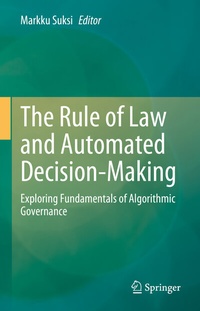
The Rule of Law and Automated Decision-Making
Description

More details
Other editions
Additional editions
Person
Markku Suksi started up legal research about automated decision-making (ADM) in 2016, and since then, he has published several articles about ADM. The perspective he adopts concerning ADM is a combination of constitutional and administrative law. An article published in 2019 was awarded the bi-annual price of the legal journal Tidskrift utgiven av Juridiska Föreningen i Finland (JFT) in December 2021. He is involved since 2020 as a permanent member of the WASP-HS project's Scientific Evaluation Committee (The Wallenberg AI, Autonomous Systems and Software Program - Humanities and Society, Sweden, a "private" funding device working in collaboration with Swedish universities in funding research related to algorithmic systems). Suksi has made presentations at several international conferences and events about legal issues related to ADM and has organized two international conferences (2019, 2021) about ADM issues at his own university, Åbo Akademi University, where he is Professor of Public Law.
Content
- Introduction.- 2. Situating the Rule of Law in a Context of Automated Decision-Making.- 3. Legislating for Legal Certainty, with a Right to a Human Face, in an Automated Public Administration.- 4. Formal, Procedural, and Material Requirements of the Rule of Law in the Context of Automated Decision-Making.- 5. Automation in Administrative Decision-Making Concerning Social Benefits: A Government Agency Perspective.- 6. Artificial Intelligence, Public Administration, and the Rule of Law: Towards the Uncertainties of a New "Rule of Algorithms".- 7. Discretion, Automation, and Proportionality.- 8. Legislating AI: A Matter of High-Risk Administration?.- 9. Algorithms in Public Administration: Legal Implications.- 10. Concluding Reflections on the Digitalization of Government Functions through Automated Decision-Making, with Some Wider AI Issues.
