

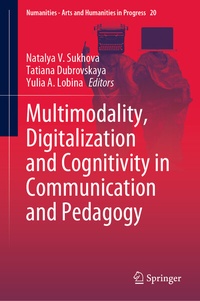
Multimodality, Digitalization and Cognitivity in Communication and Pedagogy
1st Edition
Published on 21. October 2021
X, 245 pages
978-3-030-84071-6 (ISBN)
Description

This book positions itself at the intersection of the key areas of the modern humanities. Different authors from a variety of countries take innovative approaches to investigating multimodal communication, adapting pedagogical design to digital environments and enhancing cognitive skills through transformations in teaching and learning practices. The eclectic forms under study require eclectic approaches and methodologies, and the authors cross disciplinary boundaries drawing on philosophy, linguistics, semiotics, computational linguistics, mathematics, cognitive studies and neuroaesthetics.
Part I presents methods of analysing multimodal communication in its different displays, covering promotional video in crowdfunding project presentations, multimodal public signs of prohibition and visuals as arguments. Part II explores varied teaching methodologies that have emerged as a result of and in response to modern technological changes and contains somepractical hints for educators. It demonstrates the pedagogical potential of video games, virtual worlds, linguistic corpora and online dictionaries. Part III focuses on psychological and cognitive factors influencing success in the classroom, primarily, ways of developing students' and teachers' personalities.
The volume sits at the intersection between Communication Studies, Digital Humanities, Discourse Analysis, Education Theory and Cognitive Studies and is useful to scholars and students of communication, languages, education and other areas of the humanities. This book should trigger scholarly discussions as well as stimulating practitioners' interest in these fields.
Part I presents methods of analysing multimodal communication in its different displays, covering promotional video in crowdfunding project presentations, multimodal public signs of prohibition and visuals as arguments. Part II explores varied teaching methodologies that have emerged as a result of and in response to modern technological changes and contains somepractical hints for educators. It demonstrates the pedagogical potential of video games, virtual worlds, linguistic corpora and online dictionaries. Part III focuses on psychological and cognitive factors influencing success in the classroom, primarily, ways of developing students' and teachers' personalities.
The volume sits at the intersection between Communication Studies, Digital Humanities, Discourse Analysis, Education Theory and Cognitive Studies and is useful to scholars and students of communication, languages, education and other areas of the humanities. This book should trigger scholarly discussions as well as stimulating practitioners' interest in these fields.
More details
Series
Language
English
Place of publication
Cham
Switzerland
Publishing group
Springer International Publishing
Target group
Professional and scholarly
Product notice
Reflowable
Illustrations
X, 245 p. 43 illus., 35 illus. in color.
File size
4,54 MB
ISBN-13
978-3-030-84071-6 (9783030840716)
DOI
10.1007/978-3-030-84071-6
Schweitzer Classification
Other editions
Additional editions
Natalya V. Sukhova | Tatiana Dubrovskaya | Yulia A. Lobina
Multimodality, Digitalization and Cognitivity in Communication and Pedagogy
Book
10/2021
Springer
€128.39
Shipment within 7-9 days
Persons
Natalya V. Sukhova
is Associate Professor at the National University of Science and Technology MISiS (Moscow, Russia). She got her Ph.D. in Philology from the Moscow Linguistic University (2004). She taught ESP courses at Lomonosov Moscow State University (School of Public Administration) and was affiliated with the Institute of Linguistics at Russian Academy of Sciences where she took part in the project on multichannel linguistics and gesture studies. She has published over 50 articles on pedagogy, gesture studies and English Phonetics and 5 textbooks on teaching English for Specific Purposes. She is a member of the editorial board of Numanities series (Springer) and of Association of Public Relations Educators of Russia. The main interests are non-verbal semiotics and gesture studies, English Phonetics and foreign language teaching.
Tatiana Dubrovskaya is Habilitated Doctor, Professor and Head of the English Language Department at Penza State University, Russia. She is also affiliated with Belgorod National Research University, Russia, as a Professor at the Department of Communication Studies, Advertising and Public Relations. She has published extensively in the areas of linguistic pragmatics, political, legal and media discourse, cross-cultural communication in internationally acknowledged journals, such as Discourse and Communication, Critical Discourse Studies, Discourse Studies. She co-edited a few volumes, including Young Scholars' Developments in Linguistics: Tradition and Change (Cambridge Scholars Publishing, 2015). She is a member of the Russian Communication Association and the International Society for the Study of Argumentation.
Yulia A. Lobina is Professor at Ulyanovsk State University of Education (Ulyanovsk, Russia). She got her Ph.D. in Language Theory from Ulyanovsk State University (Russia, 2002). She is Professor at the English language department of Ulyanovsk State University of Education. She teaches courses in introductory linguistics, cross-cultural studies and English for Academic Purposes. She has published over 60 articles on genre studies, cross-cultural communication and pedagogy and edited/co-edited 5 volumes of young scholars' research papers. The main interests are academic discourse, genre studies and language teaching.
Tatiana Dubrovskaya is Habilitated Doctor, Professor and Head of the English Language Department at Penza State University, Russia. She is also affiliated with Belgorod National Research University, Russia, as a Professor at the Department of Communication Studies, Advertising and Public Relations. She has published extensively in the areas of linguistic pragmatics, political, legal and media discourse, cross-cultural communication in internationally acknowledged journals, such as Discourse and Communication, Critical Discourse Studies, Discourse Studies. She co-edited a few volumes, including Young Scholars' Developments in Linguistics: Tradition and Change (Cambridge Scholars Publishing, 2015). She is a member of the Russian Communication Association and the International Society for the Study of Argumentation.
Yulia A. Lobina is Professor at Ulyanovsk State University of Education (Ulyanovsk, Russia). She got her Ph.D. in Language Theory from Ulyanovsk State University (Russia, 2002). She is Professor at the English language department of Ulyanovsk State University of Education. She teaches courses in introductory linguistics, cross-cultural studies and English for Academic Purposes. She has published over 60 articles on genre studies, cross-cultural communication and pedagogy and edited/co-edited 5 volumes of young scholars' research papers. The main interests are academic discourse, genre studies and language teaching.
Content
Chapter 1. Communication challenges in modern social practices (Tatiana Dubrovskaya, Natalya V. Sukhova and Yulia A. Lobina).- Part I: Studies in multimodality.- Chapter 2. Patterns of discourse organization in multimodal discourse of crowdfunding project presentations (Grzegorz Kowalski).- Chapter 3. Regulating social behaviour by multimodal public signs: Semiotic pragmatics of prohibition (Evgeniy Kozhemyakin and Tatiana Dubrovskaya).- Chapter 4. Methodological problems in analysing non-verbal arguments: The case of visual argumentation (Igor Z. Zagar).- Part II: Language teaching methodology for digital environments.- Chapter 5. Video games in the development of cognitive skills relevant for language learning: A systematic review (Lilia V. Bondareva and Tatiana V. Potemkina).- Chapter 6. Language acquisition in virtual worlds versus traditional classroom environments: A comparative overview between the United States and Russia (Jasmin B. Cowin and Sana S. Saulembekova).- Chapter 7 Corpus technologies in teaching English to speakers of other languages (Natalya N. Koshkarova).- Chapter 8. Improving lexicography teaching: A practical approach (Raluca Sinu).- Part III: Cognitive approaches to language and pedagogical design.- Chapter 9. Writing, imitation and the brain: insights from neuroscience research (Irene Clark).- Chapter 10. Modelling spoken genres for foreign language learners (Yulia A. Lobina).- Chapter 11. Methods of psycholinguistic research as possible cognitive approaches to linguistic data processing (Irina V. Privalova).- Chapter 12. Teacher personality as a factor of pedagogical design (Ekaterina N. Shchaveleva, Andrei N. Kuznetsov and Yulia V. Pushkina).- Chapter 13. Phonetics as an art: Real or surreal assessment criteria? (Natalya V. Sukhova).
