

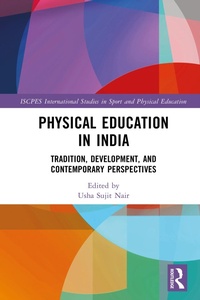
Physical Education in India
Tradition, Development, and Contemporary Perspectives
Will be published approx. on 1. July 2026
296 pages
978-1-040-68520-4 (ISBN)
Description

This book takes a close look at the history, policy, and practice of physical education in India. Exploring this topic in unprecedented breadth and depth, the book provides an important case study of the significance of physical education in wider society, in education more broadly, and in the context of a rapidly developing economy.
The book introduces the history of physical education in India and examines the contemporary landscape, including physical education in schools and in higher education as well as physical education teacher education programs. It takes a close look at the role of government in developing physical education, at the infrastructure and policy architecture that underpins the Indian system, and pays close attention to the challenges facing women and girls in physical education today. The book also considers the Indian experience in the wider international context and takes a deep dive into the particular circumstances, policies, and practices within each Indian state.
Shining new light on the education and development of one of the world's most important and diverse emerging nations, this book is essential reading for anybody with an interest in physical education, teacher education, education policy, the history of sport and physical activity, South Asian studies, or development studies.
The book introduces the history of physical education in India and examines the contemporary landscape, including physical education in schools and in higher education as well as physical education teacher education programs. It takes a close look at the role of government in developing physical education, at the infrastructure and policy architecture that underpins the Indian system, and pays close attention to the challenges facing women and girls in physical education today. The book also considers the Indian experience in the wider international context and takes a deep dive into the particular circumstances, policies, and practices within each Indian state.
Shining new light on the education and development of one of the world's most important and diverse emerging nations, this book is essential reading for anybody with an interest in physical education, teacher education, education policy, the history of sport and physical activity, South Asian studies, or development studies.
More details
Series
Language
English
Place of publication
London
United Kingdom
Publishing group
Taylor & Francis Ltd
Target group
Professional and scholarly
Product notice
Reflowable
Illustrations
1 Tables, black and white; 1 Line drawings, black and white; 1 Illustrations, black and white
File size
0,86 MB
ISBN-13
978-1-040-68520-4 (9781040685204)
Copyright in bibliographic data and cover images is held by Nielsen Book Services Limited or by the publishers or by their respective licensors: all rights reserved.
Schweitzer Classification
Other editions
Additional editions
Book
approx. 07/2026
1st Edition
Routledge
€191.50
Not yet published
Person
Usha Sujit Nair is the Former Officiating Vice Chancellor of the National Sports University, Imphal, India, and an Emeritus Resource Faculty at Rashtriya Raksha University, India. She also holds leadership roles with the International Society for Comparative Physical Education and Sport (ISCPES), the International Association of Physical Education and Sport for Girls and Women (IAPESGW), and the International Council of Sport Science and Physical Education (ICSSPE).
Content
Part I: Contextualizing Education in India: Exploring Global Perspectives in Physical Education Policies and Unravelling Progress and Challenges in International Research. 1. Introduction: Overview of Educational System in India. 2. Global Horizons in Physical Education Policies. 3. Exploring The Impact and Effectiveness of Quality Physical Education Worldwide. Part II: Physical Education in Post-Independence India: Systems, Policy, and Practice. 4. Physical Education in India in the Pre-Independence Era. 5. Physical Education in India in the Post-Independence Era. 6. Adapting Physical Education in Higher Education in India. 7. Teacher Preparation in Physical Education in India. 8. Girls and Women in Physical Education. 9. Government Initiatives in Physical Education and Sports. 10. Assessing Infrastructure and Accessibility in Physical Education and Sports in India. Part III: Specific Review of Physical Education in Selected States of India. 11. Physical Education in Kerala. 12. Physical Education in Delhi. 13. Physical Education in Punjab. 14. Physical Education in Manipur. 15. Physical Education in Jammu and Kashmir. 16. Physical Education in Tamil Nadu. 17. Physical Education in Haryana. 18. Physical Education in Chhattisgarh. 19. Physical Education in West Bengal. 20. Physical Education in Gujarat. 21. Physical Education in Goa. 22. Physical Education in Madhya Pradesh. Part IV: Future Perspectives and Holistic Recommendations. 23. Future Perspectives and Holistic Policy Recommendations.
