

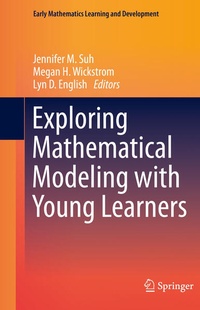
Exploring Mathematical Modeling with Young Learners
Description

This book conceptualizes the nature of mathematical modeling in the early grades from both teaching and learning perspectives. Mathematical modeling provides a unique opportunity to engage elementary students in the creative process of mathematizing their world.
A diverse community of internationally known researchers and practitioners share studies that advance the field with respect to the following themes:
-
The Nature of Mathematical Modeling in the Early Grades
-
Content Knowledge and Pedagogy for Mathematical Modeling
-
Student Experiences as Modelers
-
Teacher Education and Professional Development in Modeling
Experts in the field provide commentaries that extend and connect ideas presented across chapters. This book is an invaluable resource in illustrating what all young children can achieve with mathematical modeling and how we can support teachers and families in this important work.
Reviews / Votes
"This book is an invaluable resource . . recommended for both those conducting research in mathematical modeling pedagogy as well as elementary teachers who would like to incorporate mathematical modeling in their classroom. This could also be used as a supplemental textbook for a graduate level mathematics education student studying elementary mathematics education. . provides the reader with a broad overview of the major issues and challenges facing the field of teaching and learning mathematical modeling to young learners." (Blain Patterson, MAA Reviews, September 20, 2021)"This book makes an excellent contribution to the mathematical modeling literature. The chapters in this book are focused on areas of interest for research on mathematical modeling. . Exploring Mathematical Modeling with Young Learners is a great resource for those interested in mathematical modeling and rich mathematics education experiences for young learners. . Research and implementation of mathematical modeling with young learners will continue to grow, and this book provides direction and guidance for this work." (Micah Stohlmann, Educational Studies in Mathematics, August 18, 2021)
More details
Other editions
Additional editions
Persons
Jennifer Suh is a Professor in the Graduate School of Education, College of Education and Human Development, George Mason University. Dr. Suh teaches mathematics methods courses in the Elementary Education Program and mathematics leadership courses for the Mathematics Specialist Masters and Ph.D Programs. She directs the Center for Outreach in Mathematics Professional Learning and Educational Technology, COMPLETE, a joint center between the College of Education and the College of Science. Her research focuses on: Implementing Lesson Study to develop pedagogical mathematics knowledge across the continuum from pre-service teachers to mathematics teacher leaders; Building children's development of mathematical meaning through math modeling and representational fluency; Promoting equitable access to 21st century skills through problem-based learning encouraging creativity, critical thinking, communication and collaboration for diverse student populations. Through formal andinformal educational outreach, Dr. Suh enjoys working with schools, communities teachers and parents to show how math can be useful in solving real world problems and be enjoyable to teach and learn.
Megan H. Wickstrom
is an Associate Professor in the Department of Mathematical Sciences, College of Letters and Science, Montana State University. Dr. Wickstrom teaches mathematics content and methods courses for pre-service and in-service K-12 teachers across undergraduate, masters, and Ph.D. programs. Her research focuses on: the teaching and learning of mathematical modeling in K-16 classrooms; the teaching and learning of geometry and measurement in K-16 classrooms; pre-service teacher preparation; and integration of research into practice. Dr. Wickstrom enjoys working alongside teachers to develop tasks that engage students in rich mathematical thinking and discussion.
Lyn English
is a Professor of STEM Education at the Queensland University of Technology, Brisbane, Australia. Her areas of research, spanning K-8, include mathematics education, STEM education, engineering in the elementary and middle schools, mathematical modeling, problem solving and reasoning, statistics education, and early mathematics learning. Lyn is a Fellow of The Academy of the Social Sciences in Australia, and is founding editor (1997) of the international journal, Mathematical Thinking and Learning (Taylor & Francis). She is the editor of the Springer series, Early Mathematics Learning and Development, and has published numerous edited books with various publishing houses, as well as many book chapters, journal articles and other papers.
