

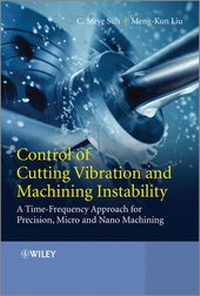
Control of Cutting Vibration and Machining Instability
Description

More details
Other editions
Additional editions
Persons
Content
Preface ix
1 Cutting Dynamics and Machining Instability 1
1.1 Instability in Turning Operation 2
1.1.1 Impact of Coupled Whirling and Tool Geometry on Machining 3
1.2 Cutting Stability 10
1.3 Margin of Stability and Instability 12
1.4 Stability in Fine Cuts 23
1.5 Concluding Remarks 31
References 32
2 Basic Physical Principles 33
2.1 Euclidean Vectors 33
2.2 Linear Spaces 34
2.3 Matrices 36
2.3.1 Eigenvalue and Linear Transformation 37
2.4 Discrete Functions 38
2.4.1 Convolution and Filter Operation 39
2.4.2 Sampling Theorem 40
2.4.3 z-Transform 41
2.5 Tools for Characterizing Dynamic Response 42
2.5.1 Fourier Analysis 49
2.5.2 Wavelet Analysis 51
References 54
3 Adaptive Filters and Filtered-x LMS Algorithm 55
3.1 Discrete-Time FIR Wiener Filter 55
3.1.1 Performance Measure 56
3.1.2 Optimization of Performance Function 58
3.2 Gradient Descent Optimization 60
3.3 Least-Mean-Square Algorithm 62
3.4 Filtered-x LMS Algorithm 64
References 68
4 Time-Frequency Analysis 71
4.1 Time and Frequency Correspondence 72
4.2 Time and Frequency Resolution 75
4.3 Uncertainty Principle 76
4.4 Short-Time Fourier Transform 77
4.5 Continuous-Time Wavelet Transform 79
4.6 Instantaneous Frequency 81
4.6.1 Fundamental Notions 82
4.6.2 Misinterpretation of Instantaneous Frequency 85
4.6.3 Decomposition of Multi-Mode Structure 90
4.6.4 Example of Instantaneous Frequency 94
4.6.5 Characteristics of Nonlinear Response 97
References 100
5 Wavelet Filter Banks 101
5.1 A Wavelet Example 101
5.2 Multiresolution Analysis 104
5.3 Discrete Wavelet Transform and Filter Banks 112
References 116
6 Temporal and Spectral Characteristics of Dynamic Instability 117
6.1 Implication of Linearization in Time-Frequency Domains 118
6.2 Route-to-Chaos in Time-Frequency Domain 125
6.3 Summary 134
References 134
7 Simultaneous Time-Frequency Control of Dynamic Instability 137
7.1 Property of Route-to-Chaos 137
7.1.1 OGY Control of Stationary and Nonstationary H¿enon Map 139
7.1.2 Lyapunov-based Control of Stationary and Nonstationary Duffing Oscillator 140
7.2 Property of Chaos Control 144
7.2.1 Simultaneous Time-Frequency Control 145
7.3 Validation of Chaos Control 155
References 162
8 Time-Frequency Control ofMilling Instability and Chatter at High Speed 165
8.1 Milling Control Issues 165
8.2 High-Speed Low Immersion Milling Model 167
8.3 Route-to-Chaos and Milling Instability 168
8.4 Milling Instability Control 170
8.5 Summary 175
References 176
9 Multidimensional Time-Frequency Control of Micro-Milling Instability 177
9.1 Micro-Milling Control Issues 177
9.2 Nonlinear Micro-Milling Model 179
9.3 Multivariable Micro-Milling Instability Control 181
9.3.1 Control Strategy 183
9.4 Micro-Milling Instability Control 186
9.5 Summary 193
References 197
10 Time-Frequency Control of Friction Induced Instability 199
10.1 Issues with Friction-Induced Vibration Control 199
10.2 Continuous Rotating Disk Model 201
10.3 Dynamics of Friction-Induced Vibration 206
10.4 Friction-Induced Instability Control 208
10.5 Summary 214
References 215
11 Synchronization of Chaos in Simultaneous Time-Frequency Domain 217
11.1 Synchronization of Chaos 217
11.2 Dynamics of a Nonautonomous Chaotic System 219
11.3 Synchronization Scheme 222
11.4 Chaos Control 223
11.4.1 Scenario I 223
11.4.2 Scenario II 227
11.5 Summary 227
References 229
Appendix: MATLAB® Programming Examples of Nonlinear Time-Frequency Control 231
A.1 Friction-Induced Instability Control 231
A.1.1 Main Program 232
A.1.2 Simulink® Model 236
A.2 Synchronization of Chaos 239
A.2.1 Main Program 239
A.2.2 Simulink® Model 244
Index 245
