

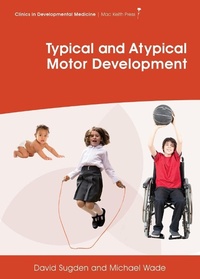
Typical and Atypical Motor Development
Published on 8. April 2013
396 pages
978-1-908316-56-1 (ISBN)
Description

Explains movement, or motor development, from differing theoretical, empirical, and experiential perspectives, and discusses atypical motor development when the resources of the child are limited in some way.
More details
Other editions
Additional editions
David Sugden | Michael Wade
Typical and Atypical Motor Development
Book
04/2013
1st Edition
Mac Keith Press
€230.27
Shipment within 3-4 weeks
Content
- Intro
- Contents
- Foreword
- Preface
- Acknowledgements
- About the authors
- 1 An Introduction to Motor Development
- Introduction
- Development
- Descriptions of change
- Motor development
- What is motor development?
- What does change look like?
- Characteristics and descriptions of movement
- Performance and learning, ability and skill
- Consequences of movement
- Movement by design
- The descriptive period
- Systems-orientated period
- Movement that informs
- Embodied cognition
- Developing adaptable motor control
- Summary
- 2 Biological Influences on DevelopmentalChange
- Selected anthropometric structural changes
- Physiological, neural, and sensory functional changes
- Influences on motor development
- Summary
- 3 Developmental Models and Theories
- Motor control and development theories
- What constitutes processing?
- Traditional information processing
- Information processing and motor development
- Summary
- 4 Early Movement Development: Birth to24 Months
- Introduction
- Movement activity in utero and at birth
- Development of vision and visual perception
- Locomotion
- Manual control
- Prospective control
- Summary
- 5 Motor Development of Young Children: 2 to7 Years of Age
- Descriptions of change
- Body control
- Manual control
- Control of limb movements
- Summary
- 6 Movement Development of Young Children:7 Years to Puberty
- A specific task illustrating spatial and temporaldemands
- Modelling mover and environmental conditions
- Spatial accuracy
- Temporal and spatial accuracy
- Development of maximal performance: normativecomparisons
- Movement abilities
- Summary
- 7 Cerebral Palsy
- Cerebral palsy: the condition
- Cerebral palsy and movement control
- Summary
- 8 Developmental Coordination Disorder
- Development of movement skill competence
- Historical context
- Terminology
- Who are the children?
- Diagnostic criteria for developmental coordinationdisorder
- Co-occurring characteristics
- Developmental progression
- Core motor characteristics of children with DCD
- Underlying biological substrates
- Constraints: perceptual, cognitive, and motor
- Summary
- 9 Children with Intellectual Disability
- General descriptions
- Constraints on control and coordination
- Summary and future directions
- 10 Motor Development in Children with OtherDevelopmental Disorders
- Introduction to developmental disorders
- Individual developmental disorders
- Summary
- 11 Children with Visual Impairment
- Role and nature of vision
- Movement development in blind children
- Summary
- 12 Assessment and Intervention for Childrenwith Movement Difficulties
- Assessment and intervention
- Purposes of assessment
- The field of intervention
- Principles underlying types of assessment andintervention
- Validity and reliability
- Intervention is about participation and learning
- Ecological approaches to assessment andintervention
- Approaches to assessment and collection ofinformation
- Process deficit and functional task-orientatedapproaches to intervention
- Interventions for cerebral palsy
- Summary
- 13 Perspectives on Typical and AtypicalDevelopment
- The 'what' and the 'how' of motor development
- Consistency and constancy
- Environmental influence
- How does development progress?
- Embodied cognition
- The typical-atypical continuum
- Index
