

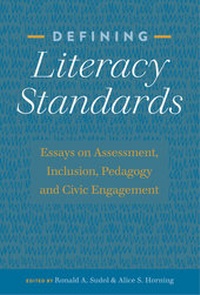
Defining Literacy Standards
Description

As individual institutions of education at all levels respond to the call for greater accountability and assessment, those who teach literacy face the challenging task of choosing what to measure and how to measure it. Both defining literacy clearly and tying that definition to strategies for assessment are two of many challenges faced by educators, theorists, and members of the public who assume responsibility for assessing literacy as well as developing and improving literacy programs. In a pluralistic and democratic society sensitive to multicultural variation, we need to find our way between the competing needs for inclusiveness and for clear and useful standards. Multiple definitions of literacy raise the issue of whether there can be a standard or set of standards and if so, what they are in an environment of multiple literacies. Indeed, the downside of the defeat of older monolithic notions of literacy is the undermining or at least the questioning of well-established methods of literacy assessment. To some extent, the older methods of assessment have been revised in the light of more expansive definitions of literacy. But will this kind of revision be enough? How are the criteria for judgment to be known and applied? Thus, this volume addresses the problems of assessing literacy development in the context of multiple and inclusive definitions. Each section consists of chapters that deal with the issue of definitions per se, with standards in postsecondary settings, with the K-12 situation, and with alternative, non-school environments where literacy is critical to human functioning in a democratic society.
More details
Other editions
Additional editions
Persons
Ronald A. Sudol is Professor Emeritus of Rhetoric and former dean of arts and sciences at Oakland University. He holds a Ph.D. from Stony Brook University and has had a long career in teaching, publication and consulting on writing and communications.
Alice S. Horning is Professor Emerita of Writing & Rhetoric and Linguistics at Oakland University. Her Ph.D. is from Michigan State University where she started her career focusing on the intersection of reading and writing.
Content
Alice S. Horning/Ronald A. Sudol: Introduction - Karen Sheingold/Joan I. Heller/Sheryl R. Kaskowitz: How Scoring Helps Teachers Understand Literacy Standards - Ronald A. Sudol: How Implementation Modifies Literacy Standards - Janice Witherspoon Neuleib/Maurice Scharton: Meeting Standards Through Effective Practices for Assessing Revision - Alice S. Horning: Adventures in Assessment: Definitions and Standards for Critical Literacy Programs - Sibylle Gruber: Learning in Different Worlds: Native American Students' Approaches to Academic Literacies - Laura Gray-Rosendale: Deconstructing "Dumb Reading Groups": Rural New England Culture, Basic Writers/Readers, and the Question of Standards - Van E. Hillard: Literacy Standards at Hull House: Forming a New Citizen in Civic Space - Ken Baake: Developing Reflective Homo Economics: How to Teach Economic Literacy in a Writing Course - Diane Kelly-Riley: Afterword: Challenges and Opportunities in the Changing Landscape of Literacy Assessment and Accountability - Contributors - Index.
