

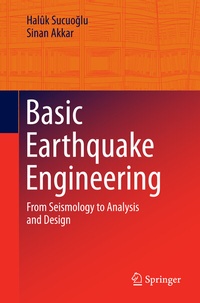
Basic Earthquake Engineering
Description

This book provides senior undergraduate students, master students and structural engineers who do not have a background in the field with core knowledge of structural earthquake engineering that will be invaluable in their professional lives. The basics of seismotectonics, including the causes, magnitude, and intensity of earthquakes, are first explained. Then the book introduces basic elements of seismic hazard analysis and presents the concept of a seismic hazard map for use in seismic design. Subsequent chapters cover key aspects of the response analysis of simple systems and building structures to earthquake ground motions, design spectrum, the adoption of seismic analysis procedures in seismic design codes, seismic design principles and seismic design of reinforced concrete structures. Helpful worked examples on seismic analysis of linear, nonlinear and base isolated buildings, earthquake-resistant design of frame and frame-shear wall systems are included, most of which can be solved using a hand calculator.
More details
Other editions
Additional editions
Persons
Sinan Akkar is professor of Civil Engineering at the Middle East Technical University, Ankara, Turkey and also a member of teaching staff on the earthquake engineering program at Pavia University, Rose School, Italy. His main research interests are displacement-based seismic assessment and prediction of strong ground-motion parameters for seismic design. Professor Akkar is currently the Principal Investigator of the Turkish National Strong Motion Project and the NATO Project Director of the Harmonization of Seismic Hazard Maps for the Western Balkan Countries. He is involved in the Seismic Harmonization in Europe project (SHARE, EC-FP7) as a research member.
