

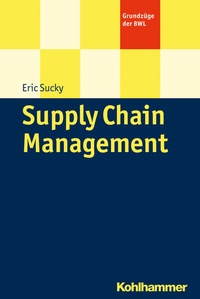
Supply Chain Management
Description

Als Supply Chain Managenent (SCM) bezeichnet man "...the integration of business processes from the end user through original suppliers that provides products, services, and information that add value for customers." (Global Supply Chain Forum, 1998) SCM basiert insbesondere auf Konzepten des Produktions- und Logistikmanagements, des Operations Research, dem Einsatz von innovativen Informations- und Kommunikationstechnologien sowie theoretischen und praktischen Erkenntnissen des Kooperationsmanagements. Die Ausbildungsnachfrage in diesem Bereich ist hoch und dieses neue Managementkonzept hat inzwischen die klassischen produktionswirtschaftlichen Teildisziplinen der BWL majorisiert. Vor diesem Hingerund bietet dieses Lehrbuch eine wissenschaftlich fundierte Einführung in die Planung, Steuerung und Kontrolle von unternehmensübergreifenden Wertschöpfungssystemen.

More details
Other editions
Additional editions
Person
Prof. Dr. Eric Sucky ist Inhaber des Lehrstuhls für Produktion und Logistik an der Universität Bamberg
Content
- Deckblatt
- Titelseite
- Impressum
- Inhaltsverzeichnis
- Vorwort
- Teil 1: Grundlagen des Supply Chain Managements
- 1 Einleitung und Motivation
- 1.1 Staffellauf zum Kunden: Koordination in Supply Chains
- 1.2 Chaos in der Supply Chain: der Bullwhip-Effekt
- 1.3 Machtspiele und Partnerschaft: die integrierte Losgröße
- 1.4 Die »Big 3« des Supply Chain Managements
- 2 Von der Supply Chain zum Supply Chain Management
- 2.1 Wertschöpfung: Prozesse, Ketten und Netzwerke
- 2.1.1 Operationalisierung der prozessbezogenen Wertschöpfung
- 2.1.2 Betriebliche Wertschöpfung
- 2.1.3 Exkurs: Wertschöpfung ist kein Unternehmensziel!
- 2.1.4 Wertschöpfungsketten und Wertschöpfungsnetzwerke
- 2.2 Die Supply Chain
- 2.2.1 Supply Chain-Definition
- 2.2.2 Modell der Supply Chain
- 2.2.2.1 Institutionelle Ebene der Supply Chain
- 2.2.2.2 Informatorische Ebene der Supply Chain
- 2.2.2.3 Prozess- und Ressourcenebene der Supply Chain
- 2.2.2.4 Interdependenzen der Supply Chain-Ebenen
- 2.3 Das Supply Chain Management
- 3 Bezugsrahmen des Supply Chain Managements
- 3.1 Denkschulen des Supply Chain Managements
- 3.2 Referenzmodelle des Supply Chain Managements
- 3.2.1 Elementares Supply Chain Management-Referenzmodell von Cooper/Lambert/Pagh
- 3.2.2 Referenzmodelle für die Supply Chain-Struktur
- 3.2.3 Referenzmodelle für Supply Chain-Prozesse
- 3.2.4 Referenzmodelle für die Managementkomponenten des Supply Chain Managements
- 3.2.4.1 Supply Chain Configuration - die strategische Gestaltungsebene
- 3.2.4.2 Supply Chain Planning - die taktische Planungsebene
- 3.2.4.3 Supply Chain Execution - die operative Ausführungsebene
- 3.2.5 Koordination in Supply Chains
- 3.2.5.1 Kurzer Exkurs: Logistikdienstleister als zentrale Koordinationsinstanz in Supply Chains
- 3.2.5.2 Kurzer Exkurs: Koordination in der Plattformökonomie
- 3.2.6 Das Zielsystem des Supply Chain Managements
- 3.3 Theorie(n) des Supply Chain Managements
- 3.3.1 Transaktionskostentheorie
- 3.3.2 Prinzipal-Agent-Theorie
- 3.3.3 Property-Rights-Theorie
- 3.3.4 Resource-based View
- 3.3.5 Market-based View
- 3.3.6 Resource-Dependence-Ansatz und soziale Austauschtheorie
- 3.3.7 Netzwerkansatz und Systemtheorie
- 3.3.8 Spieltheorie
- 3.3.9 Multitheoretischer Ansatz für das Supply Chain Management
- 3.4 Ein Bezugsrahmen für das Supply Chain Management
- Teil 2: Planungsaufgaben des Supply Chain Managements
- 1 Einleitung
- 2 Supply Chain Configuration
- 2.1 Wer ist der Suppy Chain-Konfigurator?
- 2.2 Supply Chain-Struktur folgt der Supply Chain-Strategie
- 2.3 Mittel- bis langfristige Absatzprognosen
- 2.4 Standortplanung
- 2.4.1 Kontinuierliche Standortplanungsmodelle
- 2.4.2 Diskrete Standortplanungsmodelle
- 2.4.3 Kapazitierte, mehrstufige Warehouse Location-Probleme
- 2.4.4 Dynamische und stochastische Standortplanung
- 2.5 Gestaltung der Supply Chain-Struktur: Bestimmung der Stufigkeit
- 2.6 Gestaltung der Supply Chain-Struktur: Zentralisierung von Beständen
- 2.6.1 Wirkung einer Zentralisierung auf den Losgrößenbestand (cycle stock)
- 2.6.2 Wirkung einer Zentralisierung auf den Sicherheitsbestand (safety stock)
- 2.6.3 Wirkung einer Zentralisierung von Kapazitäten auf den Lagerbestand
- 2.7 Produkt- und Prozessgestaltung in Supply Chains: Wo ist der Kundenauftragsentkopplungspunkt?
- 2.7.1 Kundenindividuelle Massenproduktion
- 2.7.2 Postponement
- 2.7.3 Portfolio-Effekt
- 2.8 Produkt- und Prozessgestaltung in Supply Chains: Gleichteileverwendung
- 2.9 Auswahl der Supply Chain-Partner: Lieferantenauswahl
- 2.9.1 Local oder Global Sourcing
- 2.9.2 Single oder Multiple Sourcing
- 2.9.3 Bewertung und Auswahl von Lieferanten
- 2.9.4 Ein dynamischer Planungsansatz zur Lieferantenbewertung und -auswahl
- 3 Supply Chain Planning
- 3.1 Mittel- bis kurzfristige Absatzprognosen
- 3.1.1 Zeitreihenprognosen
- 3.1.2 Konstantes Niveau (X-Güter)
- 3.1.3 Exponentielle Glättung 1. Ordnung
- 3.1.4 Trend und oder Saisonalität (Y-Güter)
- 3.1.5 Exponentielle Glättung 2. Ordnung
- 3.1.6 Exponentielle Glättung 3. Ordnung
- 3.1.7 Kausalprognose mit Hilfe der linearen Regression
- 3.1.8 Nachfrageprognose versus tatsächliche Nachfrage
- 3.2 Master Planning in Supply Chains
- 3.2.1 Zentrales Master Planning
- 3.2.2 Ein dynamischer Planungsansatz für das zentrale Master Planning
- 3.2.3 Dezentrales Master Planning: Upstream Planning
- 3.2.4 Hybride Koordinationsformen des Master Plannings
- 3.2.5 Partiell zentralisiertes Master Planning
- 3.3 Efficient Consumer Response (ECR): Supply Chain Management in der Konsumgüterindustrie
- 3.3.1 Efficient Replenishment
- 3.3.1.1 Continuous Replenishment
- 3.3.1.2 Computer Assisted Ordering (CAO)
- 3.3.1.3 Synchronized Production
- 3.3.1.4 Vendor-Managed Inventory
- 3.3.1.5 Co-Managed Inventory und Buyer-Managed Inventory
- 3.3.1.6 Cross Docking
- 3.3.1.7 Efficient Unit Loads
- 3.3.1.8 Roll Cage Sequencing
- 3.3.2 Category Management
- 3.3.2.1 Efficient Assortment
- 3.3.2.2 Efficient Promotions
- 3.3.2.3 Efficient Product Introduction
- 3.3.2.4 Praxisbeispiel Category Management
- 3.4 Collaborative Planning, Forecasting and Replenishment (CPFR): ECR der nächsten Generation
- 3.4.1 Bereich Strategie und Planung (Das P in CPFR: Planning)
- 3.4.2 Bereich Prognose-, Planungs- und Belieferungsmanagement (Das F in CPFR: Forecasting)
- 3.4.3 Bereich Umsetzung und Ausführung (Das R in CPFR: Replenishment)
- Bereich Analyse
- Beispiel zur Wirkung von CPFR
- 3.5 Vertragsgestaltung zur Koordination der Supply Chain
- 3.5.1 Problem der doppelten Gewinnaufschläge (double marginalization)
- 3.5.2 Bestandsdisposition bei unsicherer Nachfrage: Das Newsvendor-Modell
- 3.5.2.1 Bestimmung der Produktions- bzw. Bestellmenge
- 3.5.2.2 Bestimmung der erwarteten Über- und Unterbestandskosten bei Normalverteilung
- 3.5.2.3 Bestimmung des erwarteten Gewinns
- 3.5.3 Vertragsdesign zur Koordination der Supply Chain
- 3.5.3.1 Ausgangssituation
- 3.5.3.2 Einschaltung eines Händlers (Großhandelspreisvertrag, Wholesale Price Contract)
- 3.5.3.3 Rücknahmegarantievertrag (Buy Back Contract)
- 3.5.3.4 Vertrag mit Umsatzteilung (Revenue Sharing Contract)
- 4 Supply Chain Execution
- 4.1 Planung von Auslieferungstouren
- 4.1.1 Verfahren zur Lösung von Tourenplanungsproblemen: Das Savings-Verfahren
- 4.1.1.1 Tourenplanung mit dem Savings-Verfahren
- 4.1.2 Kooperative Tourenplanung
- 4.2 Supply Chain Event Management
- 4.2.1 Event
- 4.2.2 Aufgaben und Funktionen des Supply Chain Event Managements
- Teil 3: Informationssysteme des Supply Chain Managements
- 1 Einleitung
- 2 Informationssysteme zur Unterstützung des Supply Chain Managements
- 2.1 Produktionsplanungs- und -steuerungssysteme (PPS-Systeme)
- 2.2 Enterprise Resource Planning-Systeme (ERP-Systeme)
- 2.3 Advanced Plannings and Scheduling Systems (APS-Systeme)
- 2.4 Collaborative Supply Chain Management-Systeme (CSCM-Systeme)
- 2.5 Supply Chain Event Management-Systeme (SCEM-Systeme)
- 3 Systeme zur Informationsgenerierung bzw.-gewinnung in Supply Chains
- 3.1 Lagerverwaltungssysteme (LVS), Warehouse Management-Systeme (WMS) und Warenwirtschaftssysteme (WWS)
- 3.1.1 Lagerveraltungssysteme und Warehouse Management-Systeme
- 3.1.2 Warenwirtschaftssysteme
- 3.2 Lokalisierungs- und Identifikationssysteme
- 3.2.1 Barcode
- 3.2.2 QR-Code oder 2D-Code
- 3.2.3 RFID-Systeme
- 3.2.4 Global Positioning System (GPS)
- 3.3 Tracking und Tracing-Systeme
- 3.3.1 Blockchain-basiertes Tracking &
- Tracing
- 4 Business Ecosystems und digitale Plattformen
- 4.1 Zum Begriff des Business Ecosystems
- 4.2 Abgrenzung von Business Ecosystems und digitalen Marktplätze
- 4.3 Strategisches Management von Business Ecosystems
- Literatur
