

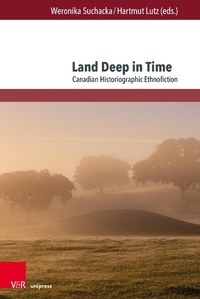
Land Deep in Time
Canadian Historiographic Ethnofiction
1st Edition
Published on 9. October 2023
323 pages
978-3-8470-1633-5 (ISBN)
Description

This volume brings together a group of most highly acclaimed Canadian writers and distinguished international experts on Canadian literature to discuss what potential Janice Kulyk Keefer's concept of 'historiographic ethnofiction' has for ethnic writing in Canada. The collection builds upon Kulyk Keefer's idea but also moves beyond it by discussing such realms of the concept as its ethics and aesthetics, multiple and multilayered sites, generic intersections, and diasporic (con-)texts. Thus, focusing on Canadian historiographic ethnofiction, 'Land Deep in Time' is the first study to define and explore a type of writing which maintains a marked presence in Canadian literature but has not yet been recognized as a separately identifiable genre.
Dr Weronika Suchacka is an assistant professor at the University of Szczecin, Poland, and teaches Canadian literature at the University of Warsaw, Poland.
Dr Weronika Suchacka is an assistant professor at the University of Szczecin, Poland, and teaches Canadian literature at the University of Warsaw, Poland.
More details
Other editions
Additional editions
Book
10/2023
1st Edition
Brill Deutschland
€55.00
Shipment within 5-7 days
Persons
Dr Weronika Suchacka is an assistant professor at the University of Szczecin, Poland, and teaches Canadian literature at the University of Warsaw, Poland.
Content
- Intro
- Title Page
- Copyright
- Table of Contents
- Body
- Hartmut Lutz (University of Greifswald / University of Szczecin): Preface
- A Bellini in Kyiv by Janice Kulyk Keefer
- Weronika Suchacka (University of Szczecin): Introduction
- Contemporary CanLit
- Ethnicity in Contemporary CanLit and Canada
- Understanding Ethnicity: Readings Against Historical Denial
- Fixing CanLit: Critical Awareness and Redefinition of Ethnicity
- Ethnicity Revisited: Canadian Historiographic Ethnofiction
- Works Cited
- Part I: Ethics and Aesthetics of Canadian Historiographic Ethnofiction
- Janice Kulyk Keefer (University of Guelph): Chapter 1 - Simple Complications: Towards an Ethics of Historiographic Ethnofiction
- How Can You Solve a Problem Like Maria?
- Caveat Lector
- Works Cited and Consulted
- Norman Ravvin (Concordia University in Montreal): Chapter 2 - Coming Across Bones at Radzanów: A Consideration of Canadian Writing, Ethnicity, and an Unmarked Burial Ground
- Works Cited
- Jutta Zimmermann (University of Kiel): Chapter 3 - Reading Contemporary South Asian Canadian Fiction as 'Historiographic Ethnofiction'
- Introduction
- South Asian Historiographic Ethnofiction: Entangled Histories
- Anita Rau Badami, Can You Hear the Nightbird Call? (2006)
- 'Bifocality' and the Juxtaposition of Multiple Realities
- Intertextuality and Interreferentiality
- Padma Viswanathan, The Ever After of Ashwin Rao (2014)
- 'Bifocality' and the Juxtaposition of Multiple Realities
- Intertextuality and Interreferentiality: Hindu philosophy and modern physics
- Temporality: "Different instances of a continuum immanent in each other" (qtd. in Hawley 9)
- Conclusion
- Works Cited
- Part II: Transcultural Perspectives on Canadian Historiographic Ethnofiction
- Anna Zurawska (Nicolaus Copernicus University): Chapter 4 - Historiographic Ethnofiction in Quebec and Acadian literature: The Case Study of Pélagie-la-Charrette by Antonine Maillet
- An Outline of Quebec Literature
- Historiographic Ethnofiction
- L'écriture migrante
- Pélagie-la-Charrette
- History and Stories
- The past, present, and future
- La charrette
- Conclusion
- Works Cited
- Ewelina Berek (University of Silesia in Katowice): Chapter 5 - Historiographic Ethnofiction à la québécoite: Régine Robin's The Wanderer
- Works Cited and Consulted
- Uwe Zagratzki (University of Szczecin): Chapter 6 - Scot-"Land Deep in Time": Alistair MacLeod's Prose from Nova Scotia
- The Country of Origin: Linear History and Dislocation
- Country of Adoption: Exploration
- Country of the Mind: Cyclical History and Metaphysics
- Conclusion
- Works Cited
- Joseph Pivato (Athabasca University): Chapter 7 - Italian-Canadian Literary Contributions to Canadian Historiographic Ethnofiction
- Introduction
- The Key Year 1978
- The Example of Feminist Writers and Academics
- A Legacy in Diversity
- Conclusion
- Works Cited
- Part III: Canadian Historiographic Ethnofiction Across Cultures and Genres
- Mateusz Swietlicki (University of Wroclaw): Chapter 8 - Some Place to Belong: Home and Homelessness in Gabriele Goldstone's Historiographic Ethnofiction for Young Readers
- Home-Away-Homelessness
- "Betwixt and between" Identity and Implication
- Conclusion
- Works Cited
- Lisa Grekul (University of British Columbia): Chapter 9 - Unmasking Trauma and Complicity: Historio/graphic Healing in Patti LaBoucane-Benson's The Outside Circle
- Introduction: Intersections
- Historiographic Ethnofiction
- "Coming Across Bones"
- Inside The Outside Circle: A Synopsis
- Reading the Historio/graphic Novel
- Removing Masks, Donning Scarves
- Works Cited
- Albert Rau (University of Cologne): Chapter 10 - Historiographic Ethnofiction Reflected in Canadian Drama - Jason Sherman: Where is My Tree?
- Introduction
- Canada and Israel: ad quem and a quo?
- The Nathans plays
- United Nathans: Where is My Tree?
- Finding Bones: Asking Questions, Expressing Criticism
- The Journey Home
- Works Cited
- Agnieszka Rzepa (Adam Mickiewicz University in Poznan): Chapter 11 - Beyond Historiographic Ethnofiction: Interfaces of Ethnicity/Race and History in Recent Canadian Diasporic Life Writing
- Carmen Aguirre: History, Ethnicity, Trauma
- Brand and McWatt: History, Race, Embodiment
- Conclusion
- Works Cited
- Dagmara Drewniak (Adam Mickiewicz University in Poznan): Chapter 12 - "A geography of the self and the landscape of otherness": Writing Mennonite and Eastern European Ethnicity in Connie T. Braun's Memoirs
- Works Cited
- Part IV: Sites of Canadian Historiographic Ethnofiction
- Janne Korkka (University of Turku): Chapter 13 - Canadian Mennonite Narratives as Historiographic Ethnofictions of Space
- "Bones and Ruins": Mennonite Identity as a Site of Spatial Knowing
- "God had chosen to bless the Mennonite farmer"
- Knowing Mennonite Selves: "You are that Jakob Friesen"
- "My grandfather says there were Mennonites near where he was born"
- Works Cited
- Cathy C. Waegner (University of Siegen): Chapter 14 - Transnational Ethnofiction: Gerald Vizenor and Heirs of the Fur Trade
- Drawn on the Backs of Indigenes: US-Canada Border
- Unsettling Fuzziness: Theoretical Considerations
- "Fur Trade Ghosts": Treaty Shirts and Resignifying History in the Borderlands
- "Motion of Stories": Satie on the Seine and Continental Liberty on Both Sides of the Atlantic
- Historiographic Ethnofiction "with a Slant": Conclusion
- Works Cited
- George Elliott Clarke (University of Toronto): Chapter 15 - Is "Historiographic Ethnofiction" Perpetually Tripped Up by Facts? Spy Invisible Blackness in Michael Ondaatje's Coming Through Slaughter
- Audit Muted History in Esi Edugyan's Half-Blood Blues
- I
- II
- III
- Works Cited
- Authors' Biographical Notes
- Index
