

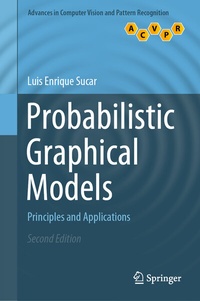
Probabilistic Graphical Models
Description

This fully updated new edition of a uniquely accessible textbook/reference provides a general introduction to probabilistic graphical models (PGMs) from an engineering perspective. It features new material on partially observable Markov decision processes, causal graphical models, causal discovery and deep learning, as well as an even greater number of exercises; it also incorporates a software library for several graphical models in Python.
The book covers the fundamentals for each of the main classes of PGMs, including representation, inference and learning principles, and reviews real-world applications for each type of model. These applications are drawn from a broad range of disciplines, highlighting the many uses of Bayesian classifiers, hidden Markov models, Bayesian networks, dynamic and temporal Bayesian networks, Markov random fields, influence diagrams, and Markov decision processes.Topics and features:
- Presents a unified framework encompassing all of the main classes of PGMs
- Explores the fundamental aspects of representation, inference and learning for each technique
- Examines new material on partially observable Markov decision processes, and graphical models
- Includes a new chapter introducing deep neural networks and their relation with probabilistic graphical models
-
Covers multidimensional Bayesian classifiers, relational graphical models, and causal models
- Provides substantial chapter-ending exercises, suggestions for further reading, and ideas for research or programming projects
- Describes classifiers such as Gaussian Naive Bayes, Circular Chain Classifiers, and Hierarchical Classifiers with Bayesian Networks
- Outlines the practical application of the different techniques
- Suggests possible course outlines for instructors
This classroom-tested work is suitable as a textbook for an advanced undergraduate or a graduate course in probabilistic graphical models for students of computer science, engineering, and physics. Professionals wishing to apply probabilistic graphical models in their own field, or interested in the basis of these techniques, will also find the book to be an invaluable reference.
Dr. Luis Enrique Sucar is a Senior Research Scientist at the National Institute for Astrophysics, Optics and Electronics (INAOE), Puebla, Mexico. He received the National Science Prize en 2016.
More details
Other editions
Additional editions
Person
Dr. Luis Enrique Sucar is a Senior Research Scientist in the Department of Computing at the National Institute of Astrophysics, Optics and Electronics (INAOE), Mexico.
Content
Introduction.- Probability Theory.- Graph Theory.- Bayesian Classifiers.- Hidden Markov Models.- Markov Random Fields.- Bayesian Networks: Representation and Inference.- Bayesian Networks: Learning.- Dynamic and Temporal Bayesian Networks.- Decision Graphs.- Markov Decision Processes.- Partially Observable Markov Decision Processes.- Relational Probabilistic Graphical Models.- Graphical Causal Models.- Causal Discovery.- Deep Learning and Graphical Models.- A Python Library for Inference and Learning.- Glossary.- Index
