

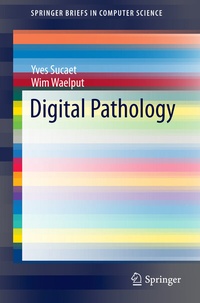
Digital Pathology
Description

Digital pathology has experienced exponential growth, in terms of its technology and applications, since its inception just over a decade ago. Though it has yet to be approved for primary diagnostics, its values as a teaching tool, facilitator of second opinions and quality assurance reviews and research are becoming, if not already, undeniable. It also offers the hope of providing pathology consultant and educational services to under-served areas, including regions of the world that could not possibly sustain this level of services otherwise. And this is just the beginning, as its adoption by the also rapidly-emerging fields of medical systems biology and 3D tissue imaging indicate.
This work describes how digital pathology not only has the potential to dramatically impact medical education and the delivery of health care, but also to exert an immensely positive influence worldwide, including in countries and regions that normally fail to benefit from such technological advances.
Reviews / Votes
From the book reviews:
"This relatively brief text provides a nice introduction and overview of the technology, history, and uses of telepathology as enabled by whole slide imaging. Intended for novices to the field, its six chapters cover the history, hardware/software, common applications, role in image analysis, use case examples, and predictions about the near horizon. . I found the book easy to read and understand, and it does a nice job of introducing a novice to 'digital pathology'." (John H. Sinard, Journal of Pathology Informatics, Vol. 6 (12), 2015)
"This is a short, concise book for individuals with minimal experience in the field who want to learn more. The audience includes pathologists with a particular interest in the history and future of digital pathology. It could also serve as a reference for other medical professionals who have an interest in learning more about the field." (Raquel K. Walsh Jahnke, Doody's Book Reviews, October, 2014)
More details
Other editions
Additional editions
Persons
Dr. Sucaet holds a Ph.D. in bioinformatics from Iowa State University. His research background is in systems and network biology. He is a co-founder of Pathomation and currently fulfills the role of Chief Technology Officer. Before that, he was at HistoGeneX in the function of Section Head, Data Management & Bioinformatics, where he met Dr. Waelput. They decided to combine their expertise and have been promoting the use of digital pathology ever since.
Dr. Waelput is an M.D. and certified pathologist, currently employed as a senior staff member at the University Hospital of Brussels (UZ-Brussels). He is also a consulting (pharma-)pathologist at HistoGeneX and a co-founder of Pathomation. Dr. Waelput has been involved in research on protein-protein interactions and signal transduction within the Department of Medical Protein Research at the Flemish Institute for Biotechnology (VIB - Vlaams Instituut voor Biotechnologie). He obtained his PhD from the University of Ghent.
Content
Digital Pathology's Past to Present.- Hardware and Software.- Applications.- Image Analysis.- Use Cases.- A Bright Future.
