

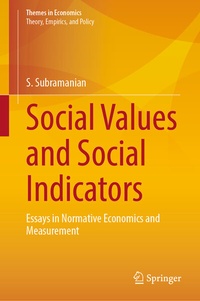
Social Values and Social Indicators
Description

The book is a collection of essays written since 2010, and dealing, in one way or another, with the place of values in economic analysis. The centrality of values in the collection is not surprising, given that the thematic concerns informing the essays in the book relate principally to methodological issues in economic enquiry, to the normatively constrained aggregation of personal preferences into collective choice, and to problems of logical coherence and ethical appeal in the axiom systems underlying the measurement of economic and social phenomena such as poverty, inequality and literacy. While many of the essays are more or less technical in nature, they are all explicitly motivated by considerations that go beyond the formalisms of presentation to an involvement with the role of moral reasoning in economic analysis. In particular, the essays emphasize the importance of 'ought propositions' in a science which is all too often regarded as being wholly and exclusively 'positive' in its orientation. The book should be of particular interest to researchers, students, and public policy makers.
More details
Other editions
Additional editions
Person
Content
Chapter 1: "Instrumentalism" and Friedman's Methodology: A Short Objection.- Chapter 2: A Sort of Paretian Liberalism.- Chapter 3: Liberty, Equality, and Impossibility: Some General Results in the Space of "Soft" Preferences.- Chapter 4: The Arrow Paradox with Fuzzy Preferences.- Chapter 5: Equality, Priority, and Distributional Judgements.- Chapter 6: Two Logical and Normative Issues Relating to Measurement in the Social Sciences.- Chapter 7: Social Groups and Economic Poverty: A Problem in Measurement.- Chapter 8: Reckoning Sub-Group Poverty Differentials in the Measurement of Aggregate Poverty.- Chapter 9: Poverty Measurement in the Presence of a "Group Affiliation Externality".- Chapter 10: Revisiting the Normalization Axiom in Poverty Measurement.- Chapter 11: The Focus Axiom and Poverty: On the Co-existence of Precise Language and Ambiguous Meaning in Economic Measurement.- Chapter 12: Assessing Inequality in the Presence of Growth.- Chapter 13: Revisiting an Old Theme in the Measurement of Inequality and Poverty.- Chapter 14: Inequality Measurement with Subgroup Decomposability and Level-Sensitivity.
