

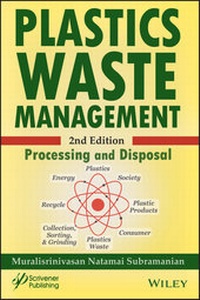
Plastics Waste Management
Description

It is seldom that a day goes by without another story or photo regarding the problem of plastics waste in the oceans or landfills. While important efforts are being made to clear up the waste, this book looks at the underlying causes and focuses on plastics waste management. Plastics manufacturers have been slow to recognize their environmental impact compared with more directly polluting industries. However, the environmental pressures concerning plastics have forced the industry to examine their own recycling operations and implement plastics waste management.
Plastics Waste Management realizes two ideals: That all plastics should be able to persist for as long as plastics are required, and that all plastics are recycled in a uniform manner regardless of the length of time for which it persists. The book examines plastics waste management and systems for the environment, as well the management approaches and techniques which are appropriate for managing the environment. It serves as an excellent and thoughtful plastics waste management handbook.
This groundbreaking book:
* Identifies deficiencies in plastics waste management
* Extrapolates from experiences to draw some conclusions about plastics waste for persistence
* Describes methods how the waste related processing techniques should be used in recycling
* Shows how the consumer and industry can assess the performance of plastics waste management
* Explains waste utilization by recycling techniques as well as waste reduction
* Life cycle assessment as an important technique for recycling of persistent plastics waste.
More details
Other editions
Additional editions
Person
Muralisrinivasan Natamai Subramanian is a consultant in the field of plastics technology, specializing in materials, additives, and processing equipment, including troubleshooting. He obtained his BSc in chemistry from Madurai Kamaraj University and his MSc in polymer technology from Bharathiar University in 1988. He received his postgraduate diploma in plastics processing technology from Central Institute of Plastics Engineering and Technology (CIPET), Chennai, India. He also holds a doctorate in polymer science from Madurai Kamaraj University. He worked in the plastic processing industry, mainly in R&D, for 13 years before entering into consultancy and building up an international client base. Muralisrinivasan holds seminars on plastics processing and serves as a Board of Studies Expert Member of Colleges in India, dealing with technology curricula. He has authored multiple books for the Wiley-Scrivener imprint.
Content
Preface xiii
1 Introduction 1
References 4
2 Plastics and Additives 7
2.1 Polymers 7
2.2 Plastics 8
2.3 Plastics Raw Material 9
2.4 Thermoplastics 9
2.4.1 Polyolefin 10
2.4.1.1 Polyethylene 11
2.4.1.2 Polypropylene 12
2.4.1.3 Polystyrene 14
2.4.1.4 Polyvinyl Chloride 14
2.4.2 Polyester 16
2.4.3 Polycarbonate 17
2.4.4 Polyamide 18
2.4.5 Biodegradable Plastics 18
2.5 Thermosets 19
2.5.1 Phenol-formaldehyde 20
2.5.2 Unsaturated Polyester 20
2.6 Additives 20
2.6.1 Antioxidants 22
2.6.2 Slip Additives 22
2.6.3 Ultraviolet Stabilizers 23
2.6.4 Heat Stabilizers 23
2.6.5 Plasticizers 24
2.6.6 Lubricants 25
2.6.7 Flame Retardants 25
2.6.8 Mold Release Agents 26
2.6.9 Nucleating Agents 28
2.6.10 Fillers 29
2.7 Plastics - Applications 29
2.8 Remarks 30
References 30
3 Plastics and Environment 37
3.1 Plastics and Conventional Materials - Comparison 37
3.2 Effects of Plastics Products and Environment 39
3.3 Landsite Effects 39
3.4 Chemical Environment 39
3.5 Marine Environment 40
3.6 Packaging Materials 42
3.7 Agricultural Fields 42
3.8 Waste Accumulation 43
3.9 Degradation of Plastics 43
3.9.1 Process Degradation 43
3.9.2 Environmental Degradation 45
3.10 Environmental Burdens 46
3.11 Industrial Ecosystem 47
3.12 Remarks 47
References 47
4 Plastics Processing Technology 53
4.1 Background 53
4.2 Management - Plastics Processing 54
4.3 Plastic Materials - Variations 55
4.4 Technology 56
4.4.1 Injection Molding 58
4.4.2 Blow Molding 60
4.4.3 Extrusion 62
4.4.4 Thermoforming 63
4.4.5 Rotational Molding 64
4.4.6 Compression Molding 66
4.5 Productivity and Task 67
4.6 Waste Processing 68
4.7 Reprocess Material in Plastics Processing 69
4.8 Challenges and Opportunities 70
4.9 Remarks 71
References 71
5 Plastics Waste - Consumer and Industry 73
5.1 Background 74
5.2 Plastics Waste 74
5.3 Polyolefin 75
5.4 Polypropylene 76
5.5 Polystyrene 76
5.6 Polyvinylchloride 76
5.7 Bioplastics 77
5.8 Additives and Environment 78
5.8.1 Heat Stabilizers 78
5.8.2 Plasticizers 78
5.8.3 Flame Retardants 79
5.8.4 Compatibilizers 79
5.9 Technological Aspects 80
5.10 Factors Influencing Plastics Waste 80
5.11 Waste Resources 81
5.11.1 Domestic Waste 81
5.11.2 Packaging Waste 82
5.11.3 E-Waste 83
5.11.4 Automotive Waste 84
5.11.5 Medical Plastics Waste 84
5.11.6 Agriculture Plastics Waste 85
5.11.7 Marine Plastics Waste 85
5.11.8 Mixed or Contaminated Plastics 86
5.12 Plastics Waste Reduction 86
5.13 Advantages of Waste Prevention 88
5.14 Waste Reduction and Performance 89
5.15 Recovery of Plastics 89
5.16 Remarks 90
References 91
6 Plastics Waste Management 97
6.1 Principles 97
6.2 Objective 98
6.3 Requirements 98
6.4 Management Concept 99
6.5 Waste Collection 99
6.6 Separation and Cleaning 100
6.7 Scientific Thinking 101
6.8 Outcome 101
6.9 Effective Management 101
6.10 Dynamic Thinking 102
6.11 Multi-Phase Approach 103
6.12 Significance 103
6.13 Progressive Management Characteristics 104
6.14 Risks in Plastics Waste Management 105
6.15 Factors - Affect, Suffer, and Influence 105
6.16 Operational Problems 106
6.17 Sustainability and Symbolic Management 106
6.18 Environmental Conservation 107
6.19 Decision-Making Process 107
6.20 Integrated Plastics Waste Management 108
6.21 Assignments 109
6.22 Advantages 110
6.23 Shortcomings 111
References 112
7 Recycling Technology 115
7.1 Man-Made Material - Plastics 116
7.2 Substantial Prerequisite 117
7.3 Philosophy 117
7.4 Purpose of Recycling Technology 118
7.5 Fortune of Plastics Material 119
7.6 Methods of Recycling 119
7.7 Plastics Waste - Stream 121
7.8 Mixed Plastics Waste - Separation 123
7.9 Origination of Plastics Waste 124
7.10 Problems of Recycling and Controls 125
7.10.1 Problems 125
7.10.2 Controls 126
7.11 Physical Characterization and Identification 126
7.12 Recycling - A Resource 127
7.13 Recycling Technology 128
7.14 Primary Recycling 129
7.14.1 Reprocessing Essentials 130
7.15 Mechanical Recycling 130
7.15.1 Limitations 132
7.15.2 Processing Problems 132
7.16 Chemical Recycling 133
7.17 Energy Recovery 136
7.18 Pyrolysis 136
7.19 Types of Reactors and Process Design 140
7.19.1 Batch and Semi-Batch Reactor 140
7.19.2 Fluidized Bed Reactor 141
7.19.3 Conical Spouted Bed Reactor 142
7.19.4 Two-Stage Pyrolysis System 142
7.19.5 Microwave-Assisted Pyrolysis (MAP) 143
7.19.6 Pyrolysis in Supercritical Water (SCW) 144
7.19.7 Fluid Catalytic Cracking 144
7.20 Thermal Co-Processing 145
7.20.1 Advantages 146
7.21 Gasification 146
7.22 Plastics Waste and Recycling 147
7.22.1 Polyolefin 147
7.22.2 Polyvinyl Chloride 148
7.22.3 Polyethylene Terephthalate 148
7.23 Environmental Burdens 150
7.23.1 Incineration - Open Air 150
7.23.2 Plastics Waste in Concrete 151
7.23.3 Plastics Waste in Tar for Road Laying 151
7.24 Plastics Waste as Blends and Composites 152
7.25 Remarks 153
References 153
8 Economy and Recycle Market 163
8.1 Economical Background 163
8.2 Growth Trajectory 164
8.3 Value of Plastics Waste 164
8.4 Economic Issues 165
8.5 Market Dynamics and Uncertainty 166
8.6 Fiscal Waste 167
8.7 Waste to Value 168
8.8 Industrial Ecology 169
8.9 Industrial Symbioses (ISs) 170
8.10 Economic Advantages 171
8.11 Economic Implications 171
8.12 Marketing Strategy 172
8.13 Modern Marketing Philosophy 173
8.14 Recycled Plastics Market 173
8.15 Industrial Marketing 175
8.16 Product Development and Marketing 176
8.17 Recycled Plastic Products and Consumer Market 177
8.18 Remarks 178
References 179
9 Life Cycle Assessment 183
9.1 LCA and Plastics Waste 183
Background 184
9.2 Life Cycle Assessment - A Tool to Assess Waste 185
9.3 Scientific Engineering 187
9.4 Purpose 187
9.5 Harmonization of LCA Method 188
9.6 Methodology 188
9.7 LCA Initiation 189
9.8 LCA in Plastics Waste 190
9.9 Advantages of LCA 191
9.10 Shortcomings of LCA 191
9.11 Environment Waste Auditing 192
9.12 Waste Prevention 193
9.13 Remarks 194
References 194
10 Case Studies 199
10.1 Waste Dump and Health Hazards 199
10.2 Utilization of Plastics Waste 200
10.2.1 Europe 201
10.2.2 India 201
10.2.3 Japan 202
10.2.4 France 203
10.2.5 Other Countries 204
10.3 Use of Case Studies 205
10.4 Property Value 206
10.5 Case Study 1: Plastics Waste from the Electric and Electronic Field 206
10.5.1 Concept 206
10.5.2 Objective 207
10.5.3 Methodology 207
10.5.4 Experimental Method 208
10.5.5 Results 210
10.5.6 Conclusion 210
10.6 Case Study 2: Plastics Waste from the Automobile Industry 210
10.6.1 Background 210
10.6.2 Design 211
10.6.3 Disposal and Recovery 211
10.6.3.1 Recycling of Bumpers 211
10.6.4 Inference 211
10.7 Pros and Cons 213
10.7.1 Positive Thinking 213
10.7.2 Negative Effects 213
10.8 Research and Case Study 214
10.9 Remarks 214
References 215
11 Present Trends 219
11.1 Economic Issues 219
11.2 Industry and Society 220
11.3 Landfilling 220
11.4 Effect of Single-Use Plastic Products 221
11.5 Effect on Food Packaging 221
11.6 Recycling Status 222
11.7 Present Research and Shortcomings 222
11.8 Population Growth and Waste 223
11.9 Remarks 224
References 224
12 Future Trends 227
12.1 Present Problems 227
12.2 Incineration in Open Air 228
12.3 Environmental Advantages 229
12.4 Plastics Waste - Challenge 229
12.5 Environmental and Social Problems - Prevention 230
12.6 Reasons - Waste Accumulation 231
12.7 Ecological Issues 232
12.8 Facts about Bioplastics 232
12.9 Future Requirements 233
12.10 Remarks 234
References 235
Index 237
Chapter 1
Introduction
Within a specific ecological-economic system, each material is generally connected to and also dependent on others. Moreover, plastics contribute to the overall integrity of this life system. However, since all plastics contribute to the functional scheme of things in waste generation, it is undoubtedly a very important issue. In particular, plastics provide key applications that are also unique; without plastics, the underlying ecological-economic system would be very different.
The first synthetic plastics developed were celluloid (cellulose nitrate) in 1869 and phenol formaldehyde in 1909. Other plastics such as cellulose acetate and polyvinylchloride were made into semi-durable items, such as electrical equipment or insulation, motion picture film, billiard balls, etc., which are considered a nuisance when they become waste. Plastics production and consumption have increased considerably since the first industrial production of plastics in the 1940s [1]. The high-volume production of low-density polyethylene began in 1940, which is also when plastic waste started being recycled. Included in the rapidly growing plastics industry are all thermoset plastics and thermoplastics, with the consumption of plastic materials having grown to around one million tons per year as of 1962. Worldwide production and consumption of plastics has increased at an average rate of about 8 percent per annum [2]. However, it is now a billion tons of plastics waste. Plastics consumption has increased rapidly while the deposit of natural resources is decreasing. The decrease in crude oil and natural gas puts pressure on plastics production. Therefore, rapid, large changes in oil prices can cause significant long- and short-term economic consequences. Obtaining and using this oil also carries with it the enormous burden of adverse environmental consequences, social issues, and geopolitical risk, since plastics undergo little degradation and dispersion by natural processes.
Global post-consumer waste generation totals approximately 900-1,250 metric tons per year [3, 4]. In an underdeveloped country, the per capita solid waste generation rate is less than 0.1 tons per capita per year as opposed to developed countries where it is greater than 0.8 tons per capita per year in high-income industrialized countries [5-12].
Plastics waste is closely linked to population type and size, and the degree of urbanization and material comfort. It remains a major challenge for municipalities to collect, recycle, treat and dispose of increasing quantities of plastics waste in most developed and developing countries. Most technologies for plastics waste management are immature and have been difficult to implement in many countries.
Plastic waste has gone up both in absolute terms and as a percentage of solid waste. However, the volume may not be enough to warrant systems to separate different types of plastics from each other for recovery. Because of the amount of plastic waste disposed of in municipal solid waste, it needs to be managed.
Plastics waste can be used as a raw material for recycling operations or can be treated prior to disposal, resulting in the waste being transformed into material which can be safely disposed of or reused. The proper management of plastics waste starts at the production stage. Plastics waste has an economic advantage, in comparison with many other solid wastes, as it can be regularly recycled. Current processing technology enables the efficient conversion of waste into new recycled end products.
Plastics waste management does not exist in a vacuum; waste plastics are affected by and impact upon many different aspects of national life, i.e., there is a balance between the utilization of plastics waste and its production and processing. The majority of plastics waste generation is related to material comfort items; however, recycling/reuse initiatives for mixed plastics are limited [3].
In particular, it is crucial that plastics waste management is linked to the parallel development of production and processing, otherwise there is a risk that controls to limit the environmental pollution of one operation will lead to an increased level of pollution in another, hence:
- Plastic processes and activities should be chosen which produce the lowest amount of waste.
- The production of hazardous waste from antimony and lead and so on from additives, should be kept to a minimum.
- All feasible and reasonable steps should be taken to recycle and reuse materials from plastics waste and convert this waste into useful marketable products.
- The waste disposal process should include arrangements for the disposal of plastics waste that cannot be reclaimed, such as degraded polyvinyl chloride. Disposal should reduce the level of risk to public health, water supplies and the environment to acceptable levels.
- All types of solid waste should only be disposed of at sites suitable for the disposal of that particular waste, which will not be reclaimed. The site can stipulate upon acceptance, any special requirements regarding the method of deposal which includes preparation to receive the waste, the methods involved in disposing of the waste and so on.
- Plastics waste treatment and the methods to be used for the disposal of the residues from the treatment should be included in the waste disposal process.
- Waste generators are responsible for their waste, which is a very important aspect for plastics waste. Generators of waste must be assumed to have adequate knowledge of its composition, form, and of the potential hazards to public health and the environment, to ensure disposal of the waste is not detrimental to the environment. The waste generator is responsible for ensuring that only appropriate disposal methods are used for their waste.
- Future planning needs to include the proper management of plastics waste.
Recycling of post-consumer plastics has not yet become a significant recovery option. Plastics pollution in most cases results in already stressed ecosystems. Humans fear that the dangers posed by plastics waste tend to create problems more often than not. An attempt is being made to treat plastics-waste-related environmental and natural resource problems as part of an important task to help the societies of the world. The world has an emerging interest in moving away from plastics waste towards material management due to their non-degradable nature. There are strong drivers at all levels towards a culture of more sustainable plastics waste management.
Industrialists should know the type and quantity of waste produced by their operations and processes, whereas a waste generator should know the composition, properties and environmental impact of the waste. Without this knowledge industrialists cannot properly manage their operations and cannot discharge their responsibilities to protect the health and safety of employees, i.e., the nature of the waste they are exposed to must be known, otherwise they are not in full control of their operation; in addition, if the quantity of waste is unknown the cost, material balance and efficiency cannot be determined [13].
When solid waste including plastics waste disappears from an ecological-economic system, the system changes dramatically. In fact, what is particularly significant is that the disappearance of plastics often triggers the loss of other applications, and when this happens, the complex connections among nexus components, such as packaging with other substitute material, begin to evolve. Minimizing solid waste through an ecological-economic system in effect addresses environmental problems.
References
1. Albano, C., Camacho, N., Hernandez, M., Matheus, A., Gutierrez, A., Influence of content and particle size of waste pet bottles on concrete behaviour at different w/c ratios. Waste Manage., 29, 2707-2716, 2009.
2. Bernardo, C.A., Simões, C.L., Lígia, M., Costa Pinto, Proceedings of the Regional Conference Graz - Polymer Processing Society PPS. AIP Conf. Proc., 1779, 140001-1-140001-5, 2015.
3. Bogner, J. and Matthews, E., Global methane emissions from landfills: New methodology and annual estimates 1980-1996. Global Biogeochem. Cycles, 17, 341, 2003.
4. Monni, S., Pipatti, R., Lehtilä, A., Savolainen, I., Syri, S., in: Global Climate Change Mitigation Scenarios for Solid Waste Management. Technical Research Centre of Finland, VTT Publications, Espoo, Finland, 2006.
5. Bernache-Perez, G., Sánchez-Colón, S., Garmendia, A.M., Dávila-Villarreal, Sánchez-Salazar, M.E., Solid waste characterisation study in the Guadalajara Metropolitan Zone, Mexico. Waste Manage. Res., 19, 413, 2001.
6. Diaz, L.F. and Eggerth, L.L., Waste Characterization Study: Ulaanbaatar, Mongolia: Winter-Summer 2002, Final Report, CalRecovery, Inc. prepared for WHO/WPRO, Manila, Philippines, August, 2002.
7. Kaseva, M.E., Mbuligwe, S.B., Kassenga, G., Recycling inorganic domestic solid wastes: Results from a pilot study in Dar es Salaam City, Tanzania, Resour. Conserv. Recycl., 35, 243, 2002.
8. Idris, A., Bulent, I., Hassan, M.N., Overview of municipal solid waste landfill sites in Malaysia. In: Proc. of the Second Workshop on Material Cycles and Waste Management in Asia, Tsukuba, Japan, 2003.
9. Ojeda-Benitez, S. and Beraud-Lozano, J.L., Characterization and quantification of household solid wastes in a Mexican city. Resour. Conserv. Recycl., 39, 211, 2003.
10. Waste Analysis...
