

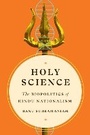
Holy Science
Description
Alles über E-Books | Antworten auf Fragen rund um E-Books, Kopierschutz und Dateiformate finden Sie in unserem Info- & Hilfebereich.
In the early 2000s, as India was emerging as a global superpower, a key development project off the southern Indian coast was thwarted by intense opposition. The construction of a new shipping canal angered Hindu nationalists who sought to protect what they saw as the land bridge built by Hanuman and his monkey army in the Indian epic Ramayana. Environmentalists also protested against the canal, claiming that it severely threatened a fragile and globally important ecosystem. As the controversy grew, the religious and environmental arguments converged, reflecting the evolving relationship between science and religion that marks the hypernationalism of the contemporary Hindu right.
Through this case study and others, Banu Subramaniam demonstrates the limitations of the "universality" of science, to reveal how science in postcolonial contexts is always locally inflected and modulated. Evoking the rich mythology of comingled worlds, where humans, animals, and gods transform each other and ancient history, Subramaniam demonstrates how Hindu nationalism sutures an ideal past to technologies of the present by making bold claims about the scientific basis of Vedic civilization and deploying this narrative to consolidate caste, patriarchal, and Hindu power. Moving beyond a critique of this emerging bionationalism, this book explores the generative possibility of myth and story, interweaving compelling new stories of fictionalized beings like the avatars of Hindu mythology into a rich analysis that animates alternative imaginaries and "other" worlds of possibilities.
All prices
More details
Other editions
Additional editions
Person
Banu Subramaniam is professor of women, gender, and sexuality studies at University of Massachusetts, Amherst, and author of Ghost Stories for Darwin: The Science of Variation and the Politics of Diversity, winner of the 2016 Ludwik Fleck Award from the Society for the Social Studies of Science.
Content
- Cover
- Title
- Copyright
- Contents
- Prologue: In Search of India: The Inner Lives of Postcolonialism
- Avatars for Lost Dreams: The Land of Lost Dreams
- Introduction: Avatars for Bionationalism: Tales from (An)Other Enlightenment
- Avatar #1: The Story of Uruvam
- 1. Home and the World: The Modern Lives of the Vedic Sciences
- Avatar #2: The Story of Amudha
- 2. Colonial Legacies, Postcolonial Biologies: The Queer Politics of (Un)Natural Sex
- Avatars #3: The Story of Nadu and Piravi
- 3. Return of the Native: Nation, Nature, and Postcolonial Environmentalism
- Avatar #4: The Story of Néram
- 4. Biocitizenship in Neoliberal Times: On the Making of the "Indian" Genome
- Avatar #5: The Story of Arul
- 5. Conceiving a Hindu Nation: (Re)Making the Indian Womb
- Avatar #6: The Story of Kalakalappu
- Conclusion: Avatars for Dreamers: Narrative's Seductive Embrace
- Notes on the Mythopoeia
- Epilogue: Finding India: The Afterlives of Colonialism
- A Note of Gratitude and Appreciation
- Notes
- References
- Index

System requirements
File format: ePUB
Copy protection: Adobe-DRM (Digital Rights Management)
System requirements:
- Computer (Windows; MacOS X; Linux): Install the free reader Adobe Digital Editions prior to download (see eBook Help).
- Tablet/smartphone (Android; iOS): Install the free app Adobe Digital Editions or the app PocketBook before downloading (see eBook Help).
- E-reader: Bookeen, Kobo, Pocketbook, Sony, Tolino and many more (not Kindle).
The file format ePub works well for novels and non-fiction books – i.e., „flowing” text without complex layout. On an e-reader or smartphone, line and page breaks automatically adjust to fit the small displays.
This eBook uses Adobe-DRM, a „hard” copy protection. If the necessary requirements are not met, unfortunately you will not be able to open the eBook. You will therefore need to prepare your reading hardware before downloading.
Please note: We strongly recommend that you authorise using your personal Adobe ID after installation of any reading software.
For more information, see our ebook Help page.
File format: PDF
Copy-Protection: Adobe-DRM (Digital Rights Management)
System requirements:
- Computer (Windows; MacOS X; Linux): Install the free reader Adobe Digital Editions prior to download (see eBook Help).
- Tablet/smartphone (Android; iOS): Install the free app Adobe Digital Editions or the app PocketBook before downloading (see eBook Help).
- E-reader: Bookeen, Kobo, Pocketbook, Sony, Tolino and many more (only limited: Kindle).
The file format PDF always displays a book page identically on any hardware. This makes PDF suitable for complex layouts such as those used in textbooks and reference books (images, tables, columns, footnotes). Unfortunately, on the small screens of e-readers or smartphones, PDFs are rather annoying, requiring too much scrolling.
This eBook uses Adobe-DRM, a „hard” copy protection. If the necessary requirements are not met, unfortunately you will not be able to open the eBook. You will therefore need to prepare your reading hardware before downloading.
Please note: We strongly recommend that you authorise using your personal Adobe ID after installation of any reading software.
For more information, see our eBook Help page.
File format: ePUB
Copy protection: without DRM (Digital Rights Management)
System requirements:
- Computer (Windows; MacOS X; Linux): Use a reader that can handle the file format ePUB, such as Adobe Digital Editions or FBReader – both free (see eBook Help).
- Tablet/Smartphone (Android; iOS): Install the free app Adobe Digital Editions or the app PocketBook (see eBook Help).
- E-reader: Bookeen, Kobo, Pocketbook, Sony, Tolino and many more (not Kindle).
The file format ePUB works well for novels and non-fiction books – i.e., 'flowing' text without complex layout. On an e-reader or smartphone, line and page breaks automatically adjust to fit the small displays.
This eBook does not use copy protection or Digital Rights Management
For more information, see our eBook Help page.
